qixinwei-pcba


TPA3118D2 Digital Amplifier Board 2.0 Dual Channel 2x45W Audio Amp
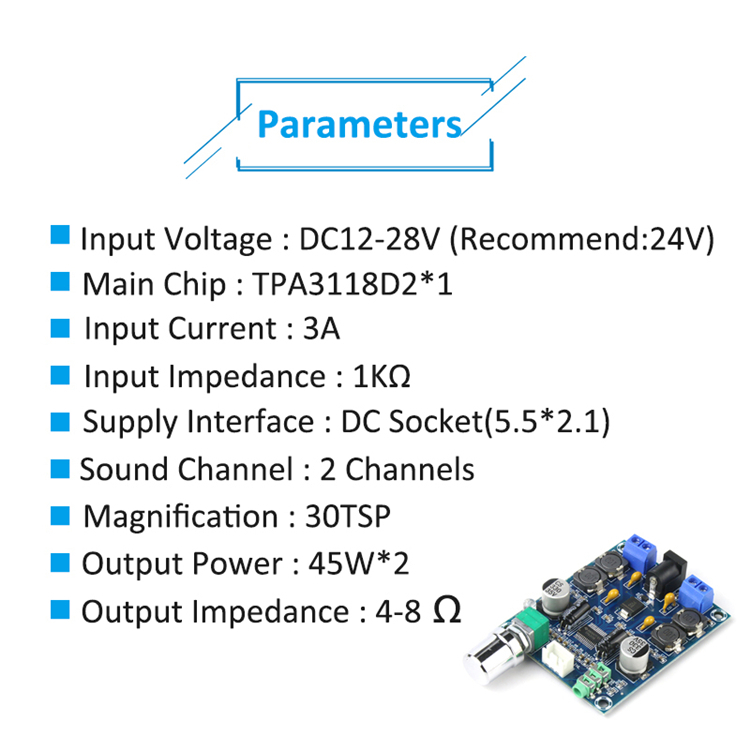
TPA3118D2 Digital Amplifier Board Application features:
◆ Main Chip
TPA3118D2 (Class D digital amplifier IC)
◆ Channel Configuration
2.0 dual channel (stereo)
◆ Output Power
2×45W into 4Ω load @24V supply
2×30W into 8Ω load @24V supply
2×15W into 4Ω load @12V supply
◆ Amplification Type
Class D (digital amplifier)
◆ Efficiency
Up to 90%+
◆ Supply Voltage
DC 5V ~ 24V (12V-24V recommended)
◆ Load Impedance
4Ω ~ 8Ω
◆ Signal-to-Noise Ratio (SNR)
100dB
◆ THD+N
< 0.1%
◆ Audio Input
3.5mm jack / solder pads (optional)
◆ Speaker Output
Terminal blocks (L/R channels independent)
◆ Protection Features
Over-voltage protection
Under-voltage protection
Thermal protection
Short circuit protection
TPA3118D2 Digital Amplifier Board Typical Applications
DIY desktop speakers
Car audio amplifier
Smart speakers
TV sound systems
Computer multimedia speakers
Portable speakers
Public address systems
TPA3118D2 Digital Amplifier Board Key Advantages
High efficiency (no large heatsink needed)
Wide voltage input
Filterless output (cost saving)
Low distortion
Compact size
Plug-and-play
Why Choose QIXINWEI
Years of experience in the electronics industry. Trusted by global customers.
Massive In-Stock Inventory – Ready to ship promptly
BOM Matching Service – One-stop solution, save time
PCBA Customization – Professional engineering team creates tailor-made solutions based on your needs
Cost-Effective & Efficient – Better channel, better cost
A dedicated team makes your procurement smoother.
Contact us for BOM quotes or PCBA inquiries



Quantity(Pieces) | 1 ~ 30000 | 30001 ~ 300000 | > 300000 |
Est. Time(days) | 5 | 7 | To be negotiated |

FAQ:
What is the TPA3118D2 digital amplifier board and its key specifications?
This is a 2.0 dual‑channel Class‑D audio amplifier board built around the Texas Instruments TPA3118D2 chip. It can deliver up to 2 × 45 W into 4 Ω speakers (or 2 × 30 W into 8 Ω) with a 24 V power supply. Key specifications: operating voltage 5 V – 26 V DC, efficiency up to > 90 %, switching frequency 400 kHz, selectable gain (26 dB / 32 dB / 36 dB), and built‑in pop‑suppression, over‑current, thermal, and DC protection. The board features a 3.5 mm stereo input jack and screw terminals for power and speakers, making it a compact and powerful solution for DIY speakers, soundbars, and portable audio systems.What power supply do I need for the TPA3118D2 amplifier board?
The board accepts a wide DC voltage of 5 V to 26 V. To achieve the full 2 × 45 W output, a 24 V power supply capable of at least 4 A – 5 A is recommended. For lower volume or smaller speakers, a 12 V / 3 A supply works well and delivers about 15 W per channel into 4 Ω. Avoid exceeding 26 V — the chip has over‑voltage protection but sustained over‑voltage may damage it. A well‑filtered switching power supply or a high‑current battery (e.g., 5S Li‑Ion) is ideal. The board does not include reverse‑polarity protection, so double‑check the polarity before powering on.How do I connect the TPA3118D2 board to speakers and an audio source?
Wiring is straightforward. Power input: connect a DC supply to the VCC (+) and GND (-) screw terminals. Speaker outputs: connect your left speaker to L+ and L‑, and your right speaker to R+ and R‑. The board supports speakers from 2 Ω to 8 Ω, but 4 Ω – 8 Ω is recommended for reliable continuous operation. Audio input: a 3.5 mm stereo jack accepts standard line‑level signals (from a phone, MP3 player, or Bluetooth receiver). There is no volume control on the board itself — volume must be adjusted at the source. The board automatically enters standby mode when no audio signal is present.What is the maximum output power, and how does it depend on supply voltage and speaker impedance?
The maximum power is 2 × 45 W into 4 Ω at 24 V (at 1% THD+N). For 8 Ω speakers, the maximum is about 2 × 30 W at 24 V. At lower supply voltages, the power drops accordingly: for example, at 12 V, you can expect approximately 2 × 15 W (4 Ω) or 2 × 10 W (8 Ω). These figures assume adequate cooling and a power supply that can deliver the required current. The board can handle 2 Ω speakers but the chip may overheat at sustained high power — a heatsink is strongly recommended in that case.Does the TPA3118D2 board need a heatsink? How is heat managed?
Under normal use (e.g., 15 W – 25 W per channel), the board typically does not require an additional heatsink, because the TPA3118D2 uses the PCB copper area as a heat spreader (the chip has an exposed thermal pad that is soldered to the board). However, for continuous high‑power operation near 2 × 45 W, especially with 4 Ω or lower impedance speakers, the chip temperature can rise. It is advisable to mount a small aluminium heatsink on the TPA3118D2 chip and ensure some airflow. The on‑chip thermal protection will automatically shut down the amplifier if it overheats, preventing permanent damage.What are the gain settings and how do I change them?
The TPA3118D2 supports three fixed gain levels, selected by the state of the GAIN/SLV pin: 26 dB (GND), 32 dB (unconnected / floating), and 36 dB (to VCC). On most pre‑built boards, the gain is fixed at 26 dB or 32 dB via a solder jumper or resistor. This is sufficient for standard line‑level inputs. If you need higher gain (e.g., for a weak audio source), you can change the resistor configuration according to the chip’s datasheet. Do not set the gain too high, as it may amplify noise and cause distortion.What protection features does the TPA3118D2 chip have?
The chip includes a comprehensive set of protections: over‑current protection (OCP) on both channels, over‑temperature protection (OTP) with automatic recovery, under‑voltage lockout (UVLO) to prevent malfunction at low voltage, and DC detection on the speaker outputs (to protect speakers from DC offset if the amplifier fails). It also features a built‑in pop‑free start‑up/shutdown circuit that eliminates annoying clicks. These protections make the module rugged and reliable for long‑term use in consumer and industrial audio applications.Can I use the TPA3118D2 board as a mono amplifier (PBTL mode)?
Yes. The TPA3118D2 can be configured for mono parallel bridge‑tied load (PBTL) operation by connecting the two channels in parallel. This typically requires external component changes (specific resistor and capacitor connections) as described in the datasheet, and is not simply a matter of wiring the two outputs together. Most off‑the‑shelf TPA3118D2 boards are designed for stereo use and do not offer a simple jumper for mono mode. If mono operation with higher power is needed, consider a dedicated mono board like the TPA3118 mono PBTL module (often rated at 1 × 60 W).How does the TPA3118D2 compare to the TPA3116D2?
The TPA3118D2 and TPA3116D2 are very similar Class‑D amplifier chips. The key difference is the maximum supply voltage: the TPA3118D2 goes up to 26 V, while the TPA3116D2 can handle up to 30 V. This allows the TPA3116D2 to deliver slightly higher output power at the top end. The TPA3118D2 typically has a smaller package (HTSSOP‑32 vs. TSSOP‑32) and is optimized for slightly lower‑power, compact applications. Both share the same audio performance, efficiency, and feature set. For most 2 × 45 W applications, the TPA3118D2 is perfectly adequate and often more cost‑effective.What are the most typical applications for the TPA3118D2 dual‑channel amplifier board?
This board is extremely popular in DIY Bluetooth speakers, compact soundbars, portable boomboxes, PC speaker upgrades, home audio systems, and embedded industrial audio. Its small size, high efficiency, and clean sound make it a favourite among hobbyists and product designers who need a powerful, ready‑to‑use stereo amplifier module that runs from a single DC supply.
- 安装方式:
- 表面贴装
- 描述:
- 功率放大器
- 型号:
- XH-M312
- 种类:
- 音频数字功率放大器板
- 原产地:
- China
- 品牌:
- Origin
- 服务:
- 支持的BOM列表
- 质量:
- 保函