qixinwei-pcba


Orange Pi 3 LTS SBC Allwinner H6 2GB RAM 8GB eMMC Gigabit Ethernet Board
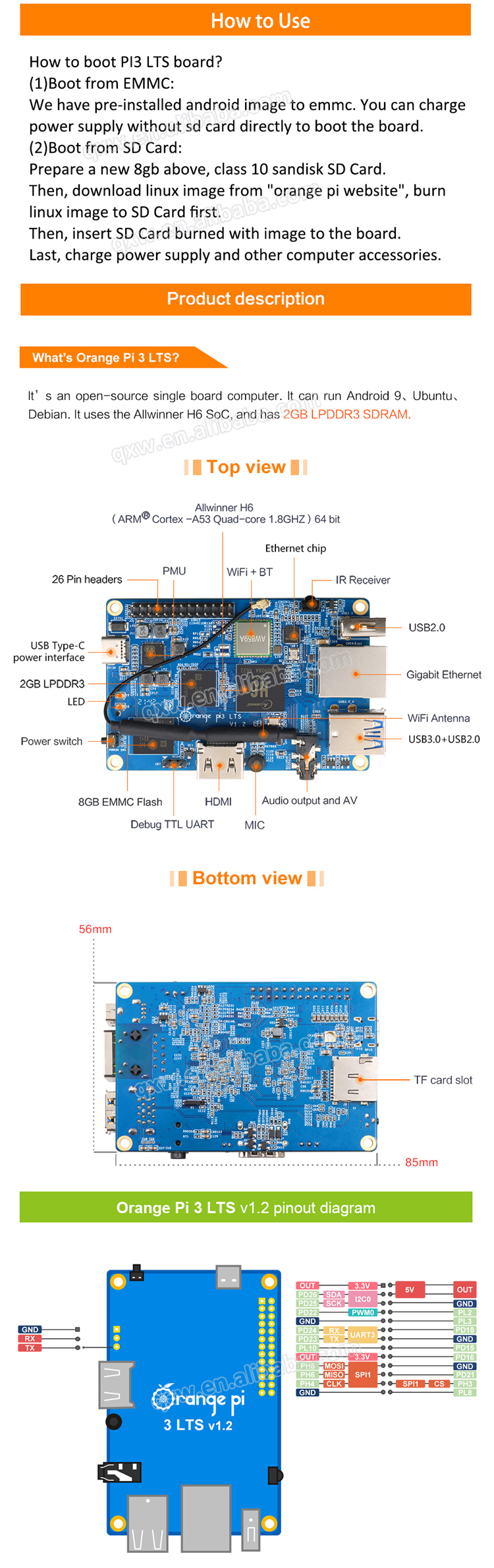
Orange Pi 3 Application features:
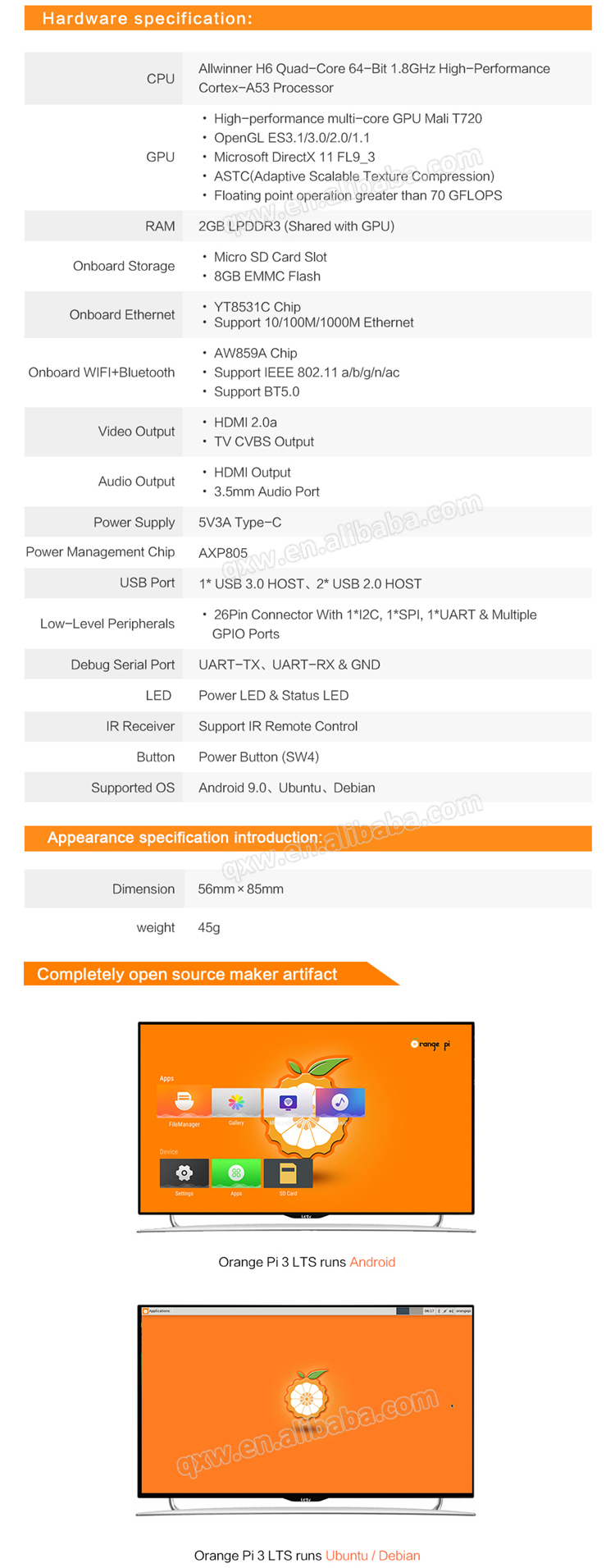
◆ CPU
Allwinner H6, quad-core 64-bit Cortex-A53 @1.8GHz
◆ GPU
Mali-T720 MP2, OpenGL ES3.1 support, >70 GFLOPS
◆ RAM
2GB LPDDR3 (shared with GPU)
◆ Onboard Storage
8GB eMMC Flash + Micro SD card slot
◆ Wired Network
Gigabit Ethernet (YT8531C chip)
◆ Wireless Connectivity
◆ Video Output
◆ Audio Output
◆ USB Ports
◆ Expansion
26-pin GPIO header (I2C, SPI, UART, multiple GPIOs)
◆ Other Interfaces
◆ Power Supply
5V/3A Type-C (AXP805 PMIC)
◆ Dimensions & Weight
85mm × 56mm, ~45g
◆ Supported OS
Android 9.0, Ubuntu, Debian, Manjaro, etc.
◆ Typical Applications
Smart home gateway
IoT development
Game emulator
Network Attached Storage (NAS)
◆ Key Advantages
LTS (Long Term Support) version with high stability
8GB onboard eMMC (no TF card needed for OS)
Gigabit Ethernet + USB 3.0 for fast data transfer
Dual-band WiFi + BT5.0 for stable wireless
Type-C power for convenience
Active open-source community, rich documentation
Why Choose QIXINWEI
Years of experience in the electronics industry. Trusted by global customers.
Massive In-Stock Inventory – Ready to ship promptly
BOM Matching Service – One-stop solution, save time
PCBA Customization – Professional engineering team creates tailor-made solutions based on your needs
Cost-Effective & Efficient – Better channel, better cost
A dedicated team makes your procurement smoother.
Contact us for BOM quotes or PCBA inquiries
Quantity(Pieces) | 1 ~ 30000 | 30001 ~ 300000 | > 300000 |
Est. Time(days) | 5 | 7 | To be negotiated |
FAQ:
What is the Orange Pi 3 LTS and its key specifications?
The Orange Pi 3 LTS is a single‑board computer (SBC) built around the Allwinner H6 quad‑core processor. It features four ARM Cortex‑A53 cores running up to 1.8 GHz, an ARM Mali‑T720 MP2 GPU, 2 GB of LPDDR3 RAM, and 8 GB of on‑board eMMC flash storage. The board includes Gigabit Ethernet, HDMI 2.0a (up to 4K@60fps), USB 3.0 and USB 2.0 ports, a 40‑pin GPIO header compatible with Raspberry Pi, and a microSD card slot for additional storage or OS booting. It is powered via a USB Type‑C port (5 V/3 A). The “LTS” designation means Long‑Term Supply, guaranteeing availability for industrial and commercial projects. It supports Android, Ubuntu, Debian, and Orange Pi OS.How does the Orange Pi 3 LTS differ from the original Orange Pi 3?
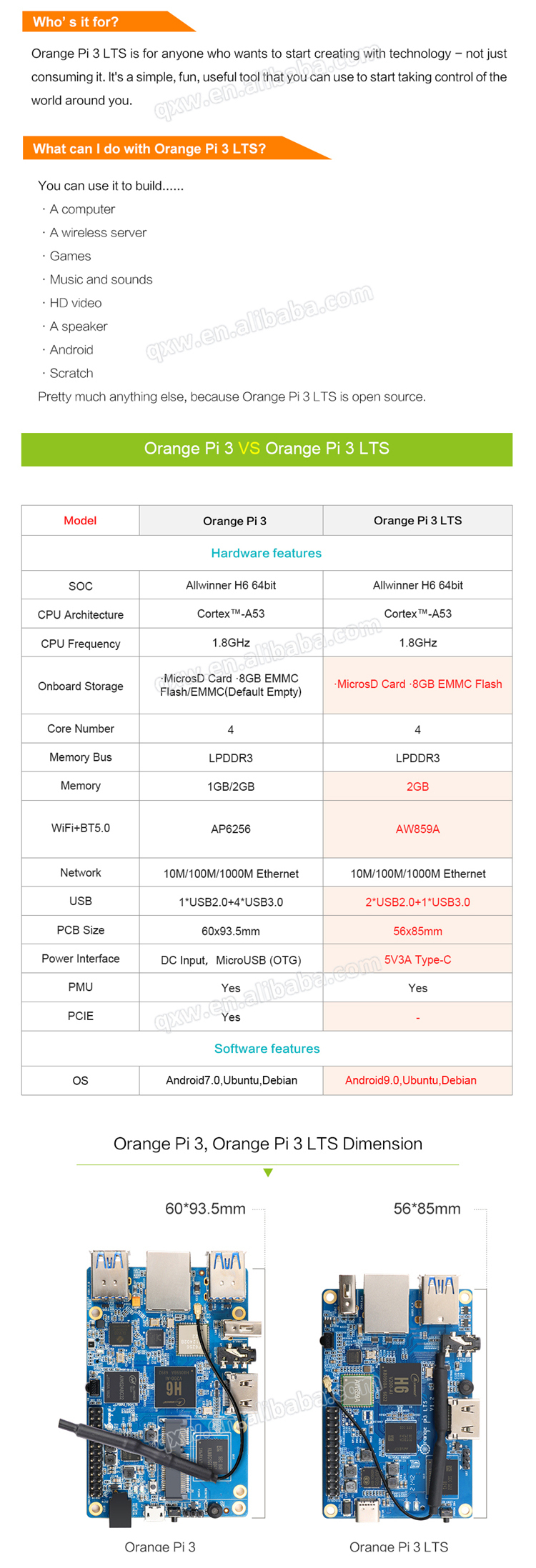
The Orange Pi 3 LTS is an improved, long‑term‑support version of the Orange Pi 3. The key upgrades are: 8 GB of built‑in eMMC storage (the original Pi 3 had no eMMC and relied solely on a microSD card), on‑board Gigabit Ethernet (the Pi 3 had a 10/100 M Ethernet port), and a USB Type‑C power input (the Pi 3 used a micro‑USB). The LTS also has a more robust power management IC and improved Wi‑Fi/BT antenna design for the optional wireless module (the LTS does not include on‑board Wi‑Fi/BT by default, but a dedicated M.2 slot allows adding a wireless card). Both boards share the same H6 processor, RAM, HDMI, and GPIO layout. The LTS is the recommended choice for new designs because of its eMMC, faster Ethernet, and guaranteed long‑term availability.What operating systems are supported on the Orange Pi 3 LTS?
The Orange Pi 3 LTS supports Android (typically Android 9 or 10), Ubuntu (20.04, 22.04), Debian (Bullseye/Bookworm), and Orange Pi OS (based on Arch/Droid). Community‑driven distributions such as Armbian and DietPi also provide excellent support. The operating system can be booted from the on‑board 8 GB eMMC or from a microSD card. All images are downloadable from the Orange Pi official website and can be flashed using tools like Balena Etcher. The eMMC provides significantly faster boot times and application loading compared to microSD.What display and video capabilities does the Orange Pi 3 LTS offer?
The board supports HDMI 2.0a output up to 4K@60fps with HDR, thanks to the Allwinner H6’s video engine. It can hardware‑decode H.265/HEVC 4K@60fps, H.264 4K@30fps, and VP9 4K@60fps, making it an excellent media player. The GPU (Mali‑T720) supports OpenGL ES 3.1 and provides smooth desktop and 3D performance. There is also a MIPI‑DSI connector for raw LCD panels, though a dedicated adapter is required. The board can drive a single 4K display and handle light 3D tasks.Does the Orange Pi 3 LTS have built‑in Wi‑Fi and Bluetooth?
No. The Orange Pi 3 LTS does not include on‑board Wi‑Fi or Bluetooth by default. However, it provides a dedicated M.2 Key‑E slot (with USB 2.0 and PCIe 2.0 lanes) that allows you to install an optional wireless module (such as the RTL8822CE, which adds Wi‑Fi 5 and Bluetooth 5.0). This modular approach gives designers the flexibility to choose the wireless solution that best fits their needs or to omit it entirely for cost‑sensitive or secure (air‑gapped) applications. For wired connectivity, the Gigabit Ethernet port is always available and is independent of the M.2 slot.How much memory and storage does the Orange Pi 3 LTS have, and can they be expanded?
The board comes with 2 GB of LPDDR3 RAM (soldered, not upgradable). For storage, it includes 8 GB of on‑board eMMC flash, which is used for the operating system and applications. In addition, there is a microSD card slot that supports cards up to 256 GB (or larger). The system can boot from either the eMMC or the microSD card, and you can use the microSD as extra storage when booting from eMMC. External USB drives can also be connected for additional space.What is the power supply requirement and typical power consumption?
The Orange Pi 3 LTS is powered through a USB Type‑C port and requires a 5 V/3 A (15 W) DC power adapter. A good‑quality charger with adequate current is essential for stable operation, especially when using USB peripherals or the M.2 wireless card. Under typical desktop usage with Ethernet and HDMI active, the board consumes about 4 W – 6 W. The Allwinner H6 is built on a 28 nm process and is quite power‑efficient, making the board suitable for always‑on and battery‑powered applications.What GPIO and expansion interfaces are available on the Orange Pi 3 LTS?
The board features a 40‑pin GPIO header that is physically and functionally compatible with most Raspberry Pi HATs (with proper software configuration). It provides UART, SPI, I2C, PWM, and up to 28 general‑purpose I/O pins. Additionally, the board includes a MIPI‑CSI camera connector (compatible with the official Orange Pi camera module), a USB 3.0 host port, and two USB 2.0 ports. The M.2 Key‑E slot can also be used for other PCIe peripherals with appropriate adapters, though it is primarily intended for wireless cards.How does the Orange Pi 3 LTS compare to the Raspberry Pi 4?
Both are powerful SBCs, but they have different strengths. The Raspberry Pi 4 offers a quad‑core Cortex‑A72 (faster per‑core performance), up to 8 GB RAM, dual micro‑HDMI, and a richer ecosystem. The Orange Pi 3 LTS offers 8 GB of built‑in eMMC (the Pi 4 requires a microSD card or external SSD), true USB 3.0 (with a dedicated bus, often faster than the Pi 4’s shared bus), and native 4K@60fps HDMI 2.0a with HDR. The Pi 4 has on‑board Wi‑Fi/Bluetooth, while the LTS uses a modular M.2 approach. The Pi 4 is generally better for community support and software, while the Orange Pi 3 LTS excels in applications that need fast built‑in storage, long‑term availability, and a compact form factor with industrial‑grade supply commitment.What are the most typical applications for the Orange Pi 3 LTS?
Thanks to its reliable eMMC storage, Gigabit Ethernet, 4K video output, and long‑term supply guarantee, the Orange Pi 3 LTS is widely used in digital signage players, industrial HMI terminals, IoT gateways, thin clients, network‑attached storage (NAS) (with an external USB drive), and embedded media centres. The LTS commitment makes it particularly attractive for commercial and industrial products that cannot tolerate sudden board discontinuation.
- 原产地:
- origin
- 品牌:
- origin
- 型号:
- Orange Pi 3 LTS
- 安装方式:
- 表面贴装
- 描述:
- 开发板