qixinwei-pcba


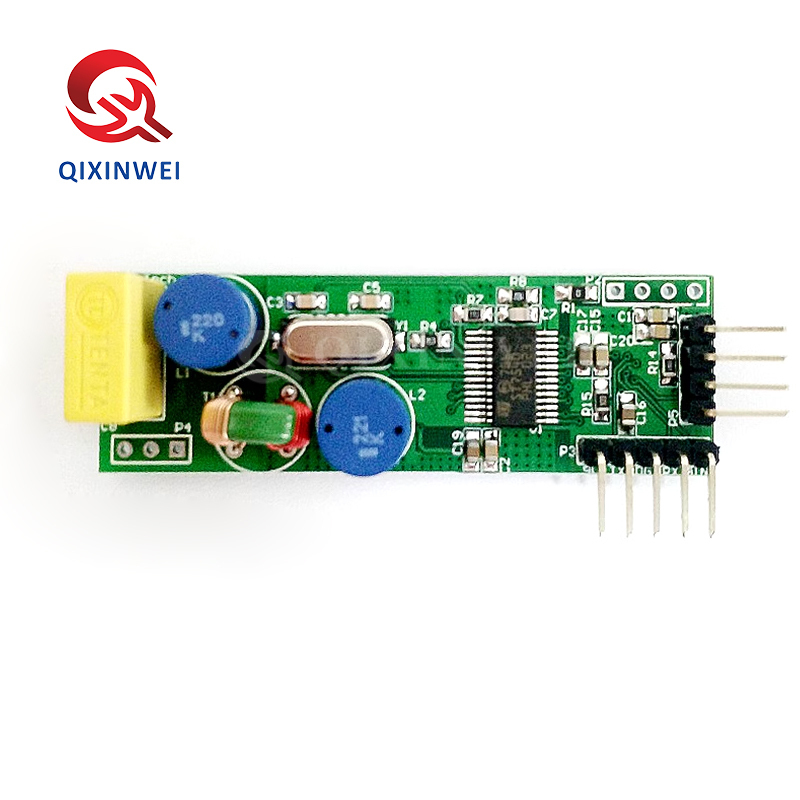
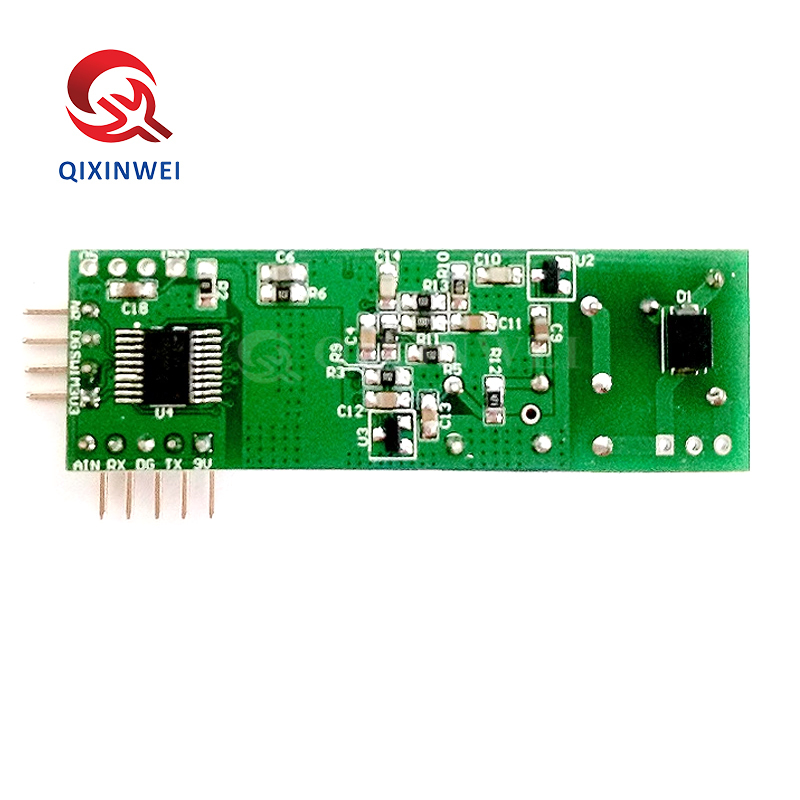
ST7540 Power Line Carrier Module DC 3-Phase Communication Ultra Compact Board
ST7540 Power Line Carrier Module Application Features
Core Chip
◆ Main Chip
ST7540 FSK power line transceiver (STMicroelectronics)
◆ Auxiliary MCU
STM32F103xB (ARM Cortex-M3)
◆ Modulation
Half-duplex Frequency Shift Keying (FSK)
Communication Parameters
◆ Carrier Frequencies
8 programmable frequencies (60-132.5kHz)
◆ Baud Rate
600/1200/2400/4800bps programmable
◆ Receive Sensitivity
Up to 250µVRMS
◆ Mains Access
Synchronous/Asynchronous programmable
Power Line Support
◆ Line Types
DC power line
Single-phase AC
Three-phase AC
◆ CENELEC Bands
Supports A, B, C bands
◆ Standard Compliance
EN 50065 Cenelec compliant
Hardware Resources
◆ Communication Interfaces
◆ Digital I/O
Up to 8 programmable GPIOs
◆ Real-Time Clock
Built-in RTC (lithium battery backup)
◆ Storage
Flash memory for parameters + user data
Power Specifications
◆ Supply Voltage
7.5V ~ 13.5V (single supply)
◆ Integrated Regulators
5V (50mA) + 3.3V (50mA) regulators
◆ Quiescent Current
5mA (ultra-low power)
Protocol Stack Features
◆ Operating Modes
Master/slave, multimaster configurable
◆ Addressing
Unicast and broadcast frame support
◆ Collision Handling
CSMA/CA + repetition management
◆ Payload
Up to 100 bytes user data
Physical Specifications
◆ Package Type
HTSSOP28 (28-pin thin-shrink with exposed pad)
◆ Board Design
Ultra-compact modular design
◆ Mounting Type
SMD surface mount
◆ Operating Temperature
-40°C ~ +85°C
Development Support
◆ Evaluation Board
STEVAL-IHP005V1 reference design
◆ Firmware Architecture
Layered structure with API interface
◆ Development Tools
STM32 standard peripheral library, IAR EWARM
◆ PC Software
Graphical configuration GUI (via RS232)
Typical Applications
◆ Smart Grid
Smart meter communication
Remote meter reading
◆ Renewable Energy
PV inverter communication
Energy storage monitoring
◆ Industrial Automation
Factory equipment control
Industrial data acquisition
◆ Smart Lighting
Street light remote control
Building lighting management
◆ Smart Home
◆ Appliance Control
Key Advantages
◆ 3-Phase/DC Compatible
Works on DC, single-phase, and three-phase power lines
◆ No Extra Wiring
Uses existing power lines for data transmission
◆ Ultra-Low Power
5mA quiescent current for 24/7 operation
◆ Complete Protocol Stack
Built-in CSMA/CA, no additional development needed
◆ Strong Anti-Interference
FSK modulation + programmable filters
◆ Rich Development Resources
ST official reference designs and firmware libraries
◆ Ultra-Compact Size
Ideal for space-constrained applications
Why Choose QIXINWEI
Years of experience in the electronics industry. Trusted by global customers.
Massive In-Stock Inventory – Ready to ship promptly
BOM Matching Service – One-stop solution, save time
PCBA Customization – Professional engineering team creates tailor-made solutions based on your needs
Cost-Effective & Efficient – Better channel, better cost
A dedicated team makes your procurement smoother.
Contact us for BOM quotes or PCBA inquiries

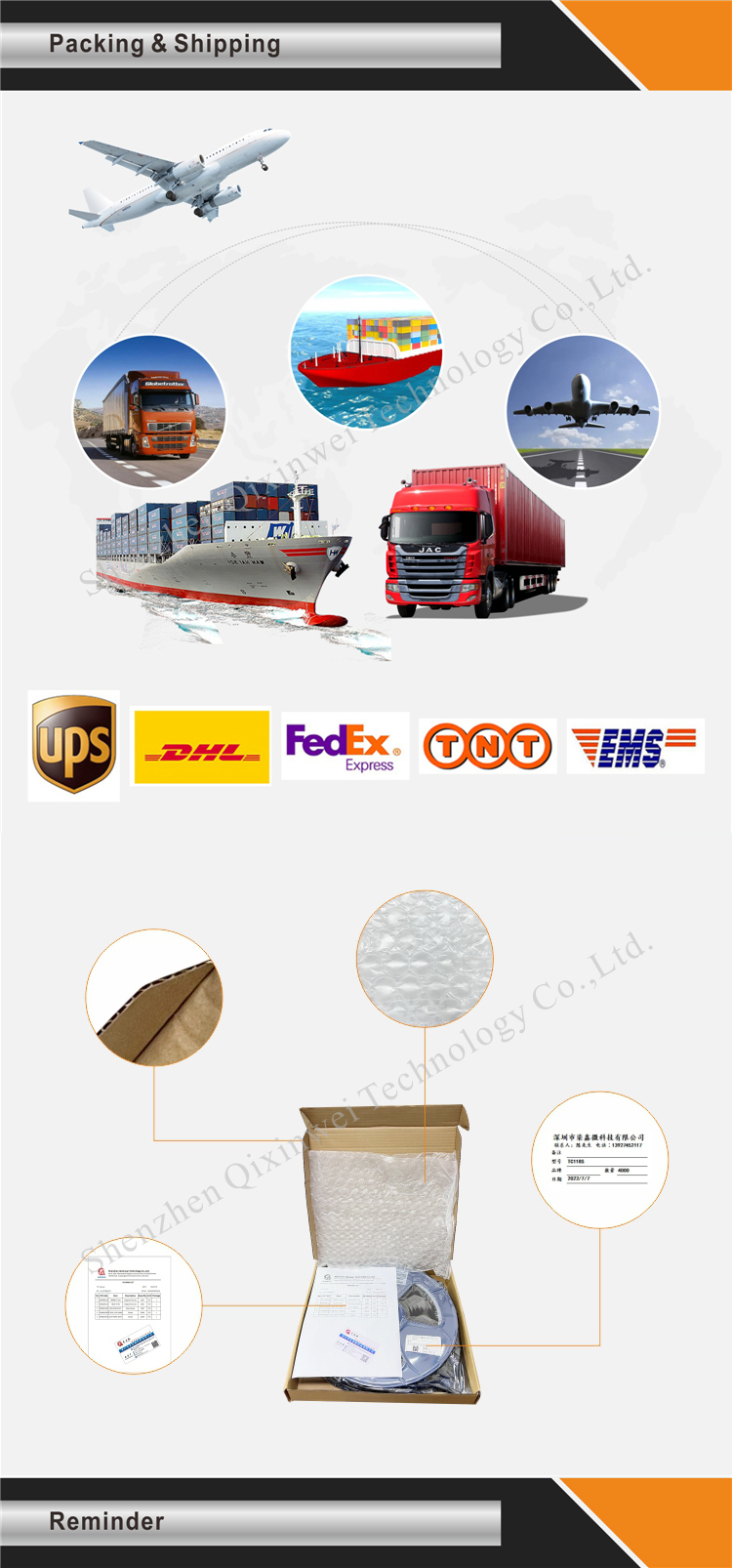
Quantity(Pieces) | 1 ~ 30000 | 30001 ~ 300000 | > 300000 |
Est. Time(days) | 5 | 7 | To be negotiated |

FAQ:
What is the ST7540 power line carrier module and its key specifications?
This module is based on the STMicroelectronics ST7540, a highly integrated narrowband power line communication (PLC) transceiver. It enables data transmission over existing DC or AC power lines, supporting both single‑phase and 3‑phase systems. Key specifications: operates in the CENELEC A, B, C, and FCC bands (configurable frequency up to 250 kHz), adjustable data rates from 600 bps to 4800 bps, FSK and PSK modulation with programmable deviation, a UART/SPI host interface, integrated power amplifier delivering up to 1 A RMS into the line, over‑current and over‑temperature protection, and a compact form factor with an on‑board coupling transformer. The module operates from a single 7.5 V – 18 V DC supply and is designed for robust communication in harsh electrical environments.How does the ST7540 PLC module work? What is its communication principle?
The module uses Frequency Shift Keying (FSK) or Phase Shift Keying (PSK) to modulate digital data onto a high‑frequency carrier. The modulated signal is coupled onto the power line via an on‑board transformer and coupling capacitor. At the receiver, the ST7540 demodulates the signal, extracting the original data. The chip automatically handles carrier sense, preamble detection, and address filtering. Communication is half‑duplex, and multiple modules can share the same power line using a carrier sense multiple access (CSMA) protocol. The module’s integrated power amplifier provides sufficient drive for long‑distance communication without external amplifiers.What are the typical applications of the ST7540 DC 3‑phase power line carrier module?
It is widely used in industrial automation, building management, smart grid, solar inverter communication, motor control, and remote metering. It excels in systems where dedicated data cables are impractical — for example, communicating with sensors and actuators across a factory floor, transmitting inverter status in photovoltaic arrays, or reading remote water/power meters. The module’s support for 3‑phase DC lines and its robust noise immunity make it ideal for electric vehicle (EV) charging stations and industrial DC microgrids.How do I interface the ST7540 module with an MCU? What communication interfaces are available?
The module provides a UART (TTL) interface as the primary host connection, with an optional SPI interface for advanced register access. To connect to an Arduino or ESP32, simply wire VCC (7.5–18 V), GND, TX, and RX. The module’s logic pins are 3.3 V tolerant, so a level shifter is recommended for 5 V MCUs. The ST7540 can be configured via hardware strapping pins (frequency band, modulation, data rate) or through software registers over SPI/UART. The module also provides a RESET pin, a REG_OK flag, and a carrier detect (CD) output to synchronise transmission with other nodes.What is the maximum communication distance and what factors affect it?
The achievable distance depends heavily on the power line impedance, noise level, and the number of branches. Under good conditions (a dedicated DC bus with low attenuation), reliable communication at 2400 bps can span several hundred meters, with reports of up to 1 km on clean lines. The ST7540’s high‑output amplifier and sensitive receiver (‑90 dBm sensitivity) help overcome attenuation. To maximize range, use the lowest data rate (600 bps), select the appropriate frequency band for your line, and add line terminators at both ends to reduce reflections. Avoid placing large capacitive loads directly across the line without decoupling inductors.What modulation and data rate options does the ST7540 support, and how do I choose?
The ST7540 supports FSK (Frequency Shift Keying) with programmable deviation, and BPSK/QPSK. Data rates are selectable: 600, 1200, 2400, and 4800 bps. FSK at lower rates (< 2400 bps) is more robust in noisy environments. PSK offers better spectral efficiency but requires a cleaner line. For industrial environments with motor drives and inverters, FSK at 1200 bps is a reliable default. The choice can be set via hardware configuration pins (F0–F3, MOD) without any software, making it easy to optimise during installation.What are the power supply requirements and typical power consumption?
The module operates from a single 7.5 V to 18 V DC supply (typical 12 V). During transmission, the integrated power amplifier draws up to 1 A RMS peak into the line; the average current depends on the duty cycle. In receive mode, the consumption drops to about 15 mA – 25 mA. In standby mode, the chip consumes < 1 µA, allowing the module to remain connected without draining the supply. A stable power source is essential for reliable communication, and a 100 µF – 470 µF bulk capacitor near the module is recommended to buffer the amplifier’s current peaks.Does the ST7540 module provide any security or encryption?
The ST7540 itself does not include hardware encryption. Security must be implemented by the host MCU in software (e.g., AES‑128, TLS). The chip supports address filtering (1‑byte node address), which can be used to ignore frames not intended for a specific node, but this is not a cryptographic security measure. For applications requiring authenticated and encrypted PLC communication, a lightweight software encryption layer is recommended, with key exchange handled over the PLC link or during initial configuration.How does the ST7540 PLC module compare to other power line communication solutions?
Compared to HomePlug GreenPHY or G3‑PLC, the ST7540 is a narrowband, low‑data‑rate solution optimised for simple command and control, not high‑speed networking. It is much simpler to integrate, requires no complex protocol stack, and works on DC lines where many broadband PLC modems fail. Against the ST8500 or ST7580, the ST7540 offers higher output current (1 A vs 0.5 A) and better suitability for long‑distance, low‑frequency bands. It is a proven, cost‑effective choice for industrial telemetry, remote I/O, and sensor data acquisition over existing wiring.What are the most common issues when setting up an ST7540 PLC network, and how can I troubleshoot them?
Common issues: 1) No communication – verify the coupling transformer and capacitor are correctly connected; check that the power line does not have a large filter capacitor that shorts the carrier. 2) High error rate – reduce the data rate, change the carrier frequency away from noisy bands, add line terminators, and ensure the power supply is clean. 3) Signal blocked by DC‑DC converters – place decoupling inductors (e.g., 100 µH) between the converter and the PLC line to prevent the converter’s input capacitors from attenuating the signal. 4) Multiple nodes colliding – implement a simple CSMA back‑off in the host firmware, or use the ST7540’s carrier detect to defer transmission. 5) Module overheating – ensure the amplifier is not transmitting continuously; limit the duty cycle or add a small heatsink.
- 原产地:
- Original
- 品牌:
- Standrad
- 型号:
- ST7540 Module
- 种类:
- 标准
- 芯片组:
- 标准
- 应用:
- 通用