qixinwei-pcba


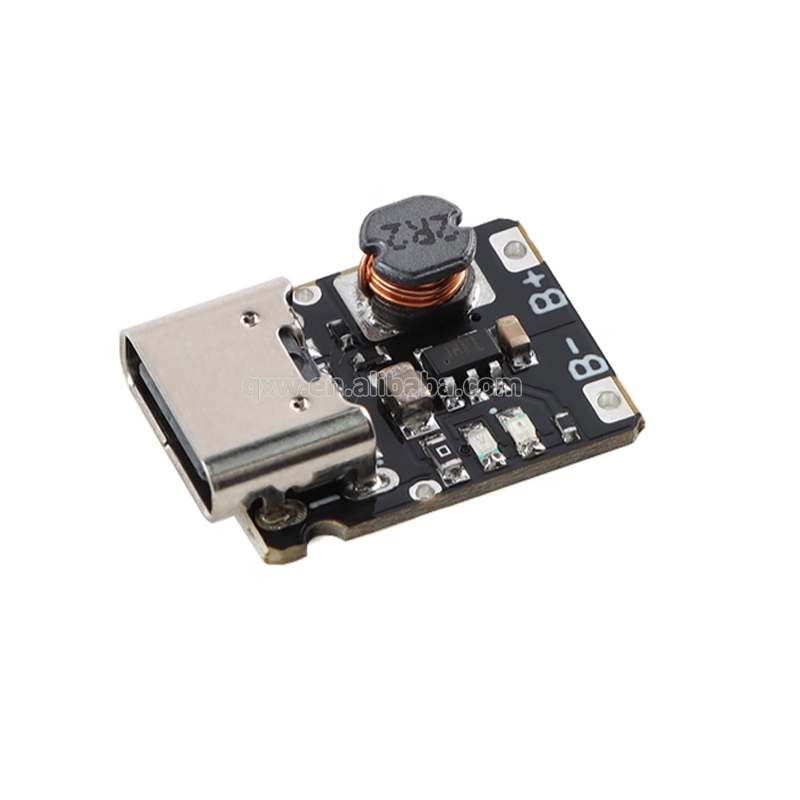
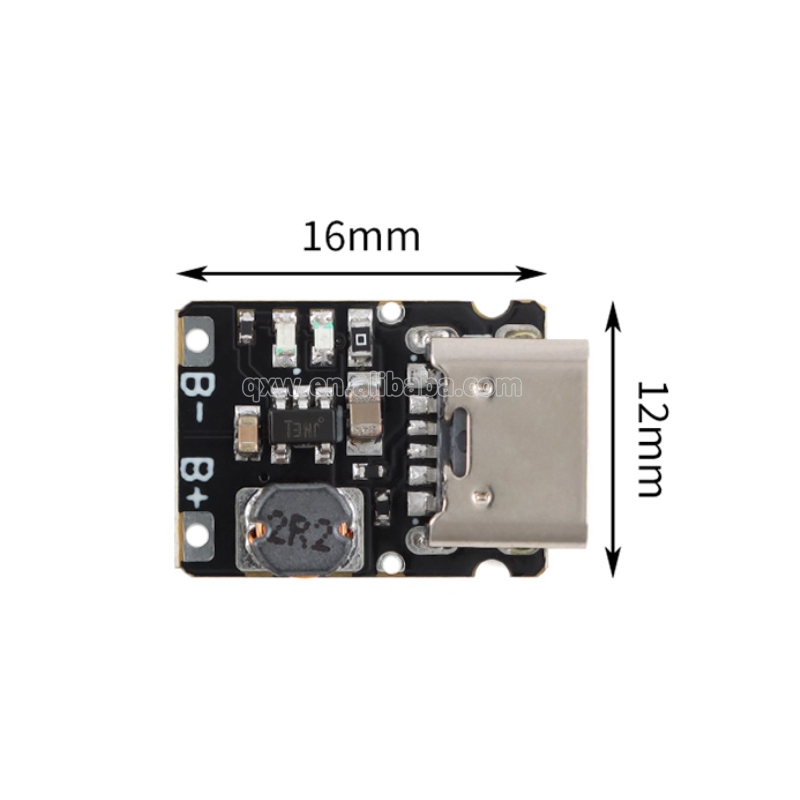
Type-C 5V Boost Charge Discharge Module 3.7V to 5V 18650 Li-Ion Battery Power Board
Type-C 5V Boost Charge Discharge Module Application Features:
◆ Core Function
Charge management + 5V boost output (2-in-1)
◆ Input Interface
Type-C (5V charging)
◆ Battery Type
3.7V / 4.2V 18650 Li-Ion battery (single cell)
◆ Output Voltage
5V (boost output)
◆ Output Current
Up to 2A
◆ Charging Current
1A (typical)
◆ LED Indicator
Red = charging, Green/Blue = full
◆ Typical Applications
DIY power banks
Portable device power supply
Arduino/ESP8266 wireless power
LED strips / lighting
Small fans / pumps
◆ Key Advantages
Type-C for easy power access
Charge + discharge integrated, simple circuit
Battery protection (over-charge / over-discharge)
- Compact size, plug-and-play
Why Choose QIXINWEI
Years of experience in the electronics industry. Trusted by global customers.
Massive In-Stock Inventory – Ready to ship promptly
BOM Matching Service – One-stop solution, save time
PCBA Customization – Professional engineering team creates tailor-made solutions based on your needs
Cost-Effective & Efficient – Better channel, better cost
A dedicated team makes your procurement smoother.
Contact us for BOM quotes or PCBA inquiries



Quantity(Pieces) | 1 ~ 30000 | 30001 ~ 300000 | > 300000 |
Est. Time(days) | 5 | 7 | To be negotiated |
FAQ
1. What is the Type‑C 5V boost charge/discharge module and its key specifications?
This compact module combines a single‑cell lithium battery charger, a boost converter, and a protection circuit into one board. It charges a 3.7 V 18650 cell via a Type‑C USB port and boosts the battery voltage to a stable 5 V output to power USB devices. Key specifications include:
- Input: USB Type‑C, 5 V DC (for charging).
- Battery: single 3.7 V Li‑Ion 18650 cell (or Li‑Po pouch cell).
- Charge current: typically 1 A (set by on‑board TP4056 or similar charger IC).
- Boost output: 5 V DC, up to 1 A – 2 A (depending on model).
- Efficiency: up to 90% (boost converter).
- Protections: over‑charge, over‑discharge, over‑current, and short‑circuit.
- Features: dual USB‑A output ports, LED battery indicator, pass‑through charging.
2. How do I connect an 18650 battery and use the module as a power bank?
Wiring is simple. Solder or attach the 18650 cell to the B+ and B‑ pads (respect polarity — reversing will destroy the module). Insert a microSD card is not required. Plug a USB Type‑C cable into the input to charge the battery — the LED indicator shows the charge level. To use the power bank, connect your device (phone, tablet, Arduino) to one of the USB‑A output ports. The module automatically boosts the battery voltage to 5 V. The on‑board button can wake the display or check battery status. For first use, fully charge the battery before connecting a load to ensure stable operation.
3. What is the charging current and how long does it take to charge an 18650?
Most modules charge at a fixed 1 A current, which is determined by the on‑board charger IC (typically a TP4056 or similar). For a 2000 mAh cell, a full charge takes about 2.5–3 hours; a 3000 mAh cell takes about 3.5–4 hours. The LED display shows the progress as a percentage (0–100%). Once the battery reaches 4.2 V, the charger automatically stops and the display shows 100%. Some modules allow you to change the charge current by replacing a resistor (Rprog on the charger chip), but the default 1 A is safe for most 18650 cells. Using a higher current may require an external charger IC upgrade.
4. What is the maximum output current of the boost converter, and can I charge two devices at once?
The module typically provides a total output current of 1 A – 2 A across one or two USB‑A ports. Some models support 2.4 A max. When two devices are connected, the current is shared. If the combined load exceeds the rated current, the over‑current protection will shut down the output to protect the battery. For fastest charging of a single device, use one port and a short, high‑quality cable. The actual output also depends on the battery voltage; when the cell is nearly empty, the maximum current may drop slightly.
5. Does the module support pass‑through charging (charging while powering a load)?
Yes, most of these modules support pass‑through charging. When the Type‑C input is connected, the boost converter can remain active, and the USB outputs will deliver power while the battery charges. However, this can cause additional heat and may reduce the charging speed. It is generally safe for light loads, but for heavy loads it is recommended to charge the battery without a load connected to keep the module cool. The internal charger and boost circuits operate independently, but they share the same power path.
6. What protection features does the module include?
The module includes a comprehensive set of safety features: over‑charge protection (stops charging at 4.25 V ± 0.05 V), over‑discharge protection (cuts off output when the battery drops to about 2.9 V – 3.0 V to prevent deep discharge), over‑current protection on the USB outputs, and short‑circuit protection. These are usually implemented by a dedicated battery protection IC (DW01 + 8205A) combined with the charger chip. The boost converter also has its own over‑temperature shutdown. Always use a quality 18650 cell and avoid physical damage to the board.
7. What type of 18650 batteries can I use? Are protected cells required?
You must use standard 3.7 V Li‑Ion cylindrical 18650 cells. The module is designed for a single cell. You can use flat‑top or button‑top cells as long as they fit the holder. Protected cells (with a built‑in protection PCB) are generally too long to fit the on‑board holder and may interfere with the module’s own protection. It is best to use unprotected, high‑quality cells (e.g., Samsung, Panasonic, LG) and let the module’s protection circuit manage the battery. Never use a damaged cell, and do not mix different types or capacities in parallel.
8. Why does my module get warm or not deliver full output current?
Warmth during charging or discharging is normal. The boost converter and charger IC dissipate heat, especially at high currents. Ensure the module has some ventilation — do not wrap it in insulation. If the output current is lower than expected, check that you are using a good‑quality USB cable and that the battery is sufficiently charged. A weak battery or a USB cable with high resistance will limit the output. Also, some modules have a fixed current limit; check your specific board’s specifications. Dirty or oxidized battery contacts can also cause resistance and reduce efficiency.
9. How does this module compare to a standard TP4056 charger without a boost converter?
A bare TP4056 module only charges a battery; it cannot output 5 V to power other devices. This module integrates both the charger and a boost converter, so it can function as a complete power bank. It also includes battery level indication and dual USB outputs, which a simple TP4056 board lacks. The trade‑off is slightly larger size and slightly lower efficiency due to the boost stage. For projects that only need to charge a battery and power a 3.7 V load, a TP4056 board is sufficient. For any application requiring a 5 V output (e.g., powering an Arduino or charging a phone), this integrated module is the right choice.
10. What are the most typical applications for this charge/discharge module?
It is a staple in DIY power banks, portable USB chargers, solar‑powered projects, IoT sensor nodes, robotics, portable LED lighting, wireless headphones/speakers, and any battery‑operated device that uses a single 18650 cell. Its Type‑C convenience, dual USB outputs, and built‑in protection make it the go‑to power solution for hobbyists and product designers alike.
- 原产地:
- Origin
- 品牌:
- Origin
- 型号:
- 5V Charge Discharge Module
- 系列:
- 模块
- 特征:
- 标准
- 安装方式:
- 标准
- 尺寸/尺寸:
- 标准
- 描述:
- 5V充放电模块