qixinwei-pcba


MP1584EN DC-DC Step Down Module 24V to 12V 9V 5V 3V 3A Adjustable Buck Converter
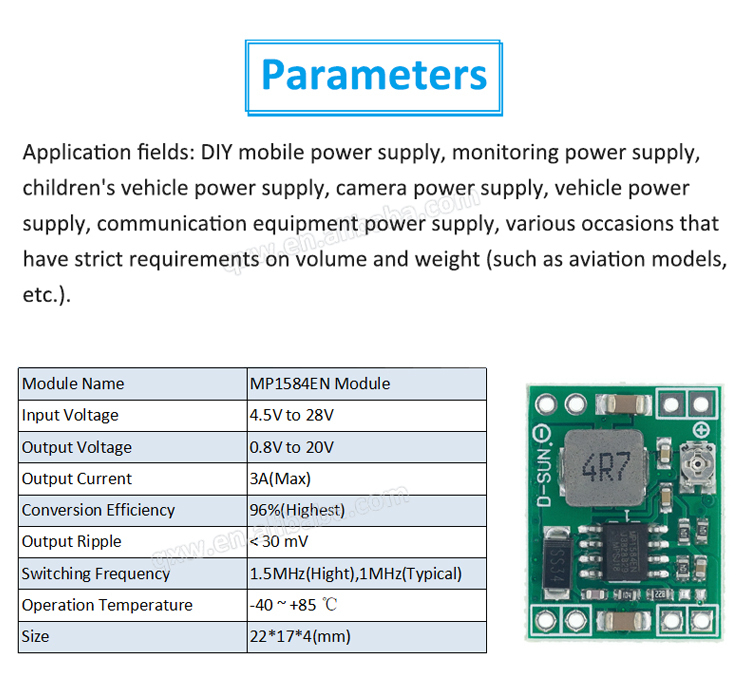
◆ Main Chip
MP1584EN (MPS, SOP-8 package)
◆ Input Voltage
DC 6V ~ 30V (7V-28V recommended)
◆ Output Voltage
DC 1.8V ~ 28V (adjustable, 1.5V dropout required)
◆ Output Current
Max 3A (peak)
2A recommended (continuous)
◆ Switching Frequency
1.5MHz
◆ Conversion Efficiency
Up to 92%
◆ Voltage Adjustment
Onboard 3296W multi-turn potentiometer
◆ Indicator
Red power LED
◆ Module Size
Approx. 22mm × 17mm × 4mm
◆ Protection
Over-current, thermal protection
◆ Typical Applications
24V to 12V (car devices)
24V to 9V (router/camera)
24V to 5V (MCU/sensors)
24V to 3.3V (ESP8266/ESP32)
Industrial equipment step-down
Battery regulation
◆ Key Advantages
Compact size (thumb-sized)
Wide input voltage range
Continuously adjustable output
1.5MHz high frequency, low ripple
High efficiency, low heat
Cost-effective

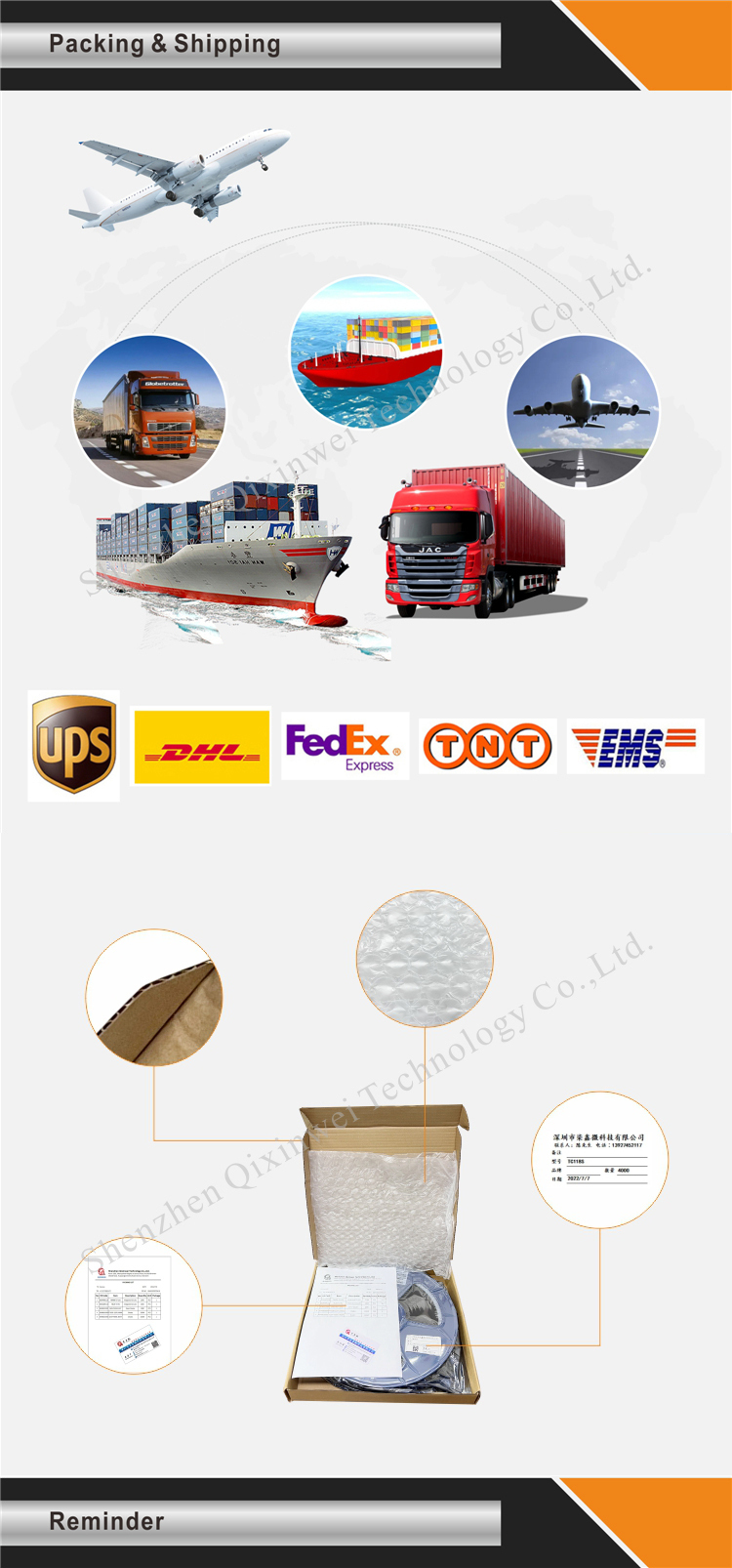
Quantity(Pieces) | 1 ~ 30000 | 30001 ~ 300000 | > 300000 |
Est. Time(days) | 5 | 7 | To be negotiated |

FAQ:
What is the MP1584EN DC‑DC step‑down module and its key specifications?
This is a compact adjustable buck converter module built around the MPS MP1584EN chip. It reduces a higher DC input voltage to a lower, stable output voltage. Key specifications: input voltage range 4.5 V – 28 V, adjustable output from 0.8 V to approximately 20 V (always lower than the input), maximum continuous output current 3 A (with adequate cooling), fixed 1.5 MHz switching frequency, peak efficiency up to ~95 %, and built‑in over‑current, thermal shutdown, and under‑voltage lockout protections. The board typically includes a multi‑turn potentiometer for fine voltage adjustment and screw terminals for easy wiring. It is widely used to power microcontrollers, sensors, and small motors from higher‑voltage sources.How do I connect the MP1584EN module and adjust the output voltage?
Wiring is simple. The board has four pins or terminals: IN+ (positive input), IN‑ (negative input), OUT+ (positive output), and OUT‑ (negative output). Connect your DC power source (e.g., 12 V or 24 V battery) to IN+ and IN‑, observing correct polarity. Connect your load to OUT+ and OUT‑. Before connecting a sensitive load, use a multimeter to set the output voltage: turn the on‑board potentiometer clockwise to increase the voltage, and counter‑clockwise to decrease it. Because the potentiometer is sensitive, make small adjustments and monitor the output closely.What is the maximum input voltage and output current of this module?
The maximum rated input voltage is 28 V DC. Exceeding this may damage the MP1584EN chip. The module can deliver up to 3 A continuous output current, but this is only achievable with good airflow and when the input‑output voltage difference is not too large. At high step‑down ratios (e.g., 24 V to 5 V) and 3 A load, the module will become very hot; a heatsink or forced cooling is strongly recommended for sustained high‑power operation. For reliable long‑term use, keep the total output power under approximately 10 W – 15 W without additional cooling.What is the typical efficiency of the MP1584EN converter?
The MP1584EN can achieve a peak efficiency of up to 95 % under optimal conditions (e.g., moderate load, 12 V to 5 V conversion). Efficiency drops slightly at very light loads or at very high step‑down ratios. The 1.5 MHz switching frequency allows the use of small inductors and capacitors, but also means that switching losses are higher than lower‑frequency converters. In practice, you can expect efficiency above 85 % – 90 % for most typical applications.Can this module be used to generate 5 V or 3.3 V from a 24 V supply?
Yes, this is a very common use case. The module can easily convert 24 V down to 5 V, 3.3 V, or any voltage between 0.8 V and about 20 V, as long as the output is at least a few volts below the input. However, the larger the voltage difference, the more heat is generated at high currents. For a 24 V‑to‑5 V conversion at 2 A – 3 A, the module will require adequate ventilation. For lower‑power loads (below 1 A), it runs cool without a heatsink.What protection features does the MP1584EN chip include?
The chip provides several built‑in protections: cycle‑by‑cycle over‑current protection (OCP) that limits the peak inductor current, thermal shutdown that turns off the chip if the die temperature exceeds approximately 150 °C, and under‑voltage lockout (UVLO) that prevents operation when the input voltage is too low. These protections help prevent catastrophic failure, but the module does not include reverse‑input‑polarity protection or output over‑voltage protection. Always double‑check wiring before applying power.How does the MP1584EN module differ from an LM2596‑based buck converter?
Both are popular adjustable step‑down modules. The LM2596 operates at a low switching frequency of 150 kHz, requiring a larger inductor and capacitors, and is generally limited to 2 A – 3 A. The MP1584EN runs at 1.5 MHz — ten times higher — enabling a much smaller module size. The MP1584EN module is typically more compact (~22 mm × 17 mm) than an LM2596 board, making it ideal for space‑constrained designs. The LM2596, however, can handle slightly higher input voltages (up to 40 V) and may have a lower dropout voltage. For most Arduino/ESP32 projects, the MP1584EN's small size and 3 A capacity make it the preferred choice.What is the minimum input‑output voltage difference (dropout voltage)?
The MP1584EN requires an input voltage at least 0.8 V – 1.0 V higher than the output to regulate correctly, depending on the load current. For example, to obtain a stable 5 V output, the input must be at least 6 V. If the input voltage drops below this threshold, the output will also drop and ripple will increase. This dropout voltage is typical for buck converters and should be considered when powering the module from a battery that discharges over time.Why does my MP1584EN module get very hot, and how can I fix it?
Heat is normal under high load. The main sources of heat are the inductor and the MP1584EN chip itself. If the module becomes too hot to touch, it is likely operating near its current limit or with a large voltage drop. Solutions: 1) reduce the output current; 2) improve airflow; 3) attach a small aluminium heatsink to the MP1584EN chip; 4) ensure the input voltage is within the specified range; 5) check that the load is not short‑circuited. The built‑in thermal protection will shut down the module if it overheats, but sustained high temperatures will shorten its lifespan.What are the most typical applications for the MP1584EN buck converter module?
It is extremely popular in DIY electronics for powering Arduino, ESP32, and Raspberry Pi from higher‑voltage supplies (e.g., 12 V or 24 V lead‑acid batteries), portable battery‑powered projects, LED drivers, small motor power supplies, and general voltage regulation where a compact, efficient step‑down converter is needed. Its tiny footprint and 3 A capacity make it a favourite for fitting into tight enclosures.
- 原产地:
- origin
- 品牌:
- origin
- 型号:
- MP1584EN Module
- 种类:
- 数据转换开发板和工具包
- 芯片组:
- MP1584EN
- 应用:
- 降压型电源模块,