qixinwei-pcba


Flame Detection Sensor Module 5V12V Infrared Fire Alarm Relay Output 1-Channel
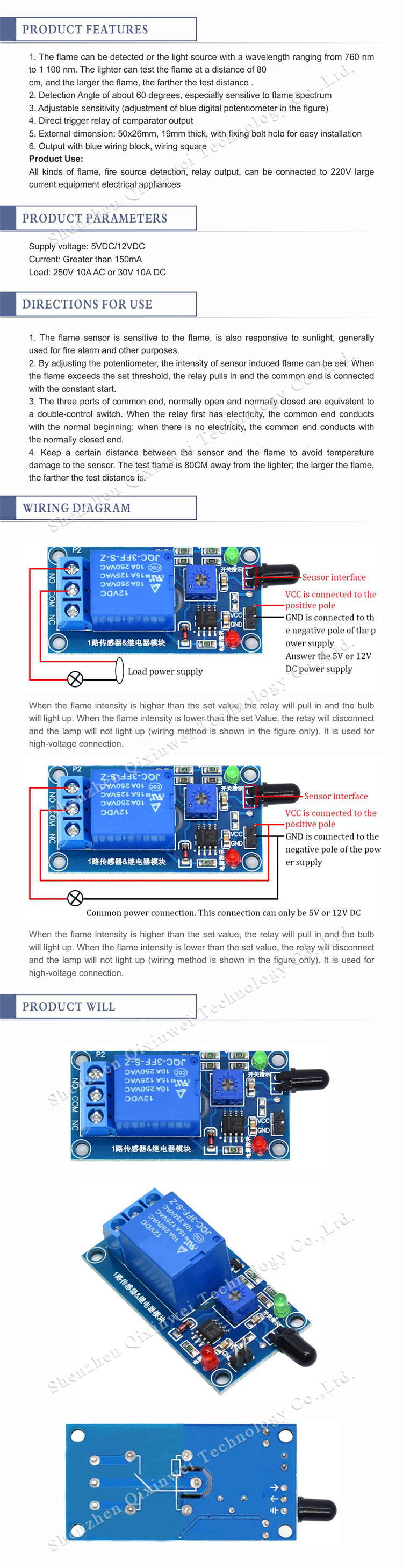
Infrared flame detection sensor module, 5V/12V power optional, onboard relay output. Detects 760-1100nm wavelength, range up to 1 meter. Adjustable sensitivity, indicator LED. Ideal for fire alarm, flame monitoring, firefighting robot, smart extinguisher system, Arduino projects
Flame Detection Sensor Module Application features:
◆ Sensor Type
Infrared flame sensor (detects flame spectrum)
◆ Detection Wavelength
760nm ~ 1100nm
◆ Detection Distance
Up to 1 meter (depends on flame intensity)
◆ Detection Angle
Approx. 60 degrees
◆ Supply Voltage (Optional)
DC 5V
DC 12V
◆ Output Method
Relay output (NO/NC contacts)
Digital level output (TTL)
◆ Relay Capacity
10A 250V AC / 10A 30V DC
◆ Sensitivity Adjustment
Onboard potentiometer
◆ Indicators
Power LED
Flame trigger LED
◆ Comparator Chip
LM393
◆ Typical Applications
Fire alarm system
Flame monitoring device
Firefighting robot
Smart extinguisher system
Stove flame detection
Safety protection equipment
Arduino/STM32 teaching
Flame Detection Sensor Module Key Advantages
Relay directly drives high loads
5V/12V wide voltage selection
Adjustable sensitivity
Dual output (digital level + relay)
Plug-and-play
- Fast response time
Why Choose QIXINWEI
Years of experience in the electronics industry. Trusted by global customers.
Massive In-Stock Inventory – Ready to ship promptly
BOM Matching Service – One-stop solution, save time
PCBA Customization – Professional engineering team creates tailor-made solutions based on your needs
Cost-Effective & Efficient – Better channel, better cost
A dedicated team makes your procurement smoother.
Contact us for BOM quotes or PCBA inquiries






Quantity(Pieces) | 1 ~ 30000 | 30001 ~ 300000 | > 300000 |
Est. Time(days) | 5 | 7 | To be negotiated |

FAQ:
What is this flame detection sensor module and its key specifications?
This is an infrared flame sensor module designed to detect the presence of fire or flame by sensing the infrared (IR) radiation emitted by flames. It is available in 5 V and 12 V versions (the operating voltage is typically marked on the board or selected by a jumper). Key specifications: detection wavelength 760 nm – 1100 nm (most sensitive to the IR spectrum of a hydrocarbon fire), detection angle of approximately 60 degrees, adjustable detection distance up to about 1 meter (depending on flame size and sensitivity setting), and a relay output rated for 10 A at 250 V AC / 10 A at 30 V DC. The module also provides a digital (TTL) output and a potentiometer for sensitivity adjustment, along with indicator LEDs for power and alarm status. It is widely used in fire alarm systems, firefighting robots, and industrial safety equipment.How does the infrared flame detection sensor work?
The sensor uses a photodiode or phototransistor sensitive to infrared light in the wavelength range emitted by flames. Ordinary sunlight, incandescent bulbs, and most ambient light contain significant infrared, so the module employs signal processing and a comparator (typically an LM393) to distinguish the flickering characteristic of a flame from steady IR sources. A flame flickers at a frequency of about 1 Hz – 30 Hz, and the on‑board circuit filters out DC or slowly varying signals. When a flame is detected, the comparator triggers, turning on the relay and the digital output (active‑low). This makes the sensor much more reliable than a simple IR photodiode alone.How do I connect the flame sensor module to a power supply and load?
The module has a power input terminal (typically labeled VCC and GND) that accepts 5 V or 12 V DC depending on the board version — always check the label before applying power. Connect VCC and GND to a suitable DC supply. The relay output is available on a 3‑pin screw terminal with NO (normally open), COM (common), and NC (normally closed) contacts. To control a load (e.g., a siren, water valve, or alarm), connect the power source to COM and the load to NO (the circuit closes when a flame is detected). An additional digital output pin (often labeled DO) provides a TTL (0–5 V) signal that goes LOW when a flame is present, making it easy to interface with microcontrollers.What is the typical detection range and angle of this sensor?
The detection angle is approximately 60 degrees, forming a cone in front of the sensor. The detection distance depends on the flame size, the sensitivity setting, and the ambient light conditions. Under ideal conditions, a standard lighter flame can be detected at up to 80 cm – 100 cm. Larger flames (e.g., a small candle or alcohol fire) can be sensed at greater distances, while a tiny flame may only be detected at 20 cm – 40 cm. The on‑board potentiometer allows you to adjust the threshold and thus the effective range.What are the relay output specifications, and can it drive AC loads directly?
The on‑board relay is typically a single‑pole double‑throw (SPDT) electromechanical relay rated for 10 A at 250 V AC or 10 A at 30 V DC. This means it can directly switch mains‑powered devices such as alarm bells, exhaust fans, solenoid valves, or warning lights. The relay contacts are galvanically isolated from the sensor electronics, providing safety and noise immunity. Always ensure the load does not exceed the relay rating, and for inductive loads (motors, transformers), add a snubber circuit or MOV across the contacts to prolong relay life.How do I adjust the sensitivity of the flame sensor?
The module has a blue potentiometer (usually marked “R_sens” or similar). Turning it clockwise increases the sensitivity (detects smaller flames or at longer distances); turning it counter‑clockwise decreases sensitivity (requires a stronger IR signal). To set it, place the desired flame at the target distance and slowly adjust the potentiometer until the alarm LED just turns on and the relay clicks. If false triggers occur from ambient light, reduce the sensitivity slightly. The potentiometer is quite sensitive, so make small adjustments.What is the response time of the sensor, and does it have a delay?
The sensor itself responds very quickly — the photodiode reacts in microseconds. However, the on‑board signal processing includes a flicker detection algorithm that typically requires the flame to be present for 0.5 s – 1 s before the output is activated. This small delay prevents false triggers from brief IR flashes (e.g., lightning, camera flashes). Some modules also include a re‑trigger delay after the flame disappears to prevent relay chatter. For critical safety applications, this response time is still more than adequate.How can I avoid false triggers from sunlight, incandescent bulbs, or other IR sources?
The module’s internal circuitry uses AC‑coupling and band‑pass filtering to reject steady DC infrared (from sunlight or hot objects) and respond only to the flickering IR component characteristic of flames. However, very strong, fluctuating IR sources (e.g., an incandescent lamp with a fan blowing on it, or sunlight reflected off rippling water) can still cause false alarms. To improve reliability: 1) mount the sensor so it “sees” only the monitored area and is shielded from windows and lamps; 2) reduce the sensitivity slightly; 3) ensure the sensor is not directly exposed to sunlight; and 4) in code, implement a confirmation delay (e.g., require the signal to be active for 2 s before triggering).How does this flame sensor compare to a smoke detector or heat detector?
A flame sensor detects the presence of fire itself (by sensing its IR radiation), while a smoke detector senses smoke particles in the air, and a heat detector reacts to temperature rise. Flame sensors can detect a fire much faster than smoke detectors in open areas, because they do not need to wait for smoke to reach the sensor. However, they require a direct line‑of‑sight to the flame — if the flame is hidden behind an object, the sensor cannot see it. Smoke and heat detectors are better for enclosed spaces where smoke accumulates. For comprehensive fire protection, all three sensor types are often combined.What are the most typical applications for this flame detection sensor module?
It is widely used in automatic fire suppression systems, fire‑fighting robots, industrial burner monitoring (to confirm ignition), gas leak and flame safety interlocks, smart home fire alarms, campfire/smoke detector projects, and educational STEM kits. Because it provides a relay output, it can be directly integrated into existing alarm panels or used to shut down machinery without needing a microcontroller — simply wire the relay in series with the equipment's power supply.
- 原产地:
- Original
- 品牌:
- Original
- 型号:
- 1 Channel 5V 12V Flame Detection Sensor Module
- 系列:
- 标准
- 特征:
- 标准
- 安装方式:
- 标准
- 尺寸/尺寸:
- 标准
- 描述:
- 标准
- 应用程序:
- 标准