qixinwei-pcba


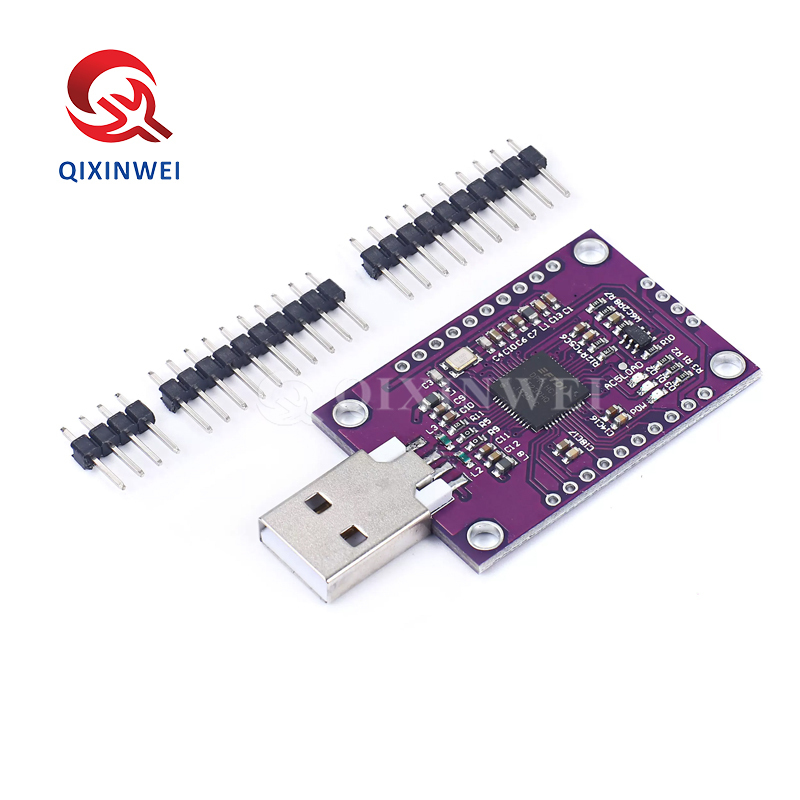
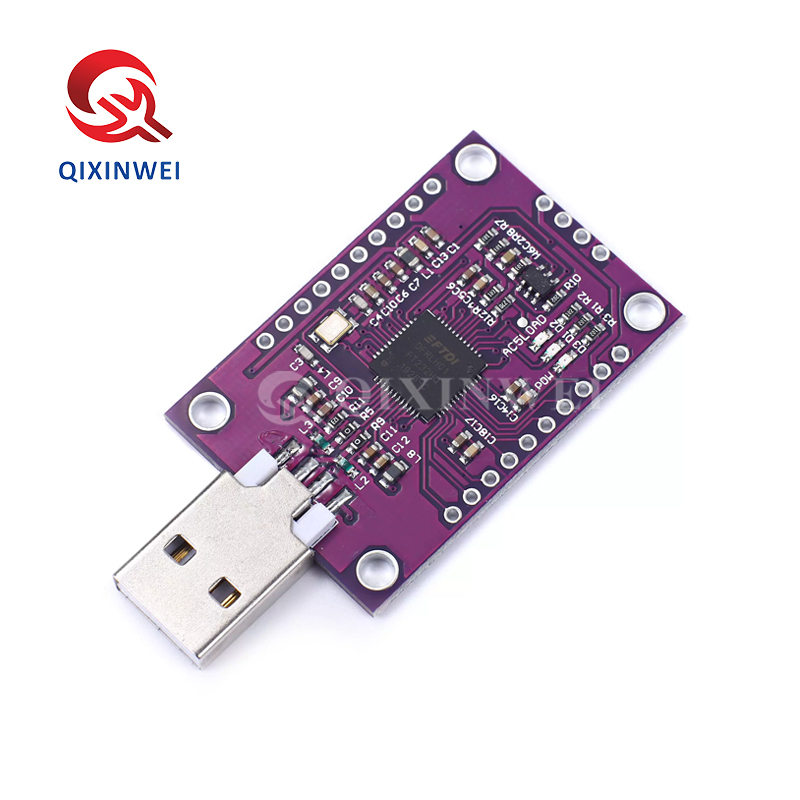
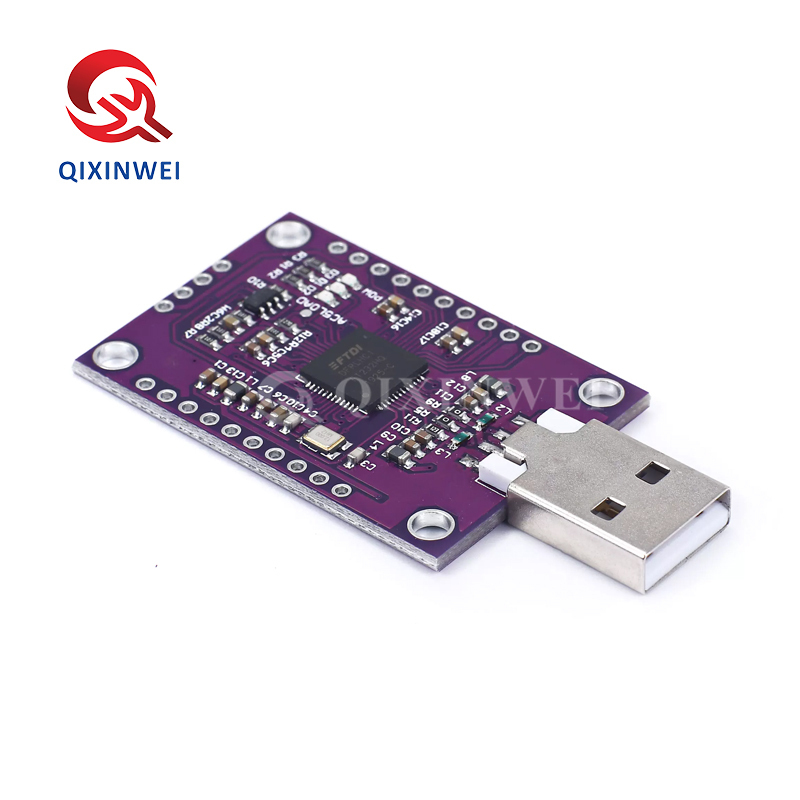
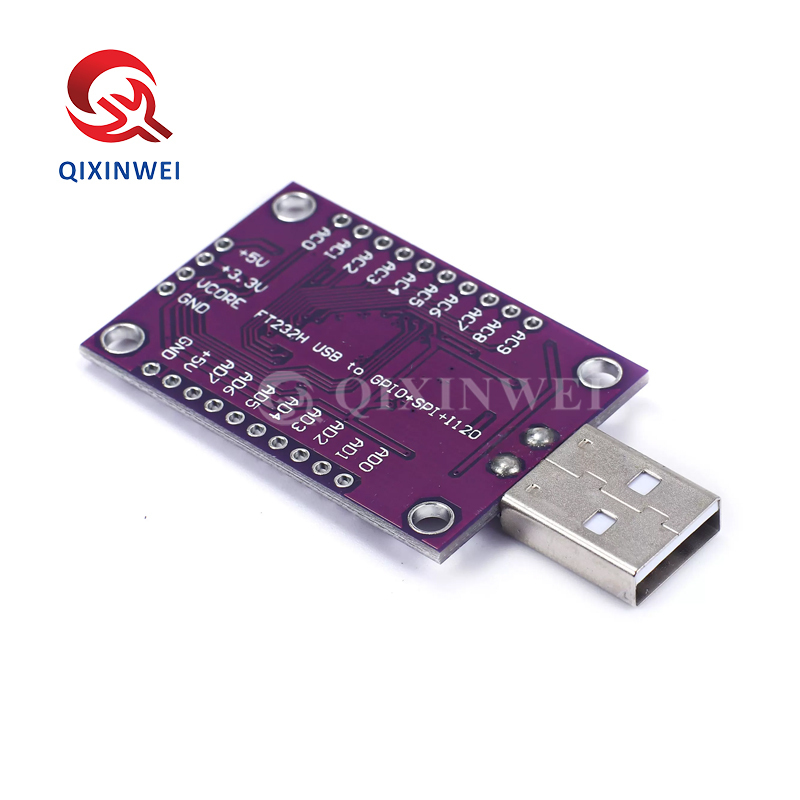
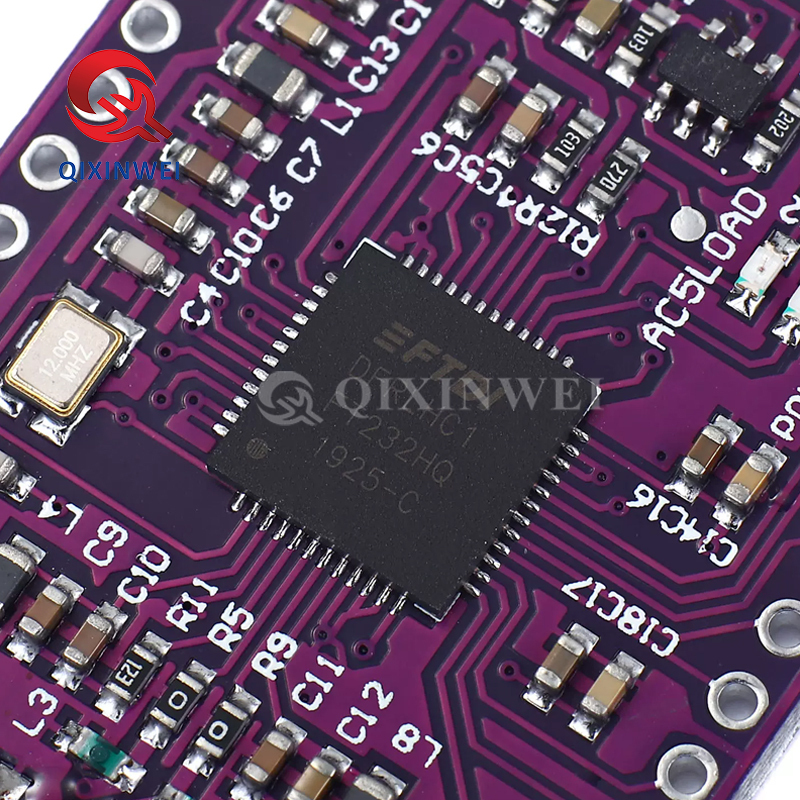
FT232H high-speed multi-protocol USB bridge supports JTAG/SPI/I2C/UART/FIFO with MPSSE technology, 480Mbps — ideal for FPGA debugging, Flash programming, and custom interface development
Core Chip
◆ Main IC
FT232H (FTDI 5th generation USB bridge chip)
◆ Core Technology
MPSSE (Multi-Protocol Synchronous Serial Engine)
◆ Package
QFN-48 / LQFP-48
◆ Development Modules
UM232H / CJMCU FT232H
USB Specifications
◆ USB Standard
USB 2.0 Hi-Speed (480Mbps) and Full Speed (12Mbps)
◆ Host Compatibility
UHCI/OHCI/EHCI compliant
◆ Transfer Mode
Bulk transfer (512-byte packets in Hi-Speed mode)
◆ Firmware Requirement
USB protocol handled on-chip — no USB firmware programming needed
Supported Protocols & Modes
◆ MPSSE Modes
JTAG (boundary scan / debug / programming)
SPI (Master mode)
I2C
Bit-Bang mode
◆ UART Mode
Data rate up to 12Mbaud
RS232/RS422/RS485 support
Full hardware handshaking
◆ FIFO Mode
Asynchronous 245 FIFO: 8MB/s
Synchronous 245 FIFO: 40MB/s
◆ Other Modes
CPU-style FIFO interface
FT1248 (half-duplex, 1/2/4/8-bit width)
Fast serial interface
Electrical Characteristics
◆ I/O Voltage
3.3V (5V tolerant inputs)
◆ Core Voltage
1.8V (built-in LDO regulator)
◆ Power Supply
Bus powered / Self powered
◆ I/O Drive Strength
Configurable 4/8/12/16mA
◆ Operating Temperature
-40°C ~ +85°C (industrial grade)
Driver Support
◆ VCP Driver
Virtual COM Port for legacy serial applications
◆ D2XX Driver
Direct API access for higher performance
◆ Operating Systems
Windows / Linux / macOS
◆ Third-Party Libraries
PyFtdi (Python), libftdi, OpenOCD
Onboard Resources (Module)
◆ USB Port
Micro USB / Mini USB (module dependent)
◆ I/O Header
2.54mm pin header
◆ EEPROM
External 93LC56 (configurable VID/PID)
◆ Indicators
Power LED / TX/RX LEDs (optional)
◆ Voltage Selection
3.3V/5V logic level jumper (on some modules)
Applications
◆ Embedded Debugging
FPGA/CPLD JTAG programming
ARM Cortex core debug
MCU on-chip emulation
◆ SPI Flash Programming
BIOS/firmware burning
Configuration memory read/write
◆ I2C Device Debugging
Sensor configuration and reading
EEPROM programming
◆ Custom USB Bridge
Industrial control equipment
Instrumentation interfaces
Test automation devices
Key Advantages
◆ One Chip for Multiple Protocols
Single chip supports JTAG/SPI/I2C/UART/FIFO
◆ High Speed Performance
USB 2.0 Hi-Speed 480Mbps for high bandwidth needs
◆ No Firmware Development
No USB firmware programming, focus on application
◆ Mature Ecosystem
OpenOCD, PyFtdi widely supported
◆ Industrial Grade Reliability
-40~85°C for harsh environments
◆ Cross-Platform Compatibility
Full driver support for Windows/Linux/macOS
◆ Dual Driver Options
VCP for legacy compatibility, D2XX for higher performance
Why Choose QIXINWEI
Years of experience in the electronics industry. Trusted by global customers.
Massive In-Stock Inventory – Ready to ship promptly
BOM Matching Service – One-stop solution, save time
PCBA Customization – Professional engineering team creates tailor-made solutions based on your needs
Cost-Effective & Efficient – Better channel, better cost
A dedicated team makes your procurement smoother.
Contact us for BOM quotes or PCBA inquiries



Quantity(Pieces) | 1 ~ 30000 | 30001 ~ 300000 | > 300000 |
Est. Time(days) | 5 | 7 | To be negotiated |

FAQ:
What is the FT232H USB bridge and its key specifications?
The FT232H is a single‑channel USB 2.0 Hi‑Speed (480 Mbps) to multi‑protocol serial/parallel bridge IC from FTDI. It integrates the MPSSE (Multi‑Protocol Synchronous Serial Engine) which enables flexible, high‑speed implementation of JTAG, SPI, I2C, UART, and FIFO interfaces directly from a USB host. Key features: USB 2.0 Hi‑Speed (480 Mbps) with a parallel FIFO bus up to 8‑bit wide, 60 MB/s throughput; support for standard JTAG (up to 30 MHz); MPSSE‑driven SPI master (up to 30 MHz) and I2C master; full UART with hardware flow control and data rates up to 12 Mbaud; on‑chip 1.8 V / 2.5 V / 3.3 V level shifters; and a single 5 V USB VBUS supply with integrated LDO regulators. It is widely used for FPGA debugging, Flash/EEPROM programming, and custom interface development.How does the FT232H differ from the FT232R or FT2232H?
The FT232R is a full‑speed (12 Mbps) UART‑only device with no MPSSE, suitable for basic serial links. The FT232H upgrades to USB Hi‑Speed (480 Mbps) and adds the MPSSE engine, enabling JTAG, SPI, I2C, and FIFO on a single channel. The FT2232H offers two independent MPSSE channels and more pins, making it ideal for dual‑protocol or high‑pin‑count applications. For most single‑interface high‑speed debugging, the FT232H provides the best cost‑performance balance. All three share the same FTDI D2XX driver stack and are supported by open‑source tools like OpenOCD and flashrom.How can I use the FT232H for JTAG debugging (e.g., with OpenOCD)?
The FT232H’s MPSSE can emulate a JTAG interface at up to 30 MHz TCK. Connect the FT232H’s ADBUS0 (TCK), ADBUS1 (TDI), ADBUS2 (TDO), and ADBUS3 (TMS) to the target’s JTAG header. In OpenOCD, configure the interface asftdiwith the proper layout. The FTDI D2XX driver must be installed, and on Linux you should use the libftdi library with the correct udev rules. This setup provides a reliable, low‑cost debug probe for ARM Cortex, RISC‑V, and FPGA devices. Many development boards (e.g., Xilinx, Intel FPGA) include an FT232H‑based onboard debugger.How do I program an SPI Flash memory with the FT232H?
The FT232H is a popular tool for in‑system programming of SPI NOR Flash. The MPSSE is configured as an SPI master at up to 30 MHz. Use software such as flashrom with theftdiprogrammer type. Connect the FT232H’s ADBUS0 (SCK), ADBUS1 (MOSI), ADBUS2 (MISO) to the Flash, and use a GPIO (e.g., ADBUS3 or ADBUS4) for CS#. Ensure the target board is powered (or use the FT232H’s 3.3 V output if the current is sufficient). This provides a fast, reliable way to read/write/erase SPI Flash chips for firmware recovery or embedded development.What is MPSSE technology, and how does it work?
MPSSE stands for Multi‑Protocol Synchronous Serial Engine. It is a programmable state machine inside the FT232H that generates clock, data, and chip‑select signals with precise timing. The host PC sends high‑level commands (e.g., “shift out 8 bits”, “read one byte”) over USB, and the MPSSE executes them at full hardware speed. This offloads the USB latency and CPU overhead, enabling deterministic, glitch‑free SPI, JTAG, and I2C waveforms. The MPSSE is controlled through the D2XX driver and libraries such as libftdi or pyftdi (Python), allowing custom protocol implementations without FPGA/CPLD hardware.What interfaces and protocols does the FT232H support?
The FT232H supports the following configurations, selectable by firmware or driver: 1) Asynchronous UART (RS232/RS485) with full hardware handshaking, up to 12 Mbaud. 2) Synchronous FIFO (8‑bit parallel bus) for high‑speed data streaming up to 60 MB/s. 3) MPSSE mode for JTAG (IEEE 1149.1), SPI master, and I2C master. 4) Bit‑bang mode for custom GPIO control. The UART and FIFO modes use the standard VCP (Virtual COM Port) driver, while MPSSE and bit‑bang require the D2XX direct driver. Most users employ open‑source libraries (libftdi, pyftdi, OpenOCD) to access the MPSSE.How do I install drivers and get started with the FT232H?
On Windows, download and install the FTDI D2XX driver from the FTDI website. For UART/VCP mode, the standard Virtual COM Port driver is used. On Linux, the kernel includes the ftdi_sio driver for UART and the libftdi library for MPSSE; ensure you add a udev rule to grant user access. On macOS, install libftdi via Homebrew. For quick testing, use pyftdi (Python) or OpenOCD to verify JTAG/SPI connectivity. Always ensure the FT232H is recognised as a USB device (VID 0x0403, PID 0x6014). A common mistake is conflicting drivers; if the device appears as a COM port but MPSSE fails, switch to the D2XX driver using the FTDI setup tool.What is the maximum data throughput of the FT232H in FIFO and MPSSE modes?
In synchronous 8‑bit FIFO mode, the FT232H can achieve a sustained throughput of up to 60 MB/s (480 Mbps USB 2.0 Hi‑Speed bandwidth). In MPSSE SPI mode, the maximum SCK frequency is 30 MHz, giving a theoretical peak of 3.75 MB/s (but practical throughput is limited by USB latency and command overhead, typically 1–2 MB/s for sustained transfers). For JTAG, the TCK can run at up to 30 MHz. The UART supports up to 12 Mbaud (about 1.2 MB/s). The actual performance depends on the host PC, USB controller, and driver efficiency.Can the FT232H be used for FPGA configuration and debugging?
Yes, it is one of the most popular uses. For Xilinx FPGAs, the FT232H can be used as a JTAG programmer with OpenOCD (for configuration and debugging) or with xc3sprog for SPI Flash programming. For Intel (Altera) FPGAs, it can replace a USB‑Blaster with OpenOCD. The FT232H also supports FTDI’s MPSSE‑SPI mode for direct configuration of many FPGAs via their slave‑serial or slave‑parallel interfaces. Many low‑cost FPGA development boards (e.g., the Lattice iCE40, Trenz modules, and various Chinese boards) integrate an FT232H as the onboard USB‑to‑JTAG/SPI bridge.What are the I/O voltage levels, and how do I interface with 1.8 V/2.5 V/3.3 V targets?
The FT232H includes on‑chip level shifters on the I/O pins. The VCCIO pin sets the I/O voltage for all digital pins. You can supply 1.8 V, 2.5 V, or 3.3 V to VCCIO (do not exceed 3.6 V). The core logic is powered from the USB VBUS (5 V) via an internal LDO. To interface with a target, connect the target’s VCCIO to the FT232H’s VCCIO pin (through a jumper or wire), ensuring the target powers this rail appropriately. The FT232H also provides a 3.3 V output (up to 50 mA) that can power small external circuits. For 5 V targets, you must use external level shifters because the FT232H I/O is not 5 V tolerant.How does the FT232H compare to other USB bridges like the CH347 or Cypress FX2?
The CH347 is a low‑cost Chinese alternative with similar MPSSE‑like functionality and higher SPI clock (up to 60 MHz), but its driver ecosystem and open‑source tool support are less mature. The Cypress FX2 (CY7C68013A) is an older USB 2.0 high‑speed device with a programmable 8051 core and GPIF, offering great flexibility but requiring complex firmware development. The FT232H provides a mature, well‑supported, and driver‑ready solution with extensive documentation, a huge user base, and compatibility with virtually all major open‑source JTAG/SPI tools. It is the de‑facto standard for reliable, no‑firmware‑development USB bridging.What are the most typical applications for the FT232H?
The FT232H is widely used in FPGA and CPLD JTAG debugging/programming, SPI Flash memory reading/writing, USB‑to‑UART/RS232/RS485 converters, USB‑to‑I2C bridges for sensor prototyping, custom test and measurement interfaces, and high‑speed data acquisition (FIFO mode). Its versatility and strong software ecosystem make it the go‑to bridge chip for developers who need to connect a PC to virtually any digital interface at high speed without writing embedded firmware.
- 原产地:
- Original
- 品牌:
- Original
- 制造商零件编号:
- FT232H Module
- 产品完成度类型:
- 模块
- 安装方式:
- 表面贴装
- 描述:
- 模块