qixinwei-pcba


DSPIC33FJ128GP706-I/PT Microchip dsPIC33F 16-Bit Digital Signal Controller 40MIPS 128KB Flash General Purpose PWM ADC TQFP-64
DSPIC33FJ128GP706-I/PT Product Overview
The DSPIC33FJ128GP706-I/PT is a Microchip general-purpose 16-bit Digital Signal Controller (DSC) in a 64-lead TQFP package, targeting industrial embedded applications that require 3.3V operation, large memory, multiple communication ports, and reliable real-time control. Based on the dsPIC33F core running at 40 MIPS, the DSPIC33FJ128GP706-I/PT integrates 128KB Flash and 16KB SRAM, comfortably hosting complex control algorithms, communication stacks, and real-time data buffering. On-chip peripherals of the DSPIC33FJ128GP706-I/PT include five 16-bit timers, four input captures, four output compares/PWM, a 10-bit ADC (up to 1.1 Msps, up to 16 analog input channels), and four analog comparators. Communication interfaces on the DSPIC33FJ128GP706-I/PT provide 2× UART, 2× SPI, and 2× I2C, all with Peripheral Pin Select (PPS) for flexible pin mapping and layout optimization. Operating from 3.0V to 3.6V with an industrial temperature range of -40°C to +85°C, in a TQFP-64 package, the DSPIC33FJ128GP706-I/PT suits general industrial control, sensor concentrators, communication gateways, digital power auxiliary management, and any real-time control system requiring large memory and rich peripherals.
DSPIC33FJ128GP706-I/PT Core Features
Processor Core: The DSPIC33FJ128GP706-I/PT features a 16-bit dsPIC33F core running at 40 MIPS, with a DSP-enhanced instruction set
Program Memory: The DSPIC33FJ128GP706-I/PT provides 128KB Flash
Data Memory: The DSPIC33FJ128GP706-I/PT includes 16KB SRAM
Timers & Signal Processing: The DSPIC33FJ128GP706-I/PT offers 5× 16-bit timers, 4× input capture, and 4× output compare/PWM
Analog Front-End: The DSPIC33FJ128GP706-I/PT features a 10-bit ADC (1.1 Msps, up to 16 channels) and 4 analog comparators
Communication Interfaces: The DSPIC33FJ128GP706-I/PT supports 2× UART, 2× SPI, and 2× I2C, with Peripheral Pin Select (PPS)
System Management: The DSPIC33FJ128GP706-I/PT includes a watchdog timer, BOR/POR, on-chip oscillator, and hardware CRC
General Purpose I/O: The DSPIC33FJ128GP706-I/PT provides up to 53 programmable I/O pins
Power & Package: The DSPIC33FJ128GP706-I/PT operates from 3.0V – 3.6V, in TQFP-64 (10mm×10mm), industrial -40°C to +85°C
DSPIC33FJ128GP706-I/PT Applications
Industrial Automation: The DSPIC33FJ128GP706-I/PT excels in sensor interfaces, process controllers, distributed I/O modules, and multi-axis motion control assistance
Communication Protocol Conversion: The DSPIC33FJ128GP706-I/PT is ideal for multi-UART/SPI/I2C bridges and industrial Ethernet gateway co-processors
Digital Signal Processing: The DSPIC33FJ128GP706-I/PT handles real-time audio processing, digital filtering, FFT analysis, and software-defined radio front-ends
General Real-Time Control: The DSPIC33FJ128GP706-I/PT suits compact embedded systems needing large memory and multiple communication ports
DSPIC33FJ128GP706-I/PT Key Advantages
Large Memory for Unrestricted Computation: The DSPIC33FJ128GP706-I/PT's 128KB Flash and 16KB SRAM provide generous space for complex algorithms, data logging, and multi-protocol stacks, reducing code optimization pressure from memory constraints.
Flexible Signal Generation & Measurement: The DSPIC33FJ128GP706-I/PT's four output compares/PWM generate multiple independent PWM signals, and four input captures handle frequency/duty-cycle measurement, meeting general control, simple motion control, and power sequencing needs.
Enhanced Analog Front-End: The DSPIC33FJ128GP706-I/PT's 16-channel 10-bit ADC paired with four analog comparators delivers a complete single-chip solution for multi-sensor acquisition and fast fault response.
Rich Communication Interfaces + PPS: The DSPIC33FJ128GP706-I/PT's 2× UART, 2× SPI, and 2× I2C can all be flexibly remapped, serving as a multi-protocol communication hub while retaining a debug console, simplifying system interconnect.
TQFP-64 High Integration: The DSPIC33FJ128GP706-I/PT's 10mm×10mm standard package provides up to 53 I/Os, suitable for medium-density PCB layouts and automated production.
Mature Development Toolchain: The DSPIC33FJ128GP706-I/PT is supported by free MPLAB X IDE and XC16 compiler, combined with MCC, DSP libraries, and peripheral libraries, enabling rapid progress from prototype verification to production.
Long-Term Availability: The DSPIC33FJ128GP706-I/PT is a mature dsPIC33F family product with stable long-term supply commitment.
Why Choose QIXINWEI
Years of experience in the electronics industry. Trusted by global customers.
Massive In-Stock Inventory – Ready to ship promptly.
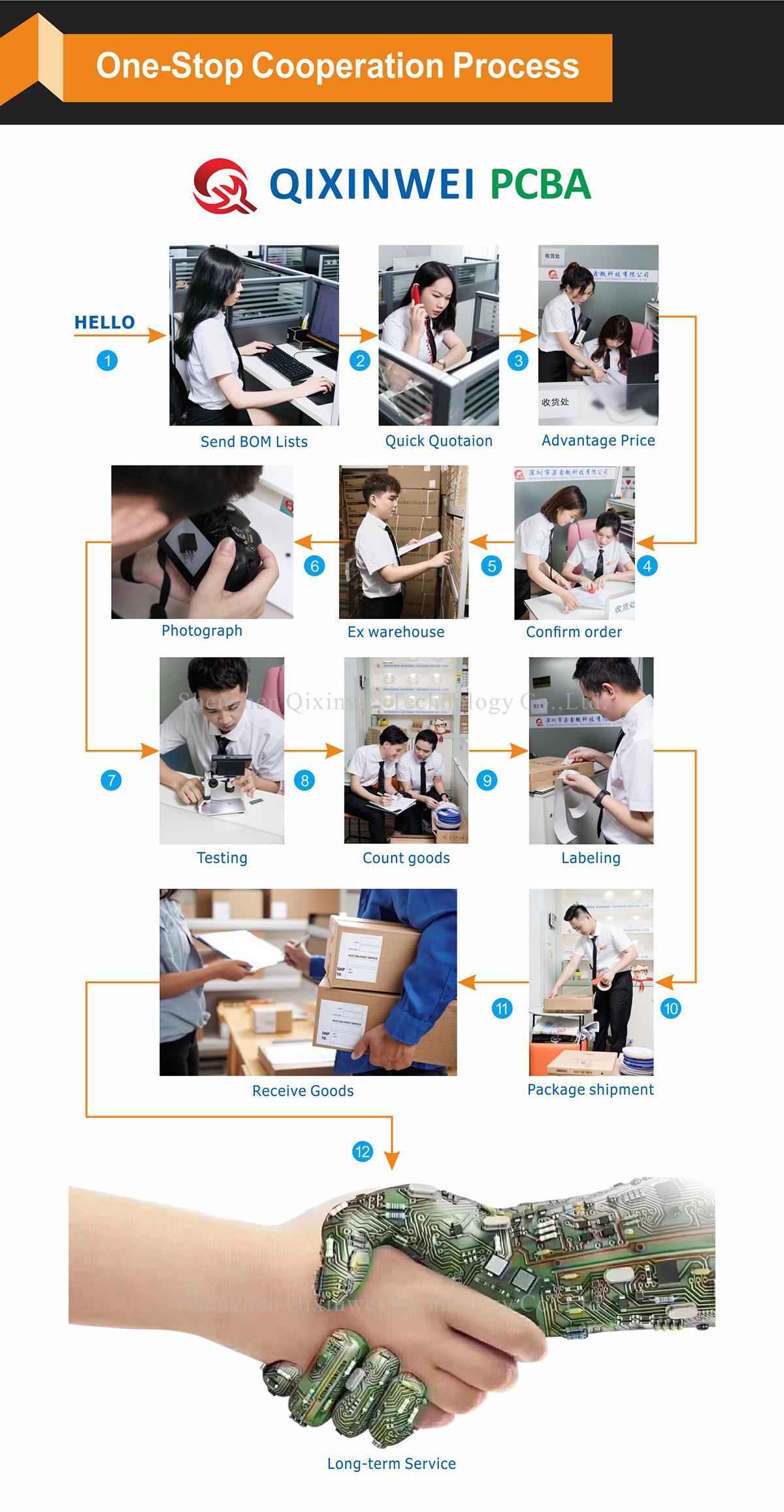
BOM Matching Service – One-stop solution, save time.
PCBA Customization – Professional engineering team creates tailor-made solutions based on your needs.
Cost-Effective & Efficient – Better channel, better cost.
A dedicated team makes your procurement smoother.
Contact us for BOM quotes or PCBA inquiries.




FAQ
- What is the core difference between the DSPIC33FJ128GP706 and the GP706A in the context of the DSPIC33FJ128GP706-I/PT?
- DMA: The DSPIC33FJ128GP706-I/PT has no DMA controller, so all data transfers must be handled by the CPU; the GP706A features a 4-channel DMA for automatic data movement.
- Capture/Compare channels: The DSPIC33FJ128GP706-I/PT provides 4 input captures and 4 output compares/PWM; the GP706A offers 9 captures and 9 compares, making it better suited for complex multi-channel timing control.
- Remaining peripherals: Flash, SRAM, ADC, analog comparators, and communication interfaces are identical, and the packages are fully compatible.
- If your application does not involve extensive background data transfers or a very high number of PWM channels, the DSPIC33FJ128GP706-I/PT is more than sufficient for most industrial control needs.
- Will the lack of DMA cause problems for high-speed ADC acquisition on the DSPIC33FJ128GP706-I/PT?
- Not having DMA does not prevent high-speed acquisition. The CPU can respond to ADC interrupts and read results after each conversion. 40 MIPS is sufficient to handle data movement and basic processing at moderate sample rates (e.g., 200-500 ksps).
- If an application requires continuous acquisition above 1 Msps while the CPU simultaneously runs complex algorithms, then an enhanced model with DMA (such as the GP706A) would be more appropriate.
- What functions can the 4 output compares of the DSPIC33FJ128GP706-I/PT achieve?
They can generate four independent PWM signals for LED dimming, multiple brushed DC motor speed control, stepper motor control (with external drivers), or power sequencing. Meanwhile, the four input captures can measure the frequency and duty cycle of external signals. - Can the DSPIC33FJ128GP706-I/PT run complex algorithms? Is the memory sufficient?
128KB Flash and 16KB SRAM is a very large configuration among general-purpose DSCs, fully accommodating digital filters, FFT, complex control logic, and dual protocol stacks, and even supporting a lightweight RTOS (e.g., FreeRTOS), providing ample room for long-term product feature evolution. - Can the DSPIC33FJ128GP706-I/PT be used to control a 3-phase motor?
The output compare modules lack complementary outputs and hardware dead-time insertion, making them unsuitable for directly driving a 3-phase BLDC/PMSM inverter bridge. However, it can certainly control brushed DC motors, stepper motors (with external drivers), or act as a supervisory motion controller sending commands to dedicated motor-drive chips. - How many communication interfaces does the DSPIC33FJ128GP706-I/PT have? Can it perform multi-protocol conversion simultaneously?
It provides 2× UART, 2× SPI, and 2× I2C, all with flexible PPS mapping. For example, one UART can be used for debugging, another for RS-485, an SPI for external ADC/DAC, and I2C for sensors or EEPROM, easily achieving multi-protocol conversion. - What tools are needed to develop and debug with the DSPIC33FJ128GP706-I/PT?
- Free MPLAB X IDE and MPLAB XC16 compiler for the DSPIC33FJ128GP706-I/PT.
- Hardware debuggers: PICkit 4 or MPLAB ICD 4, supporting in-circuit programming and real-time debugging.
- MPLAB Code Configurator (MCC) graphically generates peripheral drivers, and DSP libraries provide extensive signal processing functions.
- What is the size and soldering difficulty of the TQFP-64 package of the DSPIC33FJ128GP706-I/PT?
- Package body is 10mm×10mm with 0.5mm pin pitch, classified as a medium-density QFP.
- Standard reflow soldering processes achieve high yield. Hand soldering is also possible using flux and drag-soldering techniques.
- Does the DSPIC33FJ128GP706-I/PT require external clock or reset circuitry?
- Built-in high-accuracy on-chip oscillator and PLL enable stable operation without an external crystal, saving PCB space and BOM cost.
- Integrated Power-on Reset (POR) and Brown-out Reset (BOR) ensure reliable start-up without an external reset IC.
- What new designs is the DSPIC33FJ128GP706-I/PT suitable for?
The DSPIC33FJ128GP706-I/PT suits mid-to-high-end embedded projects that do not require DMA but value large memory, multiple communication interfaces, and general-purpose control functions, such as industrial gateways, process controllers, sensor concentrators, and digital power auxiliary management. The dsPIC33F architecture is mature with abundant reference designs, helping shorten time-to-market.
- Property:
- Specification
- Product Type:
- 16-bit Digital Signal Controller (DSC)
- Brand:
- Microchip
- Core Architecture:
- 16-bit dsPIC33F core, 40 MIPS
- Program Memory:
- 128KB Flash
- Data RAM:
- 16KB SRAM
- Timers & Signal Processing:
- 5× 16-bit timers, 4× input capture, 4× output compare/PWM
- ADC:
- 10-bit, 1.1 Msps, up to 16 channels
- Analog Comparators:
- 4 analog comparators
- Communication Interfaces:
- 2× UART, 2× SPI, 2× I2C, with PPS
- Operating Voltage & Package:
- 3.0V – 3.6V, TQFP-64, -40°C to +85°C