Electronic components
CPU vs MCU vs MPU: What Separates Them and How to Pick the Right One
Engineers and procurement managers run into these three acronyms constantly, and the lines between them blur fast. CPU, MCU, MPU. They all process data, but they target completely different jobs. Get the distinction wrong and you either overpay for compute you will never use, or spec a chip that stalls your project at the prototype stage.
What each term actually means
CPU (Central Processing Unit)
The CPU is the oldest and broadest term. At its core, it is the logic unit that fetches and executes instructions in a computing system. When you run an Intel desktop chip or the ARM core inside a phone, you are running a CPU.
In procurement terms, "CPU" usually means a high performance general purpose processor that needs external DDR memory and a chipset to function. Intel Core and AMD Ryzen are the obvious examples. On the China domestic side, Loongson 3A6000 and Phytium FT-2000 fill the same role.
The CPU design goal is maximum compute. The tradeoff is power and cost. A Core i9 pulls 250W under load, which makes it a non starter for a battery powered sensor node.
MCU (Microcontroller Unit)
An MCU crams a CPU core, Flash memory, SRAM, and peripheral interfaces (UART, SPI, I2C, ADC, timers, PWM) onto a single die. Power it up and it runs. No external memory required.
ST's STM32 family is the reference point for the category. The F103C8T6 is the chip nearly every electrical engineering student has handled: a few dollars, Cortex-M3 core, 72MHz, 64KB Flash, 20KB SRAM. Enough to run a motor controller or a temperature logger.
MCUs target low power, low cost, control oriented tasks. Most run bare metal code or a lightweight RTOS like FreeRTOS or RT-Thread, not Linux. There are exceptions: STM32H7 reaches 480MHz and can run a stripped down Linux with external SDRAM.
MPU (Microprocessor Unit)
The MPU definition overlaps the most with CPU. In simple terms, an MPU is also a processor chip, but unlike an MCU it does not integrate Flash and RAM. It needs external memory (DDR, eMMC, NAND) to operate. Its compute tier sits above MCU and below desktop CPU, aimed at embedded applications.
Rockchip RK3588 is the textbook MPU/SoC. Eight cores (four Cortex-A76 plus four Cortex-A55), 8nm process, a 6TOPS NPU, 8K video decode. It has no built in bulk Flash, so it boots from external eMMC or NAND and uses external LPDDR4/LPDDR5 as working memory. It runs Linux or Android.
MPU and SoC get used interchangeably. RK3588 integrates CPU cores, GPU, NPU, VPU, and ISP, so "SoC" is technically more accurate. But the industry lumps these high performance embedded processors under MPU.
Where they split: six dimensions
Integration
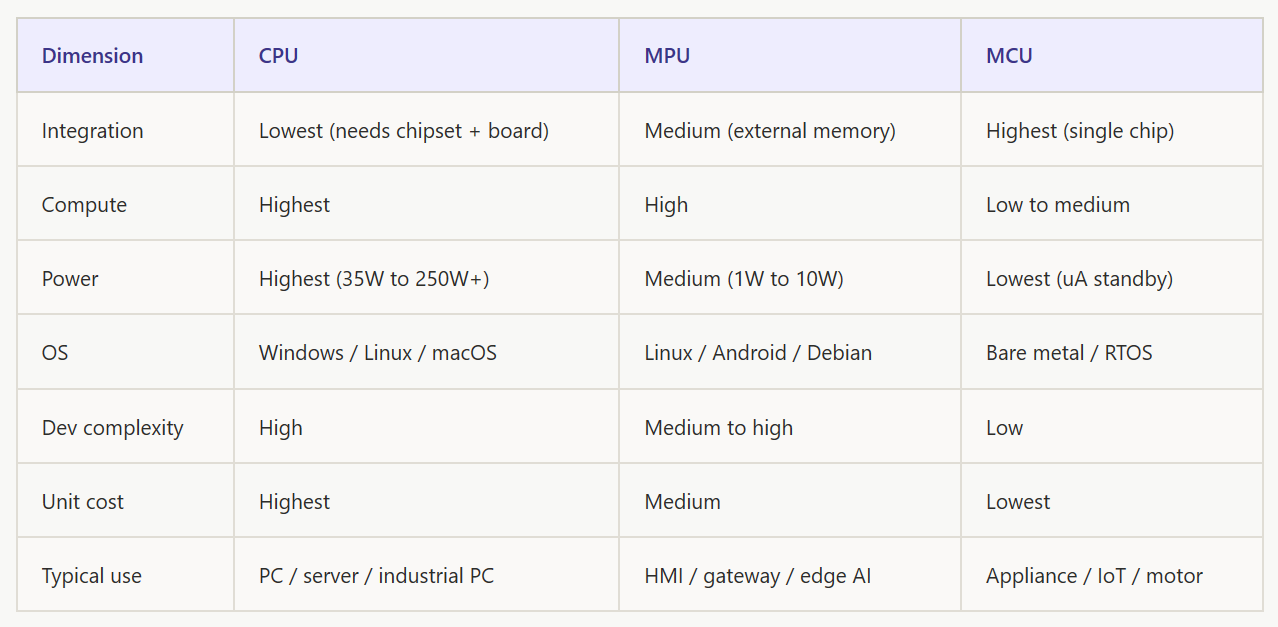
MCU wins. An STM32F103 carries core, Flash, SRAM, and peripherals on one die. MPU comes next: it integrates the processor and some high speed interfaces (PCIe, USB 3.0, HDMI) but needs external memory. CPU has the lowest on die integration and depends on a chipset and board.
Compute
CPU leads. An i7-13700K multi core score reaches several million points; RK3588 is a fraction of that. MCU trails: STM32F103 at 72MHz Cortex-M3 lands around 90 DMIPS, while RK3588's Cortex-A76 single core clears 600 DMIPS. The gap is an order of magnitude.
Power
MCU sits lowest. STM32L series hits microamp standby, so a coin cell can run it for years. MPU is middle: RK3588 draws 5 to 8W at full load, hundreds of milliwatts idle. CPU tops out: desktop parts pull tens to hundreds of watts and need active cooling.
OS and development
MCU runs bare metal or RTOS; one engineer handles register setup and interrupts. MPU runs Linux or Android, which means device trees, drivers, filesystems, and application layers. CPU runs anything, but low level hardware adaptation is not trivial and usually needs board vendor support.
Common brands and models
Specifications below are typical values. Always confirm against the latest datasheet before committing to a design.
CPU brands and models
Intel — Core i7-13700K (16 cores, up to 5.4GHz, desktop), Core i9-13900K (24 cores, workstation), Xeon Gold 6348 (28 cores, server, ECC), and Atom x6000E for embedded low power.
AMD — Ryzen 9 7950X on a 5nm process for desktop and workstation, Ryzen Embedded V2000 for embedded, and EPYC at the server tier.
ARM — not a chipmaker but the licensor of the Cortex-A78, Cortex-A710, and Cortex-A520 cores that power phone SoCs and embedded MPUs.
Qualcomm — Snapdragon 8cx compute platform for Windows on ARM, plus Snapdragon 410 and 610 for IoT.
Loongson — 3A6000 (4 cores, LoongArch, China domestic) and the earlier 3A5000.
Phytium — FT-2000/4 (4 cores, ARMv8, China domestic) and the server grade FT-2000+.
MPU brands and models
RK3588 family from Rockchip — RK3588 (8 cores, 6TOPS NPU, 8K decode), trimmed RK3588S, RK3568 (4×A55, industrial HMI and gateways), cost optimized RK3566, mature RK3399, and legacy-volume RK3288.
NXP — i.MX 8M Plus (4×A53 + M7, 2.3TOPS NPU, automotive grade), i.MX 8M Mini (no NPU), i.MX 6ULL (single A7, low cost), and crossover i.MX RT1170.
Allwinner — H616, H6, and A64 for boxes and tablets, plus the dual A7 industrial R528.
Texas Instruments — Sitara AM3358 with PRU real time blocks, AM625, and AM6442.
STMicroelectronics — STM32MP157 (2×A7 + M4, industrial) and cost optimized single A7 STM32MP135.
Renesas — RZ/G2L (2×A55, industrial) and RZ/A2 (display).
Amlogic — S905X4 (4×A55, OTT) and S922X (A73 + A53, compute).
MCU brands and models
STMicroelectronics — entry level Cortex-M3 STM32F103, mid range Cortex-M4 STM32F407, 480MHz Cortex-M7 STM32H743, ultra low power STM32L4, and cost optimized STM32G0.
STC (China domestic, 8051) — enhanced 8051 STC8H8K64 and 32-bit 8051 STC32G12K128.
GigaDevice (China domestic) — Cortex-M4 GD32F303 with STM32 pin compatibility, Cortex-M3 GD32F103 as a near clone, and cost Cortex-M23 GD32E230.
Espressif — dual core ESP32-S3, RISC-V ESP32-C3, and WiFi 6 ESP32-C6, all with BLE.
Microchip — 8-bit PIC16F877A and PIC18F46K22, Arduino standard AVR ATmega328P, and Cortex-M0+ SAMD21.
NXP — LPC1768 (Cortex-M3), Kinetis K64 (Cortex-M4), and crossover i.MX RT1060 (Cortex-M7).
Renesas — general purpose RX65N and secure Cortex-M33 RA6M5.
Infineon — XMC4800 (Cortex-M4, industrial Ethernet) and multi-core automotive AURIX TC375.
Texas Instruments — ultra low power 16-bit MSP430F5529 and Cortex-M4 TM4C123.
Nordic Semiconductor — nRF52840 (Cortex-M4, BLE, Thread, Zigbee).
Silicon Labs — low power Gecko EFM32GG (Cortex-M3).
How to choose
The decision comes down to four questions: what OS does the project need, how much compute, what is the power budget, what is the cost ceiling.
Need Linux or Android: pick an MPU. RK3588 for AI inference and video pipelines; RK3568 for HMI and gateways where cost matters; NXP i.MX 8M Plus when automotive grade certification is mandatory.
Only doing control, sensing, or comms: pick an MCU. STM32F103 or STC8H for low power cost sensitive jobs. ESP32-S3 for any IoT node that needs WiFi and BLE. STM32H7 for motor control or digital power that needs real compute without Linux.
Need Windows or heavy industrial software: pick an x86 CPU. Intel Core or Xeon on an industrial motherboard. MCU and MPU cannot carry this load.
One edge case worth flagging: RK3588 also embeds a Cortex-M0 that runs real time tasks while the A cores run Linux. Hybrid big.LITTLE plus MCU core designs are getting common, which erodes the hard line between MPU and MCU. Do not get hung up on the label. Read the spec sheet for the part you are actually buying.
Procurement notes
Spec sheets are not the whole story. A few practical points matter on a real BOM.
Supply stability. STM32F103 spiked from a few dollars to tens of dollars during the 2021 shortage, and plenty of projects were forced to re-qualify parts. Track original factory capacity and inventory, or work with a distributor who can buffer stock.
Package and temperature grade. Industrial (-40 to 85C) costs more than commercial (0 to 70C), and automotive (AEC-Q100) more still. Match the grade to the actual environment. Do not pay automotive prices for a consumer product.
Replacement feasibility. GD32 covers some STM32 parts, and ESP32 can replace some WiFi MCU schemes. But drop in is not automatic. Verify firmware compatibility, peripheral differences, and electrical characteristics. Line down incidents from careless substitution are not rare.
FAQ
1. What is the actual difference between a CPU and an MPU?
A CPU is the general term for the instruction executing core. An MPU is that core packaged as a standalone processor chip, typically without integrated memory, aimed at embedded use. In practice, "CPU" points to desktop and server parts, "MPU" to embedded application processors. The boundary is softening because Cortex-A cores appear in both phone SoCs and parts like RK3588.
2. Can an MCU run Linux?
Most MCUs lack an MMU, so standard Linux will not boot. A few high end MCUs (STM32H7 with external SDRAM) can run uClinux or RT-Thread SMP. If you need Linux, an MPU is the cleaner choice.
3. Is RK3588 a CPU or an MPU?
It is an MPU/SoC. It contains CPU cores (Cortex-A76 and A55) but as a chip it needs external memory to function and targets embedded applications. Calling it an MPU is more precise; SoC is also correct.
4. Can domestic MCUs replace STM32?
Some can. GD32F303 matches STM32F303 on pins and most peripherals, but Flash size and certain register definitions differ, so porting needs validation. STC runs a completely different 8051 architecture, so it is a functional alternative, not a pin to pin drop in.
5. How do I choose between RK3568 and RK3588?
Pick RK3588 when you need the 6TOPS NPU and 8K video pipeline. Pick RK3568 for HMI and gateways where cost dominates; it carries dual Gigabit Ethernet and CAN bus that cover most industrial needs, and its field volume and stability are better established than RK3588.
6. What MCU should I use for a battery powered IoT sensor?
Look at STM32L4 or STM32U5 for ultra low power, or ESP32-C3 / ESP32-C6 when you need wireless. Both run for years on a coin cell or small Li battery in sleep heavy duty cycles.
7. Is an RTOS required on an MCU?
No. Many MCUs run a bare metal super loop (while(1)). An RTOS like FreeRTOS or RT-Thread becomes worth it when you have multiple concurrent tasks with timing constraints.
8. Why would I pick an x86 CPU over an ARM MPU?
x86 gives you the widest software compatibility, including Windows and legacy industrial applications. If your product must run existing x86 software or needs PCIe peripherals with mature drivers, x86 is the safer bet despite higher power draw.
9. What does AEC-Q100 mean for processor selection?
It is the automotive reliability standard. Parts certified to AEC-Q100 are qualified for the temperature cycling, vibration, and lifetime demands of vehicle applications. For non automotive products it is usually unnecessary cost.
10. How do I avoid getting burned by a component shortage?
Diversify your BOM across at least two sources, qualify a second supplier or pin compatible alternative during design rather than during a crisis, and keep buffer stock through a distributor with factory direct relationships. Watch lead times on long cycle parts like automotive grade MCUs and certain MPUs.
Spec sheets look similar on paper but behave differently in production. Datasheet numbers and mass production stability are not the same thing. If you are building a BOM, hunting for alternates, or unsure whether a specific part fits your project, talk to Shenzhen Qixinwei Technology Co., Ltd. (QIXINWEI). We have spent years in electronic component distribution and selection support, covering Rockchip, ST, STC, Espressif, Intel, NXP, GigaDevice, and more. We help you step back from the parameter table and make calls based on real supply and cost. Spot stock and PCBA customization are part of the package.
0users like this.