Electronic components
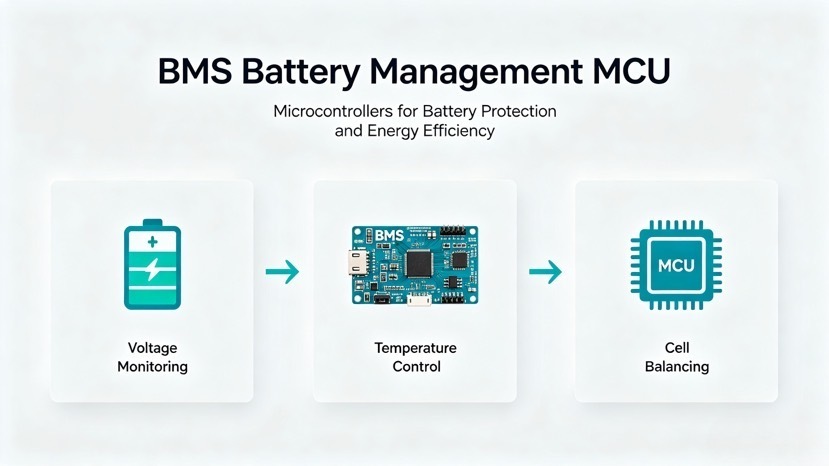
How to Select a BMS Battery Management MCU? Selection Criteria and Popular MCU/AFE Models
Anyone who has designed a battery management system (BMS) has run into the same pain points: a technical reviewer questioning whether the selected MCU is truly fit‑for‑purpose, supply‑chain teams asking for a drop‑in replacement for the LTC6813, or endless scrolling through component lists with no clear starting point for model selection.
BMS design is far different from consumer‑electronics development. A poor component choice can trigger inaccurate SOC calculations, abnormal temperature‑monitoring performance, or failures in functional‑safety audits — forcing you to restart the entire battery‑pack design from scratch.
This article addresses these challenges in two parts. The first section outlines the critical criteria for BMS‑MCU selection. The second compiles widely‑adopted MCUs and AFEs from real‑world implementations, and matches each device to its typical use‑case scenarios. Whether you are developing automotive battery packs, ESS cabinets, light‑EV systems or industrial backup power solutions, you will find viable hardware combinations for your project.
1. How MCU and AFE divide the work in a BMS
A BMS rests on two core chips: an MCU that computes and controls, and an AFE that samples and balances. A common mistake is spending all the effort on the MCU while the AFE — the component that decides sampling accuracy — gets picked almost as an afterthought. If the AFE is wrong, no MCU can recover the raw data.
The AFE (analog front end) measures per-cell voltage and temperature and runs passive balancing, usually daisy-chained over isoSPI or a similar isolated bus for multi-cell packs. The MCU runs SOC/SOH estimation, schedules balancing, controls charge/discharge, and handles CAN or daisy-chain communication. They are a pair; select them together.
2. What to look at when selecting a BMS MCU
Sampling accuracy and ADC handling The MCU's own ADC is usually not enough for high-precision cell measurement; that job sits with the AFE. The MCU must reliably receive and process the AFE stream, with digital filtering and calibration. Check that the MCU has enough resolution and a fast enough interface to absorb AFE data without bottlenecks.
Balancing workload Passive balancing is simple and light on the MCU. Active balancing pushes scheduling, thermal management and energy-transfer control onto the MCU, which raises the bar on compute and real-time response. Do not throw a passive-only MCU at an active-balancing design.
Functional safety: ASIL and lockstep Automotive packs and ESS often target ISO 26262 ASIL C or ASIL D. That calls for lockstep cores, ECC memory and hardware self-test. This is exactly why TI TMS570, NXP S32K3 and Infineon AURIX TC3xx — all with lockstep — dominate automotive BMS.
Isolated communication and daisy chain In a multi-cell pack, the AFE-to-MCU link runs over isolated communication. ADI isoSPI and NXP daisy chain are the mainstream options. The MCU side needs the right interface and timing headroom, which also sets how many AFEs — and therefore how many cells — you can manage.
Temperature range and reliability AEC-Q100 Grade 1 (-40°C to 125°C) is the norm for automotive; some powertrain scenarios need Grade 0 (-40°C to 150°C). ESS is less extreme thermally but demands long service life, so component drift and long-term supply stability matter.
Long-term availability Automotive and ESS programs run for years. Both MCU and AFE need a credible lifecycle commitment from the vendor. It pays to qualify a Pin-to-Pin or ecosystem-compatible backup early, so a future EOL does not stall production.
3. Popular MCU models
TI (Texas Instruments) TI TMS570 (Hercules) is a long-standing name in functionally safe automotive MCUs — ASIL D, lockstep cores — and a default choice for high-safety powertrain and ESS masters. Searches for "TI TMS570 BMS" almost always point to high-safety designs. C2000 (e.g. F28004x) handles real-time power and motor control and shows up on the BMS control side. MSP430 fits low-power sensing nodes.
NXP NXP S32K1 is the mid-range workhorse for body and battery nodes; S32K3 adds multi-core lockstep up to ASIL D and is the high-frequency model in "NXP S32K3 BMS solution" searches, covering both powertrain and ESS. MPC5777, a Power-architecture veteran, still carries real volume in high-voltage battery roles.
Infineon Infineon AURIX TC3xx (typically TC397) is a regular in pack-level and powertrain masters — multi-core lockstep, strong functional safety. "Infineon AURIX TC397 BMS" searches mostly return high-voltage pack designs. Traveo II leans toward body and peripheral control and appears in some BMS-adjacent roles.
STMicroelectronics SPC58 and Stellar SR6 serve powertrain and electrification and are ST's main automotive BMS parts. STM32 sees heavy use in engineering validation and light or prototype builds; its automotive-grade variants are a separate line.
Renesas RH850 is a traditional powertrain and body mainstay; RL78 covers low-cost nodes and appears in some BMS slave and sensing roles.
Microchip PIC and ATSAM have automotive-grade versions used in body comfort and some control nodes, with limited but present BMS-adjacent adoption.
China-based vendors This group has moved fast and is no longer just "usable" — several are in mass production. AutoChips AC784x / AC781x are automotive MCUs already in BMS, " C*Core CCFC targets Power-architecture powertrain/battery scenarios and has landed in battery management. SemiDrive E3 serves zonal control and safety islands and can act as BMS master or co-processor. HDSC HC32A, GigaDevice GD32A and ChipON KF32A all have automotive-grade parts in progress, used in BMS-adjacent and light-ev roles. BYD Semiconductor supplies its own vehicle BMS and also sells chips externally.
4. Popular AFE models
The AFE decides sampling accuracy, so this choice carries outsized weight.
ADI ADI is effectively the benchmark in BMS AFEs. LTC6810 (12 cells), LTC6811 (12 cells, isolated), LTC6812 (15 cells) and LTC6813 (18 cells) daisy-chain over isoSPI to manage dozens or hundreds of cells. "ADI LTC6813 BMS pairing" and "LTC6810 BMS" return an overwhelming number of designs. MAX17843 is another automotive-grade AFE option.
NXP NXP MC33771 and MC33774 (collectively MC3377x) are NXP's own BMS AFEs with daisy-chain communication, typically paired with S32K into a complete solution — "NXP MC3377x BMS" is the canonical combo.
TI TI BQ79616 and BQ79656 (BQ796xx family) are automotive BMS AFEs with isolated communication, fitting TI's own MCU ecosystem.
China-based vendors Sinowealth and Cellwise are in mass production on battery gauging and BMS AFEs, heavily used in light-ev and portable. BYD Semiconductor supplies its own vehicle BMS AFE and also sells externally. Others such as Datang NXP are also building in this space.
5. Typical combinations by scenario
- Automotive powertrain pack: Infineon AURIX TC397 + ADI LTC6813, ASIL D, high-voltage multi-cell; or NXP S32K3 + NXP MC3377x as a native pair.
- Energy storage system (ESS): NXP S32K3 + MC3377x, or TI TMS570 + ADI LTC68xx — reliability and lifespan first.
- Light-ev / e-bike: AutoChips AC784x + Sinowealth / Cellwise AFE, cost-sensitive, passive balancing.
- Industrial / telecom backup: ST SPC58 or a China-based automotive MCU + industrial-grade AFE, stability first.
- R&D / prototype: STM32 + ADI LTC681x, fast development, abundant references.
5.1 Application Examples
The following are solution-level illustrations based on common industry practice, not specific customer records. Always verify against the original Datasheet and testing for any specific project.
Example 1: Cost reduction in an e-bike An e-bike OEM was tied to an imported MCU with long lead times and high unit cost. Moving the master to AutoChips AC784x with a Sinowealth battery-gauge AFE, passive balancing, cut BOM cost noticeably and shortened development. E-bike BMS rarely needs high ASIL, so cost and availability lead.
Example 2: Commercial ESS through certification A commercial ESS cabinet prioritized lifespan and field reliability. The design used NXP S32K3 with MC3377x as a native pair — same ecosystem, simpler toolchain and comms — with functional safety and long-term supply handled on an automotive-grade track, resulting in near hands-off field operation.
Example 3: Automotive pack targeting ASIL D A passenger-car pack with high voltage and many cells required ASIL D. The master was Infineon AURIX TC397 with lockstep and ECC; the AFE was ADI LTC6813 daisy-chained over isoSPI at 18 cells per chip. Sampling and balancing rode a mature chain, smoothing the safety audit.
Example 4: Prototyping to validate algorithms A university and a startup validating BMS algorithms cared about speed, not automotive grade. They built an eval board with STM32 and ADI LTC681x — abundant references and examples — and got SOC algorithms running within weeks, then moved to automotive-grade parts for production.
6. Mistakes to avoid
High clock speed is not the point. A BMS MCU is judged on functional safety and stability, not benchmark scores. Lockstep and ECC beat megahertz.
Ignoring the AFE dooms the project. Sampling accuracy and balancing live in the AFE; it deserves top priority in the selection order.
Passive balancing is not universal. In large packs with high capacity and tight thermal budgets, its limits show quickly — and active balancing needs a MCU with enough headroom to schedule it.
SOC is not a simple coulomb count. Current integration drifts; you need OCV correction, temperature compensation and a cell model, so budget MCU algorithm resources accordingly.
Consumer-grade parts do not belong in automotive BMS. Temperature range, failure rate and traceability are far apart; stick to AEC-Q100 and OEM qualification.
Pin-to-Pin does not mean drop-in. A automotive BMS part swap forces re-qualification through AEC-Q100, functional safety and OEM approval, plus re-validation of the sensing chain, algorithm and temperature range. Qualify a backup early.
7. FAQ
Q1: What do the MCU and AFE each do in a BMS?
The AFE measures per-cell voltage and temperature and runs passive balancing. The MCU runs SOC/SOH, schedules balancing, controls charge/discharge and handles communication. Select them as a pair.
Q2: Is TI TMS570 common in BMS?
Yes, especially in high-safety automotive and ESS masters — ASIL D, lockstep cores — making it TI's flagship BMS MCU.
Q3: What MCU pairs with ADI LTC6813?
Over isoSPI daisy chain, typically TI TMS570, NXP S32K3 or Infineon AURIX TC3xx — all functionally safe automotive MCUs.
Q4: What is NXP's standard BMS pair?
MCU: S32K3. AFE: MC3377x (MC33771 / MC33774). Together they form a native NXP solution.
Q5: Which China-based BMS MCUs are commonly used?
AutoChips AC784x / AC781x, C*Core CCFC, SemiDrive E3, HDSC HC32A, GigaDevice GD32A, ChipON KF32A and BYD Semiconductor, with strong adoption in light-ev and ESS.
Q6: What is the difference between LTC6810 and LTC6813?
Cell count. LTC6810 is 12 cells (6811 adds isolation), LTC6813 is 18 cells. Pick by pack configuration.
Q7: What is a common ESS BMS combination?
NXP S32K3 + MC3377x, or TI TMS570 + ADI LTC68xx. Reliability and lifespan lead; ASIL can flex but certification stays mandatory.
Q8: Can China-based BMS AFEs be used?
Yes in light-ev, portable and some ESS — Sinowealth, Cellwise and BYD Semiconductor ship volume. High-end automotive packs are still a climb.
Q9: What should I check first when selecting a BMS MCU?
First the required functional-safety level and temperature range, then whether the MCU needs lockstep and what grade, and only then clock and peripherals.
Q10: What gets overlooked most in an automotive BMS part swap?
Not pin compatibility — it is the full re-qualification chain (AEC-Q100, functional safety, OEM approval) plus re-validation of sensing and algorithms.
8. Summary
In a BMS, the MCU and AFE are the two load-bearing columns. Popular MCUs cluster around TI TMS570, NXP S32K3, Infineon AURIX TC397 and ST SPC58 from the US and Europe, with AutoChips AC784x, C*Core CCFC and SemiDrive E3 rising fast in China. Popular AFEs are led by ADI LTC681x, NXP MC3377x and TI BQ796xx, with Sinowealth, Cellwise and BYD Semiconductor now present. Decide the model together with "where it is used, what it pairs with, and whether it must pass automotive qualification" — do not wait until mass production to discover a swap means re-running the entire certification.
Shenzhen Qixinwei Technology Co., Ltd. (QIXINWEI) supports BMS sourcing: automotive-grade MCUs, AFEs and the supporting power, memory and isolation parts can be consolidated into a single BOM with alternative-part screening. When a manufacturer discontinues a part or lead times stretch, QIXINWEI offers Pin-to-Pin or ecosystem-compatible alternatives and assists with validation. Customers in Shenzhen and the Greater Bay Area get faster sample response and delivery. If you are building a BMS and need help with part matching, samples or small-batch procurement, visit https://www.qixinwei-pcba.com/ to start a conversation.
0users like this.