Electronic components
How to Read STM32 Part Numbers: Naming Rules, Selection Tips, and Replacement Guide
When engineers and purchasing teams work with STM32 microcontrollers, the part number is often the first thing they need to verify. Models such as STM32F405RGT6, STM32F103C8T6, and STM32F407ZGT6 may look like long combinations of random letters and numbers, but each part of the ordering code carries useful information about the device.
Understanding how to read an STM32 part number can help engineers select the right MCU faster, prevent BOM mistakes, and avoid costly replacement problems during production. It is especially important when two devices appear similar but differ in Flash capacity, package, pin count, temperature grade, peripherals, or electrical characteristics.
This guide explains the STM32 naming structure through practical examples and then looks at STM32 family selection, F405 vs. F407 differences, replacement considerations, and common purchasing questions.
Why Understanding STM32 Part Numbers Matters
An STM32 part number is more than a product name. It provides a compact way to identify the device family and configuration, but the exact meaning of each character depends on the specific STM32 product family and ordering-code convention.
For hardware engineers, the key questions are usually straightforward: How much Flash and RAM are available? How many GPIOs are needed? Does the MCU support Ethernet, USB, CAN, ADC, timers, or other required peripherals? Which package is required? What operating temperature range is needed?
For purchasing teams, additional questions become important. Is the exact ordering code available? Is the package correct? Does the temperature grade match the approved BOM? Is the supplier providing the exact device rather than a similar variant? If an alternative is proposed, is it actually pin-to-pin compatible or only functionally similar?
A good understanding of STM32 part numbers helps connect these engineering and purchasing requirements.
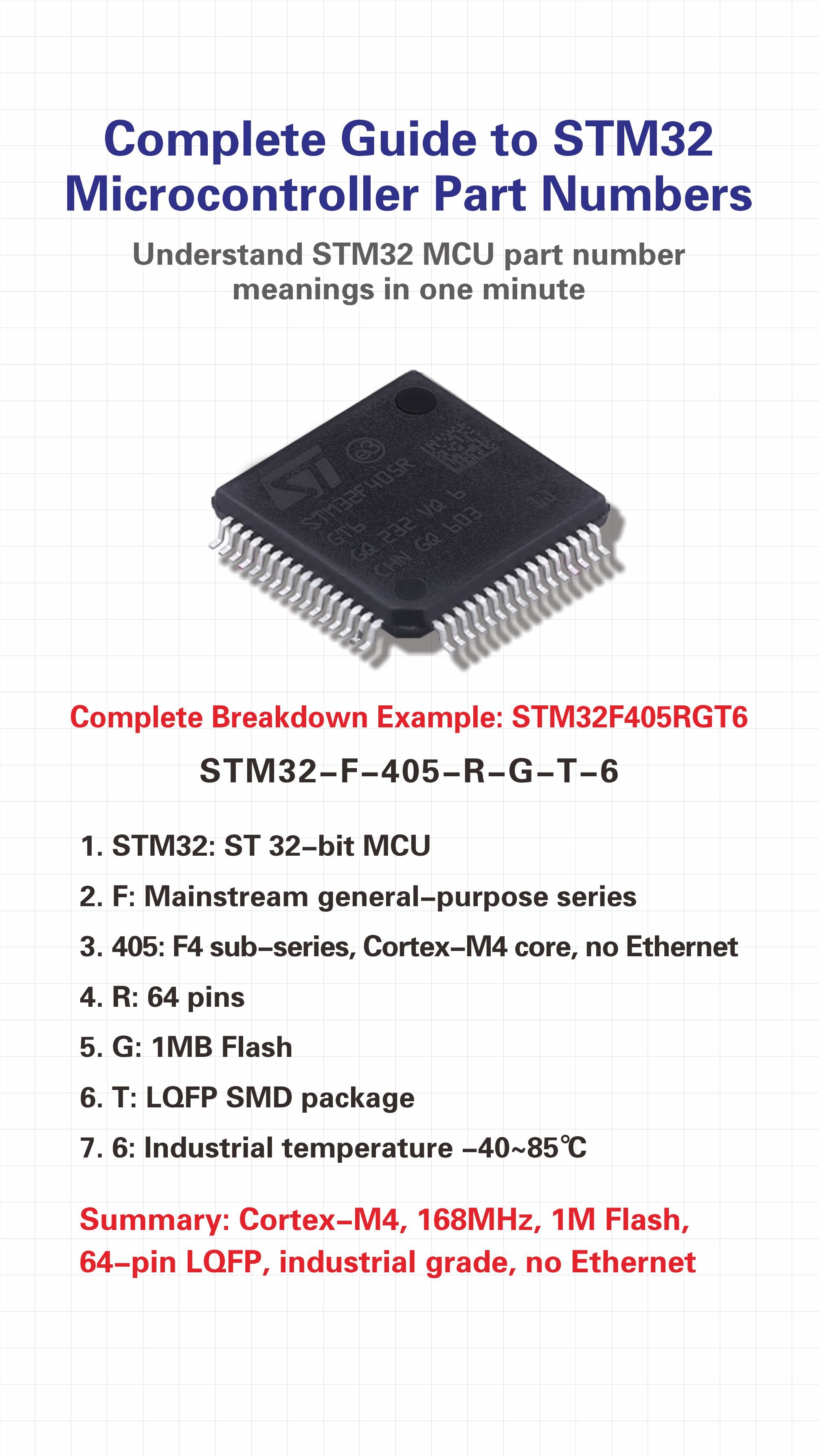
How to Read STM32F405RGT6
Let's use STM32F405RGT6 as an example.
The ordering code can be viewed conceptually as:
STM32 | F | 405 | R | G | T | 6
The first part, STM32, identifies STMicroelectronics' STM32 family of 32-bit microcontrollers based on Arm Cortex processor technology.
The letter F identifies the product family. STM32F devices cover a broad range of mainstream microcontrollers, with different generations offering different Cortex-M cores, performance levels, memories, peripherals, and power characteristics.
The 405 identifies the specific device subfamily. STM32F405 belongs to the STM32F4 family and is based on an Arm Cortex-M4 core with floating-point support. Devices in this class are widely used in industrial control, motor control, instrumentation, embedded systems, and other applications requiring relatively high MCU performance.
The R is associated with the package/pin-count configuration for this device and corresponds to a 64-pin variant in the STM32F405 ordering code.
The G identifies the Flash memory density for this particular STM32 ordering-code convention and corresponds to 1 MB of Flash.
The T indicates the package type, which is LQFP for this device.
The final 6 identifies the temperature-grade option used by this ordering code. For the relevant STM32 device, this corresponds to the standard industrial temperature range of approximately -40°C to +85°C.
Therefore, STM32F405RGT6 can be understood as a specific STM32F405 configuration with a Cortex-M4 core, 1 MB Flash, 64-pin LQFP packaging, and an industrial temperature grade.
However, engineers should not assume that the same letter always has exactly the same meaning across every STM32 family. The safest approach is to use the official datasheet and ordering information for the exact device being purchased.
Common STM32 Naming Elements
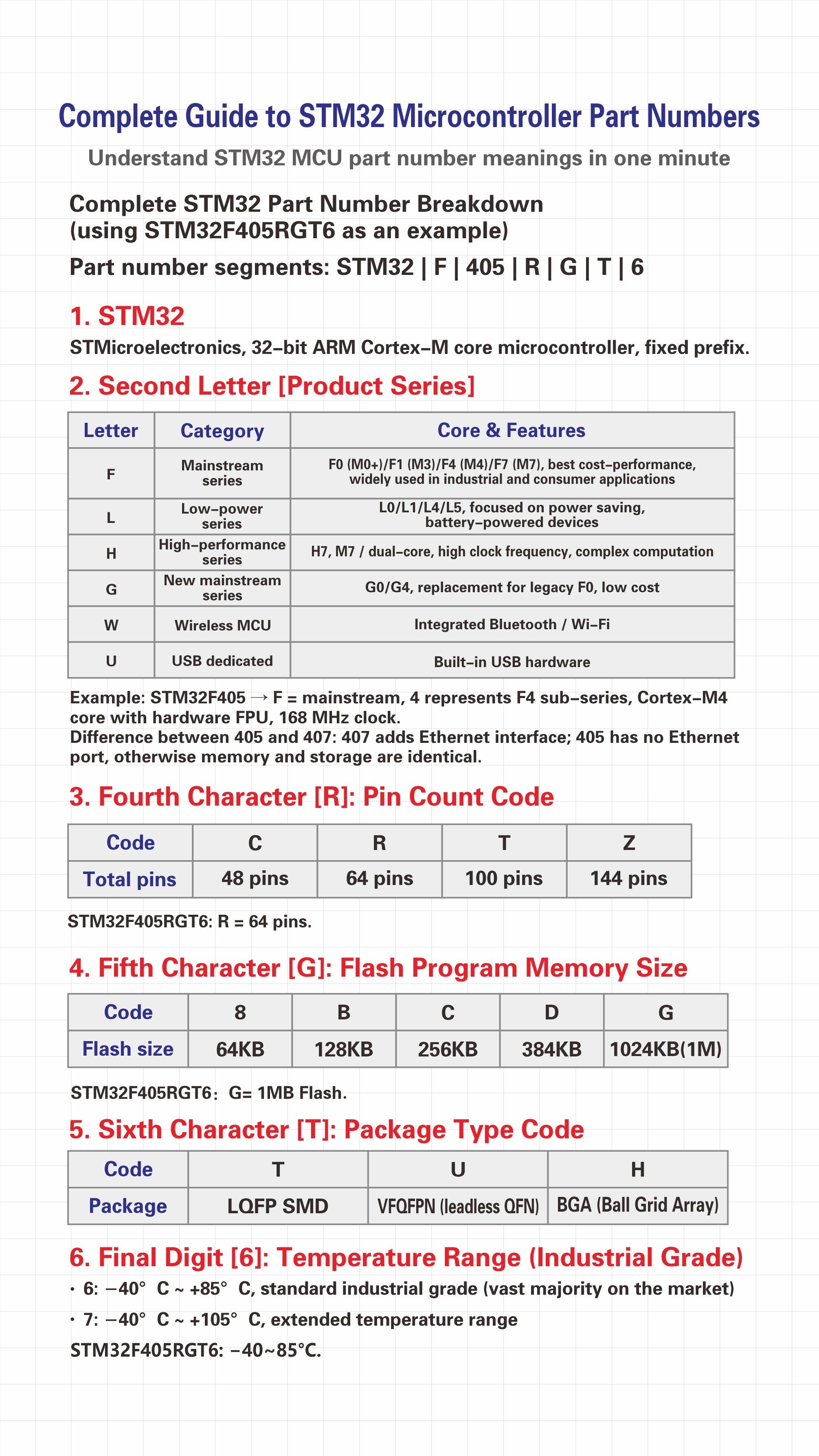
Across many STM32 families, engineers will frequently encounter characters associated with device family, device density, package, memory capacity, and temperature grade.
For example, package-related codes can include configurations associated with 48-pin, 64-pin, 100-pin, or 144-pin devices. Flash-density codes may also vary according to the product family, with different letters or numbers representing different memory sizes.
This is why an STM32 naming guide should be used as a quick reference rather than as a universal decoding table.
The important rule is simple: use the part number to narrow down the device, then confirm the exact specification in the datasheet.
This becomes particularly important when comparing older STM32 families with newer generations, because STMicroelectronics has introduced different naming conventions and ordering-code structures across its portfolio.
STM32 F, L, H, G, and W Families: What Is the Difference?
One of the easiest ways to narrow down an STM32 selection is to understand the positioning of the major product families.
STM32F Series: Mainstream Performance
The STM32F family is one of the most widely recognized STM32 product groups. It covers several generations and performance levels, including Cortex-M0/M0+, Cortex-M3, Cortex-M4, and Cortex-M7-based products depending on the specific family.
STM32F1 devices such as STM32F103 became extremely popular in embedded development because of their mature ecosystem, broad availability, and extensive development resources. STM32F4 devices such as STM32F405 and STM32F407 provide substantially higher processing capability and are frequently used in industrial controllers, data acquisition equipment, motor-control systems, communication equipment, and embedded gateways.
For an existing product already based on STM32F, continuing with a compatible F-series device may simplify software and hardware maintenance.
STM32L Series: Low-Power Applications
The STM32L family focuses on low-power embedded applications.
These devices are particularly relevant to battery-powered products, portable equipment, sensor nodes, meters, monitoring systems, and IoT devices where power consumption and standby time are important design factors.
Different generations, such as STM32L0, STM32L4, and STM32L5, provide different combinations of performance, memory, security, peripherals, and power-management capabilities.
STM32H Series: High Performance
The STM32H family targets applications that require higher processing performance, advanced peripherals, high-speed interfaces, and greater computing capability.
STM32H7 devices are commonly considered when an application requires significantly more MCU performance than a traditional mainstream Cortex-M device can provide. Typical applications include industrial HMIs, high-speed control, advanced motor control, instrumentation, communication equipment, graphics-oriented embedded systems, and edge-processing applications.
STM32G Series: Modern Mainstream and Mixed-Signal Applications
The STM32G family covers newer mainstream MCU designs and includes product lines such as STM32G0 and STM32G4.
STM32G0 is positioned for cost-sensitive general-purpose applications, while STM32G4 is particularly attractive for applications requiring advanced analog peripherals, timers, and digital control functions.
For a new design, STM32G devices can be worth evaluating alongside older F-series products, especially when the required peripherals, performance, cost, and software ecosystem fit the project.
STM32W Series: Wireless Connectivity
STM32W devices integrate wireless connectivity into selected STM32 platforms. Depending on the specific product, wireless features can support applications such as Bluetooth Low Energy, Zigbee, Thread, and other 2.4 GHz wireless technologies.
These devices can reduce the need for a separate MCU and wireless controller in suitable IoT and connected-device designs.
What About STM32U?
The STM32U series should not simply be described as a "USB-only" family. STM32 product families have different positioning and peripheral combinations, and USB support is available across multiple STM32 families.
When selecting an STM32U device, engineers should evaluate the complete feature set, including power consumption, processing capability, memory, analog functions, connectivity, security features, package, and required peripherals.
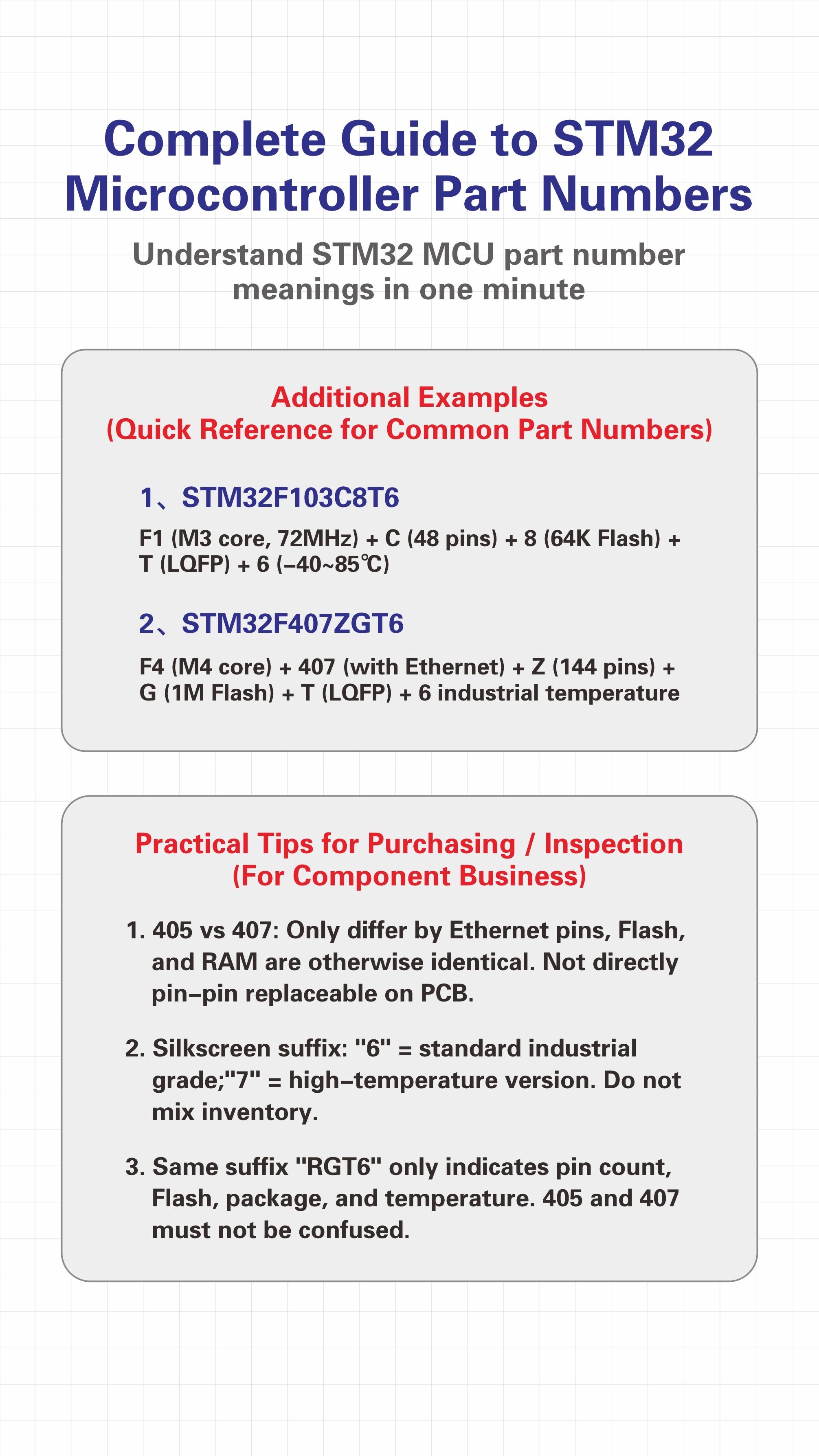
STM32F103C8T6: A Classic Example
STM32F103C8T6 is one of the best-known STM32 microcontrollers in the embedded development community.
It belongs to the STM32F1 family and uses the Arm Cortex-M3 architecture. The device operates at up to 72 MHz and is commonly associated with a 48-pin package and 64 KB Flash configuration.
Because of its long-standing ecosystem and large number of development boards, examples, libraries, and educational resources, STM32F103C8T6 has been widely used in embedded learning, control boards, instrumentation, automation, and small embedded products.
However, its popularity should not automatically make it the best choice for a new design. Engineers should compare its performance, memory, peripherals, power consumption, availability, lifecycle, and total cost against newer STM32 families.
STM32F405RGT6 vs. STM32F407ZGT6
STM32F405 and STM32F407 are often compared because they belong to the same STM32F4 generation and share many architectural characteristics.
However, engineers should not assume that they are interchangeable.
One of the most important differences is Ethernet capability. STM32F407 includes an Ethernet MAC, while STM32F405 does not provide the same integrated Ethernet MAC functionality.
The package configuration can also be different. For example, STM32F405RGT6 uses a 64-pin LQFP configuration, while STM32F407ZGT6 is a 144-pin LQFP configuration.
That difference alone means they should not be treated as simple pin-to-pin replacements.
If an existing PCB was designed specifically around STM32F405RGT6, replacing it with STM32F407ZGT6 is not a matter of changing the BOM line. The PCB, pin assignment, firmware configuration, power design, peripheral routing, and manufacturing process may all need to be reviewed.
This is a good example of why "same family" does not mean "drop-in replacement."
Can STM32F405 Be Replaced by STM32F407?
In most practical designs, the answer is not as a direct pin-to-pin replacement.
The two devices have similar positioning within the STM32F4 family, but their peripheral resources and package configurations can differ significantly depending on the exact ordering codes.
If Ethernet is required, STM32F407 may be the appropriate choice. If Ethernet is not required and the existing hardware is designed for STM32F405, moving to F407 still requires a detailed hardware review.
A replacement decision should therefore consider at least five areas: pinout, package, memory, peripherals, and software.
For production projects, engineers should also verify electrical characteristics, clock configuration, boot behavior, power requirements, PCB compatibility, firmware migration effort, and availability.
Engineering Selection and Purchasing Verification Are Different
An engineer usually starts with functional requirements.
The first questions may be:
How much processing performance is required?
How much Flash and RAM are needed?
How many GPIOs are required?
Does the design need Ethernet, USB, CAN, SPI, I2C, UART, ADC, DAC, advanced timers, or wireless connectivity?
What operating temperature range is required?
What package can the PCB accommodate?
Purchasing teams approach the same MCU from a different angle.
They need to verify the exact manufacturer part number, package, temperature grade, memory configuration, approved source, production date or lot requirements, lead time, and availability.
This difference is important because a supplier quotation saying "STM32F4" is not sufficient for production procurement. A BOM normally requires the exact ordering code approved by engineering.
Common STM32 Procurement Mistakes
One common mistake is treating similar suffixes as equivalent devices. Two STM32 parts may have similar package and memory codes while offering very different peripheral resources.
Another mistake is confusing package compatibility with functional compatibility. Even when two devices use similar packages, their pin assignments may not be identical.
Temperature grade is another important consideration. A design qualified for a wider operating-temperature range should not automatically be populated with a lower-grade device simply because the core model number looks similar.
Memory size also needs to be checked carefully. Firmware requirements can grow during development, and selecting an MCU with almost no Flash or RAM margin can create problems later.
Finally, purchasing teams should pay attention to traceability and product authenticity. For high-volume production, packaging, date codes, lot information, labeling, and supply-chain traceability can be just as important as the part number itself.
STM32 Replacement: What Does "Compatible" Actually Mean?
When discussing STM32 replacement options, the word "compatible" can be misleading.
There are several different levels of compatibility.
Package compatible means the replacement uses a similar physical package or footprint.
Pin-to-pin compatible means the pins correspond sufficiently for the same PCB design, but this still does not guarantee electrical or functional equivalence.
Functionally compatible means the alternative can perform the required system functions, but hardware or firmware changes may be necessary.
Software compatible means existing firmware can be reused with little modification. This is a much higher standard and must be verified at the device and peripheral level.
Some alternative MCU manufacturers, including Chinese MCU vendors, offer products designed to compete with or provide compatibility with selected STM32 devices. However, engineers should never approve a replacement solely from a "STM32-compatible" claim.
A proper replacement evaluation should include schematic review, pin mapping, electrical characteristics, peripheral comparison, clock configuration, firmware migration, PCB verification, prototype testing, and production validation.
A Practical STM32 Selection Workflow
For a new design, it is usually more efficient to select the MCU based on system requirements rather than starting from a familiar part number.
First, define the required processing performance and memory. Then determine the mandatory peripherals and interfaces. After that, select the appropriate STM32 family and narrow down the device according to pin count, package, Flash/RAM capacity, power requirements, temperature range, and cost.
Once a candidate has been selected, verify the exact ordering code against the latest datasheet and official product documentation.
For an existing product, the process is slightly different. Start with the current BOM part number, identify the exact device configuration, and then compare potential alternatives against the actual PCB and firmware requirements.
This approach is much safer than searching for a similar-looking STM32 part number and assuming it will work.
STM32 Selection and Procurement FAQ
Q1: What do the letters and numbers in an STM32 part number mean?
They identify different aspects of the device, such as product family, device type, package or pin configuration, memory density, package type, and temperature grade. The exact meaning varies between STM32 families, so the official ordering-code information for the specific device should always be checked.
Q2: Are STM32F405 and STM32F407 interchangeable?
Not as a general pin-to-pin replacement. They have important differences in peripheral resources, including Ethernet functionality, and specific ordering codes can use different package and pin configurations.
Q3: Which STM32 family should I choose?
For mainstream applications, STM32F and STM32G are common starting points. STM32L is worth considering for low-power applications, STM32H for higher performance, and STM32W for integrated wireless connectivity. The final choice should be based on the exact performance, peripheral, power, memory, package, and cost requirements.
Q4: Does the final number in an STM32 part number indicate temperature grade?
In many STM32 ordering codes, the final character identifies the temperature grade or related ordering option. However, the exact meaning should be verified for the specific family and device rather than generalized across the entire STM32 portfolio.
Q5: How important is the package code?
Very important. Package and pin configuration affect PCB footprint, GPIO availability, peripheral routing, thermal characteristics, and manufacturing compatibility. A package mismatch can make an otherwise suitable MCU unusable on an existing PCB.
Q6: Can I replace an older STM32 with a newer STM32?
Sometimes, but not automatically. A newer device may offer better performance, lower power consumption, more peripherals, or improved availability, but hardware and firmware compatibility must be evaluated before approval.
Q7: Is STM32F103C8T6 still suitable for new designs?
It can still be suitable for applications where its performance, memory, peripherals, cost, and lifecycle meet the requirements. For new projects, however, engineers should also evaluate newer STM32 families that may provide better performance, power efficiency, peripherals, and long-term design flexibility.
Q8: Is a pin-to-pin replacement automatically a drop-in replacement?
No. Pin-to-pin compatibility only addresses the physical pin relationship. Engineers still need to verify electrical specifications, power supply requirements, clock behavior, peripherals, boot configuration, firmware, and system-level performance.
Q9: How should I verify an STM32 part number before purchasing?
Check the complete manufacturer part number against the approved BOM and the manufacturer's documentation. Verify the device family, exact subfamily, Flash/RAM configuration, package, pin count, temperature grade, and other application-specific requirements.
Q10: How can I reduce the risk of receiving incorrect or remarked STM32 devices?
Use traceable supply channels, confirm the complete ordering code, check packaging and labeling, review lot and date information when required, and perform incoming inspection for production-critical components. For high-volume orders, supplier traceability is especially important.
Q11: What information should I provide when asking for an STM32 replacement?
The most useful information includes the current exact part number, PCB package, schematic or pin assignment, required Flash/RAM, operating temperature, critical peripherals, firmware constraints, annual quantity, and whether the replacement must be pin-to-pin or whether PCB modification is acceptable.
Final Thoughts
STM32 part numbers may look complicated at first, but they become much easier to understand once the ordering code is treated as a structured identifier rather than a random string of characters.
For engineers, the most important lesson is not to memorize every STM32 suffix. Instead, identify the device family, confirm the exact configuration, and then verify the critical specifications in the official documentation.
For purchasing teams, the same principle can prevent many common BOM mistakes. Never approve an STM32 replacement based only on a similar model number or suffix. Package, pinout, memory, peripherals, temperature grade, electrical characteristics, firmware compatibility, and supply-chain traceability all need to be considered.
If you are developing a new embedded product, dealing with an STM32 shortage or EOL concern, or evaluating an alternative MCU for an existing BOM, QIXINWEI provides electronic component sourcing, BOM kitting, component matching, and replacement evaluation support. Our team can help compare exact part numbers, check available configurations, and evaluate potential alternatives according to your hardware requirements.
For sample requests, volume procurement, or STM32 replacement evaluation, working from the exact BOM and technical requirements is the best way to reduce sourcing risk and accelerate the next stage of your project.
0users like this.