Electronic components
The Ultimate Guide to Embedded Microprocessors: Principles to Practical Implementation
Preface
From smart home gadgets, wearable electronics to industrial automation, automotive electronic control units and autonomous driving terminals, embedded microprocessors form the core of nearly all intelligent hardware. Four major processor types dominate the embedded industry: MCU, MPU, DSP and SoC. Many embedded engineers get confused by their architectural differences, application boundaries and selection criteria. Poor component selection often leads to cost overruns or even project failures.
Drawing on real‑world project experience, this article breaks down core distinctions from underlying principles, hardware architectures and field‑proven use‑cases to practical selection guidelines and industry trends. It helps hardware and firmware engineers make well‑informed chip choices for product development.
1. Deep Dive into Four Core Embedded Processors
1.1 MCU (Microcontroller Unit): The Workhorse for Real‑Time Control
Commonly known as a single‑chip microcomputer, the MCU is a compact, self‑contained computing unit built for real‑time control tasks. It integrates a complete minimal system on one die, prioritizing low cost, ultra‑low power consumption and deterministic real‑time response. MCUs are widely deployed across IoT nodes and low‑to‑mid‑range embedded hardware.
Hardware characteristics Most MCUs adopt the Von‑Neumann architecture. Popular cores include ARM Cortex‑M and RISC‑V‑based processors, with typical clock speeds ranging from 16 MHz to 300 MHz. On‑chip Flash stores firmware, while built‑in SRAM handles runtime data — no external memory chips are required. Rich native peripherals such as GPIO, ADC, PWM, timers, UART, I2C, SPI and CAN are integrated. Multiple low‑power sleep modes support microamp‑level standby current for battery‑powered devices.
Typical applications Smart home devices such as smart plugs and environmental sensors rely on ESP8266 / ESP32‑series MCUs for signal acquisition and switching control. In industrial settings, STM32 and GD32 MCUs serve as underlying control units for PLCs, performing sensor sampling, motor speed regulation and valve actuation. Body electronics in automobiles (window lift, wiper control, door lock, instrument backlight) use cost‑effective MCUs. Portable medical gear like blood‑pressure monitors and glucose meters also run on MCUs for simple computation and display driving.
Development overview MCU development has a low entry barrier. Common toolchains include Keil MDK, IAR and RT‑Thread Studio, with C as the primary programming language. Developers can run bare‑metal code or lightweight RTOS such as FreeRTOS and RT‑Thread. Complex full‑featured operating systems like Linux or Android are not supported.
1.2 MPU (Microprocessor Unit): General‑Purpose Compute Engine for Complex Smart Devices
Unlike MCUs, MPUs contain only CPU cores without large‑capacity on‑chip RAM or Flash. External DDR memory and eMMC / NAND Flash are mandatory to build a functional system. Delivering higher compute throughput and rich software ecosystems, MPUs can run full‑fledged operating systems for graphical UI, multi‑task processing and advanced networking.
Hardware characteristics MPUs are built around ARM Cortex‑A, Intel Atom or MIPS cores, operating at 500 MHz ~ 3 GHz. Integrated GPU, hardware video codec and display controllers enable LCD / HDMI output and touch interaction. Equipped with file‑system support, they can boot Linux, Android or Windows IoT.
Typical applications Smart speakers adopt Allwinner and Rockchip MPU platforms running Linux for voice parsing, cloud connectivity and audio processing. Industrial gateways based on NXP i.MX6 / i.MX8 aggregate multi‑protocol field data and upload edge‑computing results to the cloud. Commercial equipment such as digital signage and self‑service terminals leverage MPUs for 4K playback and human‑machine interaction. Traditional automotive infotainment units are also commonly built on MPU‑based Linux distributions.
Development overview MPU development is more demanding than MCU work. Engineers set up cross‑compilation environments under Ubuntu, dealing with kernel customization, device driver porting and application‑layer programming. Solid understanding of OS internals is required.
1.3 DSP (Digital Signal Processor): Special‑Purpose Chip for Signal Processing
DSPs are purpose‑built for digital signal workflows. Based on Harvard architecture with physically separated program and data memory buses, they are heavily optimized for filtering, FFT, matrix multiply‑accumulate and other signal‑processing algorithms, and are indispensable for audio, radar, communication and medical‑imaging equipment.
Hardware characteristics Hardware multiply‑accumulate units complete MAC operations within a single clock cycle. Zero‑overhead‑loop hardware reduces instruction overhead and keeps latency low. Dual‑bus parallel access fetches instructions and sample data simultaneously for high throughput. Fixed‑point DSPs handle basic audio workloads; floating‑point variants satisfy high‑precision radar and medical‑imaging computation.
Typical applications Active‑noise‑cancelling headphones use TI or ADI DSP chips to generate anti‑phase sound waves. Surveillance cameras employ DSPs for video encoding, image enhancement and facial‑feature extraction. 5G base‑stations deploy multi‑core DSP arrays for channel demodulation and beam‑forming. CT and ultrasound medical scanners depend on DSPs to reconstruct diagnostic imagery far more efficiently than general‑purpose CPUs.
Development overview DSP development demands strong domain knowledge of digital signal processing. TI Code Composer Studio (CCS) is the dominant IDE. Workflows usually start with algorithm simulation in MATLAB / Simulink before porting to target C code. Among the four processor categories, DSP engineering has the steepest learning curve.
1.4 SoC (System‑on‑Chip): The Ultimate Highly‑Integrated Platform for High‑End Smart Hardware
An SoC integrates a complete heterogeneous electronic system inside one silicon die, merging CPU clusters, GPU, DSP, NPU, ISP, baseband, memory controllers and many other functional blocks. Instead of being merely a computing core, it delivers a compact turn‑key hardware solution, widely used in premium consumer electronics, edge‑AI hardware and autonomous‑driving controllers.
Hardware characteristics Modern SoCs adopt heterogeneous multi‑core CPU configurations combining big, medium and small cores to balance peak performance and power efficiency. Dedicated accelerators handle graphics rendering, audio processing, neural‑network inference and image signal processing. On‑chip network‑on‑chip (NoC) interconnects enable high‑speed data transfer with minimal off‑chip overhead. Leading‑edge 5 nm / 7 nm process nodes pack billions of transistors and simplify surrounding BOM.
Typical applications Smartphone SoCs (Qualcomm Snapdragon, Apple A‑series) combine cellular baseband, imaging, AI and graphics subsystems. Wearable‑device SoCs for smart watches integrate Bluetooth, NFC, sensor interfaces and compact display drivers. Autonomous‑drive domain controllers powered by NVIDIA Orin and Horizon Journey SoCs perform environment perception and motion‑planning. Edge‑AI IP cameras leverage built‑in NPU resources for on‑site face recognition and behaviour analysis.
Development overview SoC projects rely heavily on comprehensive vendor SDK packages. Work spans low‑level driver adaptation, middleware integration, application programming and AI‑model deployment. Ecosystem barriers are high and upfront R&D costs are substantial, making SoCs suitable for high‑volume, feature‑rich premium products.
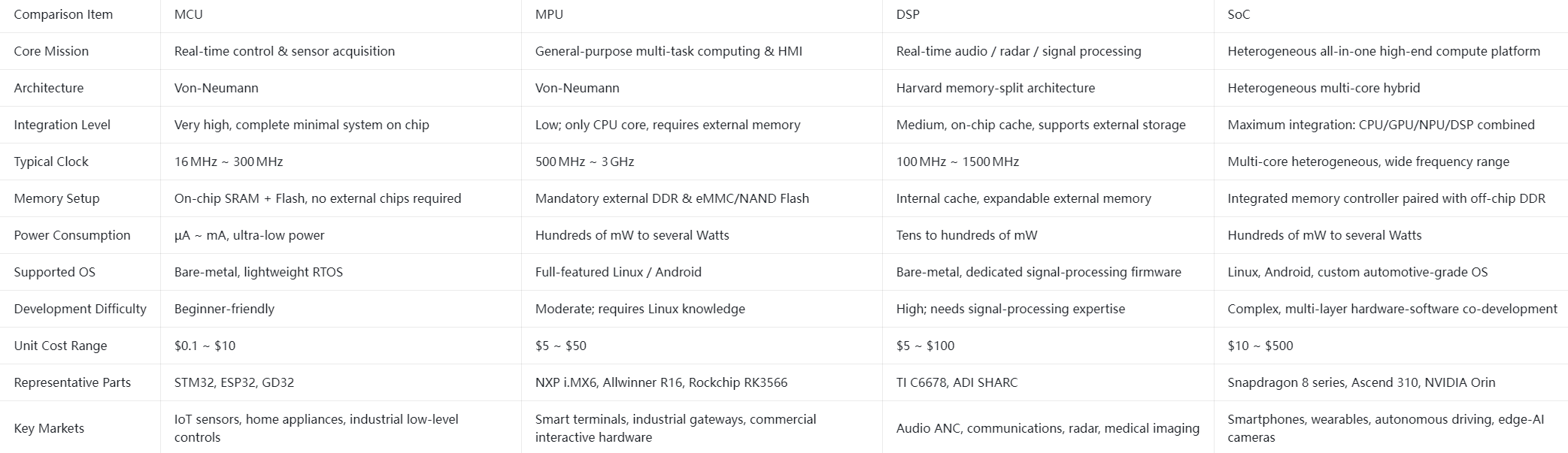
2. Side‑by‑Side Comparison of MCU / MPU / DSP / SoC
3. Practical Selection Workflow for Real‑World Projects
Many project delays and budget waste stem from improper processor selection. Instead of chasing raw performance, match components against actual functional requirements.
Quick decision flow
- Does your product need Linux / Android, graphical UI and complex multi‑process networking? If yes, consider MPU or SoC. If no, continue.
- Are heavy signal‑processing workloads present: FFT, filtering, matrix math, audio / radar / image pipelines? If yes, select DSP. If no, continue.
- If your workload mainly consists of I/O control, sensor sampling and serial‑port communication with strict cost and power constraints, choose MCU.
Scenario‑oriented recommendations
Pick MCU when: BOM budget is tight (< $10 per chip); battery‑driven hardware demands ultra‑low standby current; business logic remains simple without heavy algorithms; short development cycles and fast mass‑production are priorities. Typical products: smart locks, sensor nodes, LED controllers, appliance main‑boards, remote controls.
Pick MPU when: Full Linux stack, file management and complex TCP/IP networking are required; hardware includes touch‑screen graphical interfaces; multiple peripherals such as cameras, 4G modules and printers need to be attached. Typical products: industrial HMI panels, self‑service kiosks, network video recorders, industrial data gateways.
Pick DSP when: Core workload is streaming signal processing with heavy MAC / FFT / filtering; tight millisecond‑scale real‑time latency must be guaranteed; high‑floating‑point accuracy is needed for audio, radar or medical‑imaging data. Typical products: active‑noise‑cancelling headsets, millimetre‑radar units, medical imaging instruments, industrial servo controllers.
Pick SoC when: Mechanical space is limited and peripheral component count must be minimised; multiple compute domains (graphics, AI inference, audio, communication) run concurrently; production volume justifies high upfront SDK adaptation and engineering investment. Typical products: smartphones, smart watches, autonomous‑drive domain controllers, AI‑enabled IP cameras.
4. Industry Trends: Convergence and Domestic Innovation
4.1 Blurring boundaries between processor categories
Traditional classification boundaries keep fading. High‑end MCUs now reach 500+ MHz and can run lightweight Linux, acquiring partial MPU‑like capabilities. Many MPUs integrate on‑board memory and storage, approaching SoC‑level integration. Modern SoCs embed independent MCU and DSP sub‑cores to handle high‑level OS, signal processing and deterministic real‑time control simultaneously.
4.2 RISC‑V reshapes market landscape
Long dominated by ARM‑licensed IP, the embedded sector sees rapid adoption of open‑source RISC‑V. Mass‑produced RISC‑V MCUs are widely deployed, while high‑performance RISC‑V MPUs and DSPs are entering the market. In the near future heterogeneous RISC‑V SoCs will cover mid‑to‑low‑end embedded segments, lowering IP royalty costs and accelerating local semiconductor substitution.
4.3 Edge‑AI capability permeates all product tiers
AIoT pushes intelligence toward end‑devices, no longer exclusive to premium SoCs. Entry‑level MCUs integrate tiny NPU blocks for basic on‑device recognition. Mid‑range MPUs gain AI‑acceleration features. Dedicated AI SoCs become mainstream for machine‑vision security and industrial inspection.
4.4 Hardware security becomes baseline requirement
As IoT security risks multiply, hardware security modules migrate down from high‑end chips to mainstream MCU and MPU parts. Secure boot, encrypted storage and national‑crypto hardware acceleration are increasingly standard for consumer, industrial and automotive embedded hardware.
5. Practical Lessons & Pitfall Avoidance
5.1 Cost‑control tips
For MCU designs, prefer pin‑compatible series variants for flexible performance scaling without PCB re‑spins. For MPU projects, size DDR / eMMC capacity according to real requirements to avoid inflated BOM. For DSP development, complete MATLAB algorithm simulation first and choose fixed‑point / floating‑point variants prudently to prevent over‑specification. For SoC evaluation, analyse total system BOM including power management and peripherals instead of focusing solely on chip price.
5.2 Pre‑selection checklist
Before finalising a component choice, verify: completeness of datasheets and application notes; maturity of official SDK and community resources; availability of free or accessible toolchains; technical support from vendor or distributor. For long‑lifecycle industrial and medical products, confirm production longevity and end‑of‑life notification policies.
5.3 Mitigating supply‑chain risks
General‑purpose MCUs and MPUs enjoy stable supply. Premium DSPs and high‑end SoCs often suffer long lead‑times. Always prepare one or two alternative drop‑in‑compatible components to cope with supply volatility. Domestic alternatives should be prioritised for government and industrial projects.
6. Frequently Asked Questions
Q1: Can MCU and MPU replace each other?
Hardware‑wise it is technically feasible, yet economically impractical. Using an MPU for simple sensor and I/O tasks raises material cost dramatically. Forcing Linux onto an MCU causes memory exhaustion, instability and system hangs. Always select components based on requirements rather than raw performance metrics.
Q2: Why do smartphones not use MCUs?
Smartphones run dozens of concurrent tasks spanning cellular communication, graphics rendering, photography and AI processing, demanding synergistic work from CPU, GPU, DSP, baseband and NPU. MCUs lack sufficient memory, compute horsepower and multimedia peripherals, making highly‑integrated SoCs mandatory.
Q3: Will GPUs fully replace DSPs?
Not in the foreseeable future. GPUs excel at massively‑parallel graphic workloads. DSP hardware is optimised for low‑latency streaming signal processing such as filtering and FFT. In audio, radar and communication applications, DSPs deliver superior real‑time performance and power efficiency. The two are complementary rather than mutually‑exclusive.
Q4: Suggested learning path for embedded beginners?
Start with STM32‑series MCUs: master peripherals, C programming and RTOS real‑time systems. Progress to MPU‑based Linux kernel, driver and application development. Advanced study covers heterogeneous SoC architecture, AI‑model deployment and DSP algorithm engineering.
Q5: Which processor type holds the best outlook?
Heterogeneous SoCs with embedded‑AI accelerators will define high‑end smart hardware. MCUs will sustain steady massive‑volume demand driven by IoT. RISC‑V‑based chips with lightweight AI acceleration represent one of the most promising growth avenues.
7. Conclusion
There exists no universally “best” embedded processor among MCU, MPU, DSP and SoC — only the most suitable solution for your target application. MCUs deliver low‑cost, low‑power real‑time control for IoT and industrial field hardware. MPUs power mid‑tier interactive devices and industrial gateways. DSPs remain irreplaceable for specialised signal‑processing workloads in communications, medical and radar equipment. SoCs dominate premium consumer electronics and autonomous‑driving hardware through extreme integration and heterogeneous compute.
Driven by AIoT, edge intelligence and local semiconductor advancement, these processor families keep converging and evolving. Competent embedded engineers focus on balancing performance, power and BOM rather than blindly picking the fastest silicon.
About QIXINWEI
If you are navigating embedded hardware selection or product definition, QIXINWEI offers a broad portfolio covering MCU, MPU, DSP and SoC. We provide component supply, technical reference designs and application support for IoT, industrial control, smart audio, edge‑vision and automotive‑adjacent projects. Reach out to our technical team for consultation to streamline your hardware design and bring your product to market smoothly.
0users like this.