qixinwei-pcba


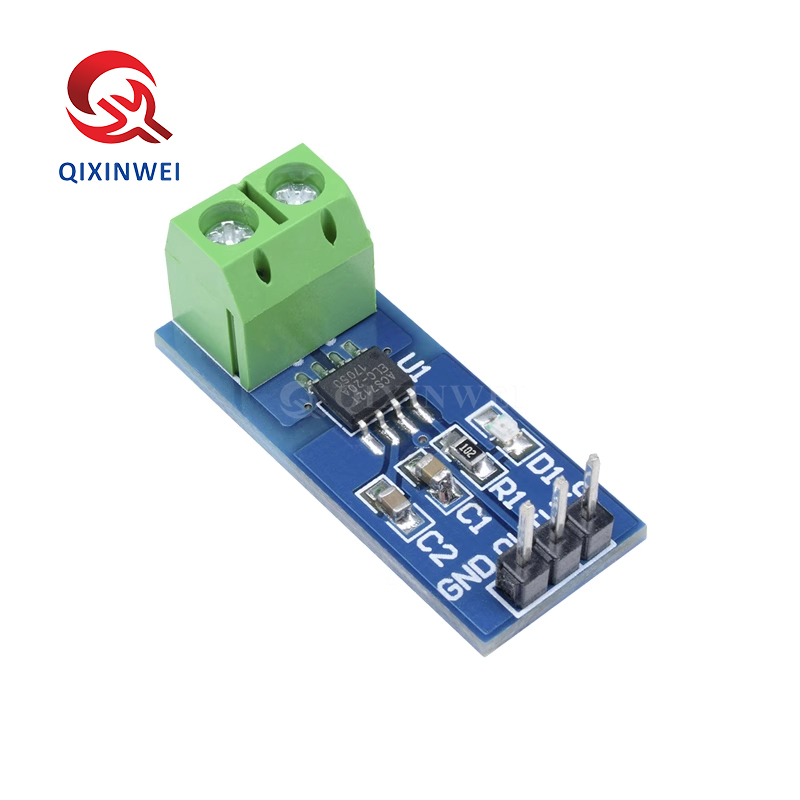
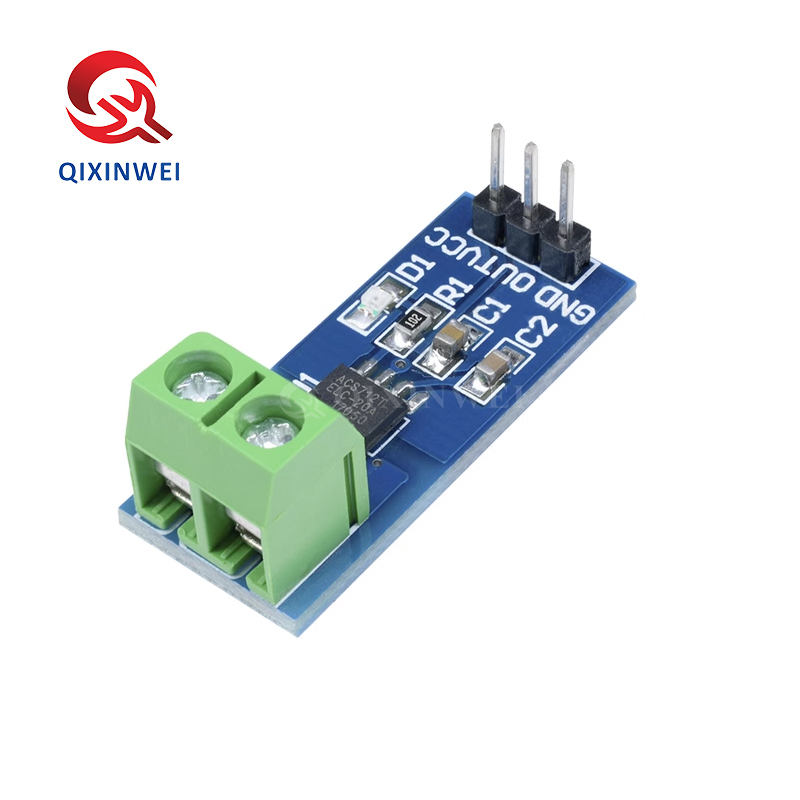
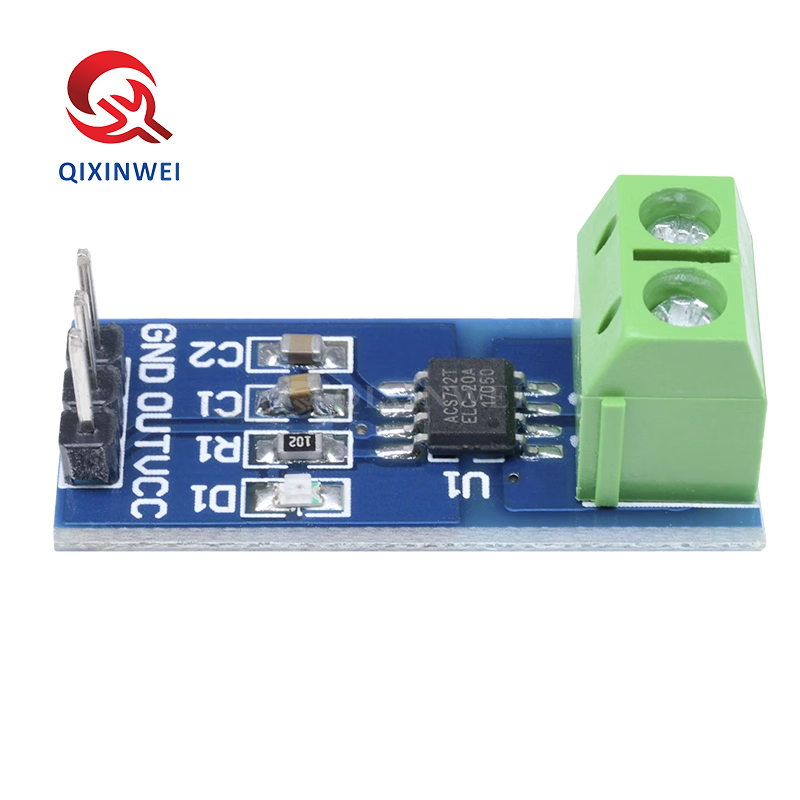
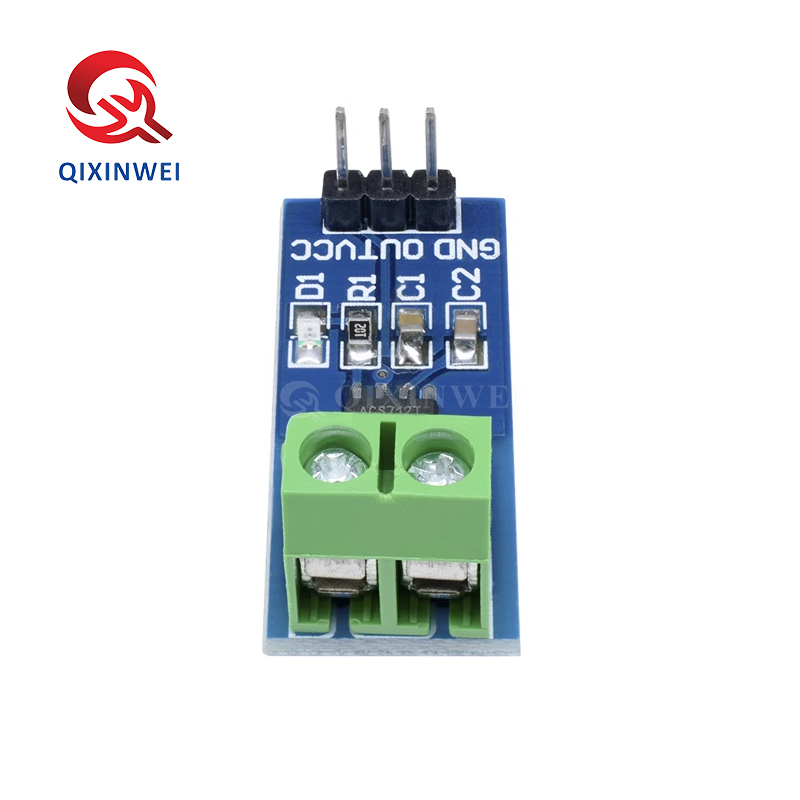
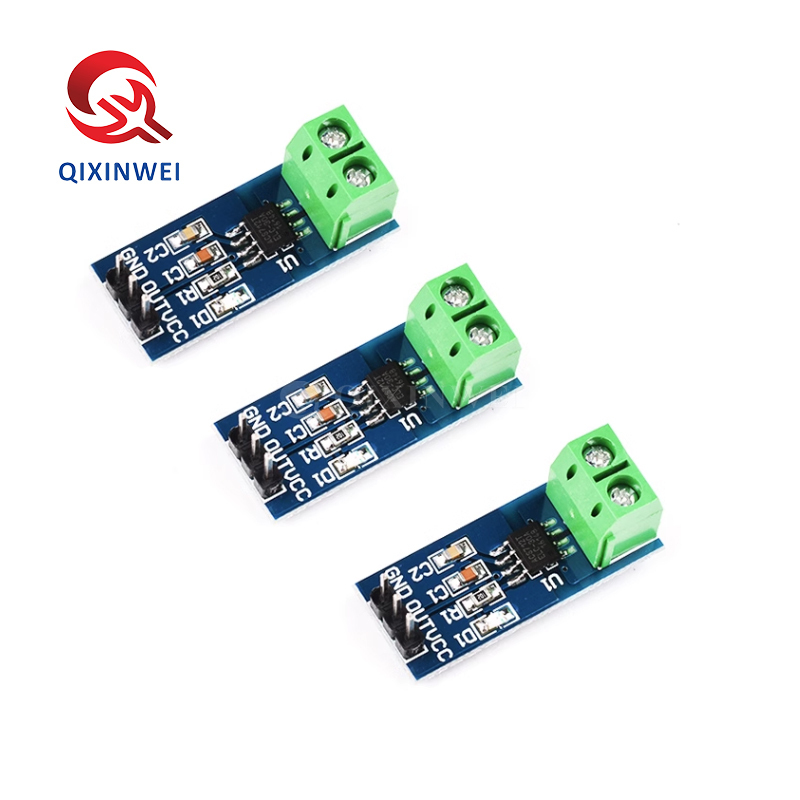
ACS712 Current Sensor Module 5A 20A 30A Hall Effect AC DC Measurement
ACS712 Current Sensor Module Core Chip
◆ Sensor Chip
ACS712 (Allegro MicroSystems Hall-effect linear current sensor)
◆ Package
SOIC-8 (small footprint, low-profile)
Electrical Specifications
◆ Supply Voltage
DC 4.5V ~ 5.5V (5V typical)
◆ Zero Current Output
2.5V (at 0A)
◆ Output Voltage Range
0.5V ~ 4.5V (negative to positive full scale)
◆ Internal Resistance
1.2mΩ (very low insertion loss)
◆ Isolation Voltage
2.1kV RMS (pins 1-4 to pins 5-8)
◆ Bandwidth
80kHz (adjustable via FILTER pin)
Accuracy Specifications
◆ Total Output Error
±1.5% @ 25°C
◆ Response Time
5µs (step input current)
◆ Linearity
Better than ±1.5%
◆ Magnetic Hysteresis
Nearly zero
Output Characteristics
◆ Output Type
Analog voltage (proportional to current)
◆ Output Formula
Current I = (Vout - 2.5V) / Sensitivity
◆ Sensitivity Values
5A model: 185 mV/A
20A model: 100 mV/A
30A model: 66 mV/A
Physical Specifications
◆ Module Dimensions
Approx. 27.5×11.6×14mm
◆ Weight
Approx. 5-10g
◆ Interface
Power: VCC / GND (2.54mm header)
Signal: Vout (analog output)
Input: Screw terminals
Applications
◆ Motor Control
Current monitoring, overload protection, speed control
◆ Battery Management
Charge/discharge current monitoring, capacity calculation
◆ Power Protection
Overcurrent protection for switching power supplies
◆ Smart Home
Device power monitoring, status display
◆ Industrial Automation
Industrial equipment current monitoring
◆ Education
Arduino/STM32 current measurement learning
Key Advantages
◆ Non-Contact Measurement
Hall effect principle with electrical isolation
◆ AC/DC Compatible
Measures both alternating and direct current
◆ Low Insertion Loss
1.2mΩ internal resistance, minimal power consumption
◆ Plug-and-Play
5V supply, analog output, simple wiring
◆ Three Range Options
5A/20A/30A for various applications
◆ Cost-Effective
Low cost, stable performance, mature ecosystem
Why Choose QIXINWEI
Years of experience in the electronics industry. Trusted by global customers.
Massive In-Stock Inventory – Ready to ship promptly
BOM Matching Service – One-stop solution, save time
PCBA Customization – Professional engineering team creates tailor-made solutions based on your needs
Cost-Effective & Efficient – Better channel, better cost
A dedicated team makes your procurement smoother.
Contact us for BOM quotes or PCBA inquiries




Quantity(Pieces) | 1 ~ 30000 | 30001 ~ 300000 | > 300000 |
Est. Time(days) | 5 | 7 | To be negotiated |

FAQ:
What is the ACS712 current sensor module and its key specifications?
This module is built around the Allegro ACS712 Hall‑effect linear current sensor IC. It provides galvanic isolation and can measure both AC and DC current. Key specifications: available in three full‑scale ranges — ±5 A, ±20 A, and ±30 A with corresponding output sensitivities of 185 mV/A, 100 mV/A, and 66 mV/A. Operating voltage is 5 V DC, and the zero‑current output voltage is VCC/2 (typically 2.5 V). The internal conductor resistance is only 1.2 mΩ, and the response time is 5 µs. The board typically includes an on‑board LED power indicator and screw terminals for easy connection.How does the ACS712 Hall‑effect current sensor work?
Current flowing through the internal copper conduction path generates a magnetic field. This field is sensed by an on‑chip Hall IC and converted into a linear analog voltage proportional to the current. The sensor output is galvanically isolated from the current path (isolation voltage up to 2.1 kV RMS), meaning the output side is completely separated from the high‑current circuit. This allows safe, accurate measurement without breaking the circuit or using shunt resistors.How do I connect the ACS712 module to an Arduino or ESP32?
Wiring is simple. Connect VCC → 5 V, GND → GND, and OUT → any analog input pin (A0 on Arduino). For ESP32, note that the module outputs 0–5 V; the ESP32’s ADC input range is 0–3.3 V, so you must use a voltage divider (e.g., 10 kΩ + 20 kΩ) to avoid damaging the pin. The current‑carrying side is connected in series with the load via the screw terminals — there is no polarity, but the sensor measures direction (positive current flows from IP+ to IP‑).How do I convert the analog output voltage into a current value?
Use the formula: Current (A) = (Vout – Vref) / Sensitivity. Vref is the zero‑current output, which is VCC/2 (typically 2.5 V). The Sensitivity depends on the module version: 185 mV/A for the 5 A version, 100 mV/A for 20 A, and 66 mV/A for 30 A. For example, with a 5 A module and Vout = 3.425 V, the current is (3.425 V – 2.5 V) / 0.185 ≈ 5 A. In code, use analogRead() and map the ADC value (0–1023 for Arduino) to voltage, then apply the formula. For accurate results, measure the actual VCC and Vref at rest.Can the ACS712 measure both AC and DC current?
Yes. For DC, simply read the output voltage and calculate the instantaneous current. For AC, the output is an instantaneous voltage that swings around 2.5 V. To measure AC current, you must sample the output rapidly over at least one complete cycle (e.g., 20 ms for 50 Hz) and calculate the root‑mean‑square (RMS) value. Arduino libraries such as EmonLib or custom code with an offset removal and RMS calculation can be used. The sensor does not distinguish between AC and DC; it simply outputs the instantaneous current value.Which range should I choose: 5 A, 20 A, or 30 A?
Choose the range based on your maximum expected current. The 5 A version provides the highest sensitivity (185 mV/A) and is best for low‑current, precision measurement (e.g., sensor nodes, small motors). The 20 A and 30 A versions handle larger loads (home appliances, power tools) but with lower resolution (100 mV/A and 66 mV/A). Never exceed the rated current, as the sensor may saturate or be permanently damaged. For inrush currents, choose a version with at least 2× headroom.What is the typical accuracy, and how can I calibrate it?
The ACS712 has a typical total output error of ±1.5 % at 25 °C. Over the full industrial temperature range, the error may increase to ±4 %. The zero‑current offset (Vref) can drift with temperature. To improve accuracy, perform a software calibration: measure the actual output at zero current, store this offset, and subtract it in your code. For high‑precision applications, take multiple readings and average them, or use a known current source to calibrate the sensitivity.Does the ACS712 provide galvanic isolation, and why is it important?
Yes, the ACS712 provides true galvanic isolation between the current‑carrying conductor and the signal output, with an isolation voltage of 2.1 kV RMS for 1 minute. This means the measurement side is completely isolated from the high‑voltage side, eliminating ground loop issues and allowing high‑side current sensing. You can safely measure current in mains‑powered circuits without connecting the grounds together, which is critical for safety and noise immunity in industrial and home automation projects.How can I reduce noise and improve measurement stability?
The ACS712 output can be noisy, especially at low currents. Solutions: 1) Add a 0.1 µF ceramic capacitor and a 10 µF electrolytic capacitor between VCC and GND near the module. 2) Place an RC low‑pass filter (e.g., 1 kΩ resistor in series with the output and a 10 µF capacitor to GND) to smooth the analog output. 3) In software, take multiple samples and compute an average or use a moving‑average filter. 4) Keep the sensor away from strong magnetic fields and high‑frequency switching sources (motor drivers, relays).What are the most typical applications for the ACS712 current sensor module?
It is widely used in motor current monitoring, over‑current protection circuits, battery charge/discharge management, solar panel current measurement, smart plugs and energy meters, industrial automation, and robotics. Its non‑intrusive measurement, ease of use, and built‑in isolation make it a go‑to choice for hobbyist and professional projects requiring reliable AC or DC current sensing up to 30 A.
- 原产地:
- Original
- 品牌:
- Original
- 型号:
- ACS712 Module
- 装运方式:
- DHL \ UPS \ Fedex \ EMS \ HK Post
- 种类:
- 传感器开发板和工具包
- 芯片组:
- ACS712-05B
- 应用:
- 通用