Arduino & Embedded Electronics Starter Kits | IoT DIY Learning Modules
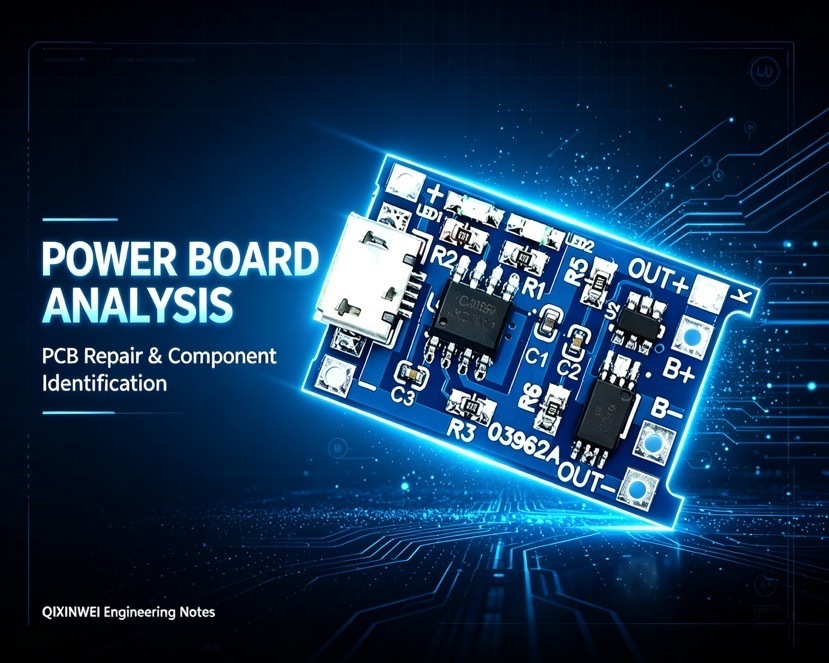
What Is a TP4056 Module Used For? A Simple Guide to TP4056 Lithium Battery Charger Modules
What Is a TP4056 Module?
If you are building a small portable electronic device with a rechargeable battery, you may have come across the TP4056 module. So, what is a TP4056 module used for?
In simple terms, a TP4056 module is a small lithium-ion battery charging board designed to charge a single 3.7V nominal lithium-ion or lithium-polymer battery from a 5V power source. It is especially popular for charging 18650 batteries because the module is inexpensive, compact and easy to connect.
A typical TP4056 module takes 5V input from a USB port, manages the charging process, and charges the battery to approximately 4.2V using a constant-current/constant-voltage charging method. Many common versions are configured for approximately 1A charging current.
This is why you can find TP4056 modules in DIY power banks, portable lamps, ESP32 projects, Arduino projects, small robots, wireless sensors and other battery-powered electronics.
However, there is an important detail that is often overlooked: not every TP4056 module has battery protection. A basic TP4056 circuit is mainly a charger. Some modules add a DW01A protection IC and dual MOSFETs such as the 8205A/FS8205A to provide additional overcharge, over-discharge, over-current and short-circuit protection.
TP4056 Brand, Product and Model
The main component on the board is the TP4056 lithium battery charger IC. TP4056 is widely used as a standalone linear charger for single-cell lithium-ion batteries.
The product commonly called a TP4056 module, TP4056 charging board, TP4056 charger module or TP4056 18650 charging module is actually a small PCB built around the TP4056 IC. Depending on the manufacturer, the PCB may include additional resistors, LEDs, USB connectors, protection ICs and MOSFETs.
This means that “TP4056 module” does not represent one completely standardized PCB design. Two boards may both be sold as TP4056 modules while having different USB interfaces, charging currents, protection functions or PCB layouts.
For procurement and engineering projects, it is therefore better to check the actual schematic and component configuration rather than relying only on the words “TP4056 module.”
TP4056 Module Main Parameters
For a common 5V 1A TP4056 module, the basic electrical concept is relatively simple.
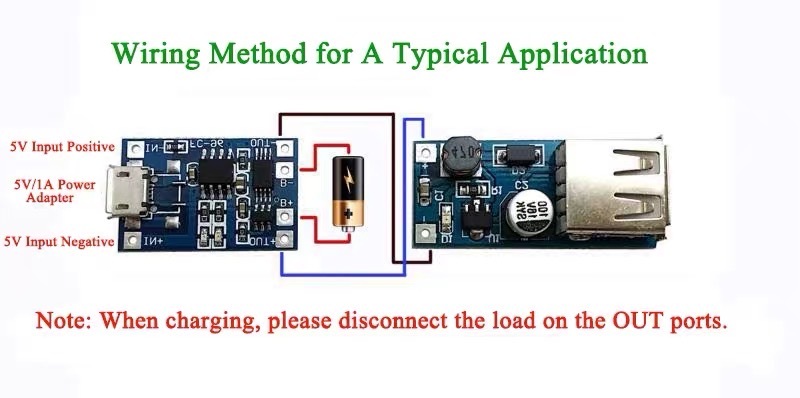
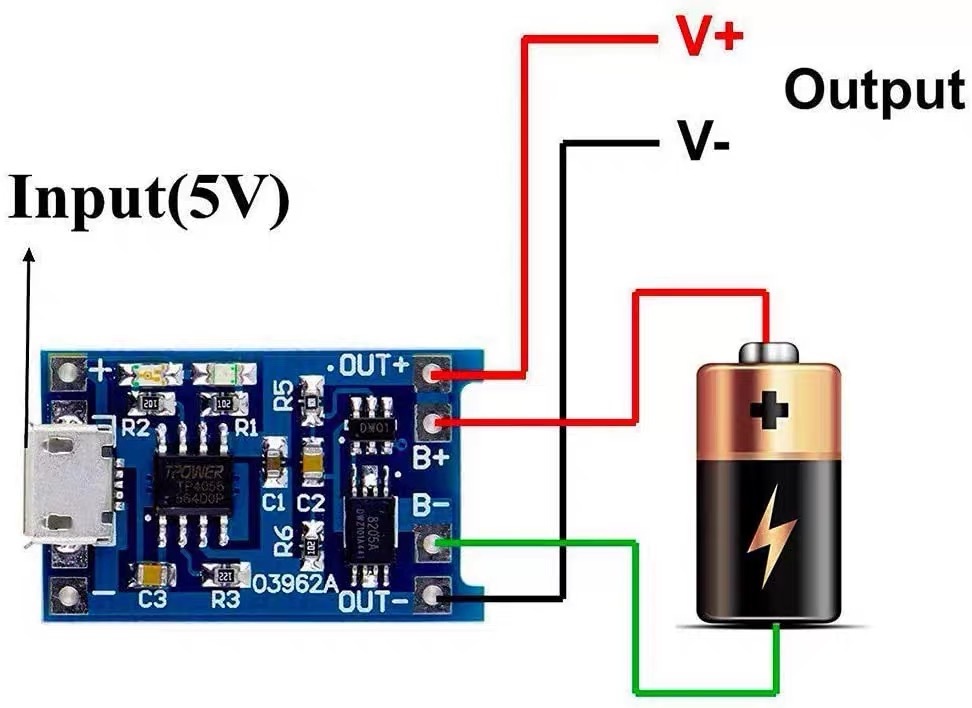
The input is normally around 5V DC, supplied through Micro-USB, USB Type-C or the module's IN+ and IN- terminals. The battery connection is normally B+ and B-, while protected output versions may provide OUT+ and OUT- terminals.
The TP4056 uses a CC/CV charging profile. During the first part of charging, it supplies a controlled constant current. As the battery voltage approaches the regulation voltage, the charger switches to constant-voltage operation and the charging current gradually decreases. The final charge voltage is approximately 4.2V, which matches the normal full-charge voltage of a standard single-cell 3.7V Li-ion battery.
The charging current is determined by the PROG resistor. Many commonly sold modules are advertised as 1A versions, but the actual current-setting resistor and PCB design should be checked before assuming that every board provides exactly 1A. The TP4056 is also a linear charger, so part of the input power is converted into heat, especially when the battery voltage is low and charging current is high.
A typical protected TP4056 module can therefore be understood as three functional sections: the USB/5V input section, the TP4056 charging section, and the battery protection section.
How Does a TP4056 Module Work?
The charging process is easier to understand than it may first appear.
When a 5V power supply is connected, the TP4056 begins charging the connected single-cell lithium battery. If the battery voltage is relatively low, the charger manages the current according to its charging algorithm. As the battery approaches 4.2V, the charger changes to constant-voltage regulation and the current gradually falls.
When the battery reaches the end of the charging cycle, the charging current becomes very small and the charger terminates the charge according to its internal control conditions.
This simple CC/CV charging process is one of the main reasons the TP4056 module has become so popular in DIY electronics.
A protected version adds another layer. The DW01A protection IC monitors the battery condition and can control MOSFETs to disconnect the battery when abnormal overcharge, over-discharge or excessive current conditions are detected. For example, the DW01A specification lists typical overcharge detection around 4.3V and over-discharge detection around 2.4V, although exact behavior depends on the protection IC and board design.
What Is a TP4056 Module Used For?
The most common use of a TP4056 module is charging a single rechargeable lithium battery.
One of the most popular examples is an 18650 lithium-ion battery. An 18650 cell is typically rated around 3.7V nominal and approximately 4.2V when fully charged, making it a natural match for a standard TP4056 charging circuit.
For example, imagine you are building a portable temperature sensor using an ESP32. You need a rechargeable battery, but you do not want to design a complete lithium battery charger from the beginning. A TP4056 module can provide a simple charging interface between a 5V USB supply and the battery.
The same idea can be used for portable LED lights, small fans, DIY power banks, wireless sensors, handheld instruments, Arduino projects, ESP32 projects, small robots, portable audio devices and other low-power electronics.
TP4056 Module Typical Applications
1. 18650 Battery Charging
This is probably the most recognizable application. A TP4056 module can be used to charge a compatible single-cell 18650 Li-ion battery from a 5V USB source.
For DIY electronics, this combination is attractive because the battery, charger and USB input can be assembled into a very small package.
2. DIY Power Banks
A TP4056 module can be used as the charging stage of a simple DIY battery-powered project. However, charging a battery and generating a regulated USB output are two different functions.
The TP4056 itself does not convert the battery's approximately 3.0–4.2V output into a stable 5V USB output. If you want to power a 5V device from the battery, a separate boost converter or a charger/power-bank IC with power-path functionality may be required.
This distinction is important because many beginners assume that a TP4056 module is a complete power-bank controller.
3. ESP32 and Arduino Projects
Portable development boards often need a rechargeable battery. A TP4056 module provides a convenient way to recharge the battery through USB.
For example, a portable ESP32 sensor can use the battery as its energy source while the TP4056 handles charging.
4. Rechargeable LED Lamps
Small rechargeable LED lights are another practical application. The TP4056 module can charge the lithium battery when USB power is available, while the LED circuit consumes battery power when the USB source is removed.
5. Portable Sensors and IoT Devices
Battery-powered temperature sensors, wireless monitoring devices, data loggers and small IoT products can also use TP4056-based charging circuits when the power requirements are modest.
The advantage is not simply low cost. The bigger advantage is reducing the amount of charger circuitry that needs to be designed from scratch.
TP4056 Module With Protection vs Without Protection
This is one of the most important differences to understand when buying a TP4056 module.
A TP4056-only module mainly provides battery charging. It should not automatically be described as a complete battery protection circuit.
A TP4056 protection module commonly adds a DW01A or similar battery protection IC together with dual MOSFETs. These components can provide additional protection against over-discharge, over-current and short-circuit conditions.
In other words:
TP4056 = charging control
TP4056 + protection IC + MOSFET = charging + battery protection
If you are using an unprotected 18650 cell, the second configuration is generally more appropriate for a basic DIY project.
But even a TP4056 protection module should not be treated as a universal BMS. It is intended for a single-cell lithium battery, not a 2S, 3S or larger series battery pack. The TP4056's 4.2V charging voltage also means it should not be used as a direct charger for LiFePO4 cells or multi-cell series packs.
TP4056 vs Other Lithium Battery Charging Solutions
The TP4056 is popular because it is simple, but it is not the best solution for every battery-powered product.
Compared with a more advanced power-management IC, the TP4056 is inexpensive and easy to use, but it has limited system-level functions.
For a basic one-cell 3.7V Li-ion battery project, TP4056 is often enough.
For a product requiring power-path management, battery fuel gauging, USB-C power negotiation, higher charging current, thermal monitoring, or more sophisticated battery management, a dedicated modern charger or PMIC may be a better choice.
The most important question is therefore not “Is TP4056 good?” but rather “Does TP4056 match the battery chemistry, cell count, charging current and system architecture?”
Can TP4056 Be Replaced?
Yes. A TP4056 can be replaced by other single-cell lithium battery charging solutions, but the correct replacement depends on the project requirements.
For a simple single-cell Li-ion/LiPo charging application, another 1-cell CC/CV charger IC can potentially replace TP4056.
If you need higher charging efficiency, a switching charger may be a better alternative because the TP4056 is a linear charger and can generate significant heat under certain operating conditions.
If you need power-path management, USB-C integration, battery monitoring or a complete power-management solution, a more advanced charger IC or PMIC should be considered instead.
However, replacement should never be based only on the words “1A lithium charger.” Engineers should compare input voltage, battery chemistry, charge voltage, charge current, thermal behavior, protection functions, package, PCB layout and charging termination characteristics.
A Practical Point Many TP4056 Users Miss
The biggest misunderstanding about the TP4056 module is that a small PCB does not automatically mean a complete battery-management system.
A module may have a USB connector, charging LED, battery terminals and several ICs, but you still need to identify what each part actually does.
For example, the TP4056 manages charging, while the DW01A-type protection circuit handles battery protection. These are different jobs.
Another common mistake is assuming that “1A charging” is always suitable for every 18650 cell. Charging current should be selected according to the battery manufacturer's specifications, cell capacity, thermal conditions and the actual design of the charging board.
The TP4056 is also a linear charger. If the input is 5V and the battery is at a much lower voltage while charging at high current, the voltage difference is dissipated largely as heat. This is why PCB copper area, thermal design and charging-current selection matter.
TP4056 Module(FAQ)
Q1: What is a TP4056 module used for?
A TP4056 module is mainly used to charge a single-cell 3.7V nominal Li-ion or LiPo battery from a 5V power source. It is commonly used with 18650 batteries, portable electronics, Arduino and ESP32 projects, rechargeable lights and small IoT devices.
Q2: Can TP4056 charge an 18650 battery?
Yes, a standard TP4056 charger is designed for a single-cell Li-ion battery with a 4.2V full-charge voltage, so it is commonly used with compatible 18650 cells. Always confirm the battery chemistry and charging requirements before connecting it.
Q3: Is TP4056 a BMS?
Not by itself. TP4056 is primarily a lithium battery charger IC. Some TP4056 modules add a DW01A protection IC and MOSFETs, providing additional battery protection functions.
Q4: Can TP4056 charge two 18650 batteries?
Not if the two batteries are connected in series. A standard TP4056 is designed for one lithium cell. A two-cell series battery pack requires a charger designed for the corresponding pack voltage and normally requires appropriate balancing/protection.
Parallel cells are a different situation because the voltage remains that of one cell, but battery matching, wiring and protection still need to be considered carefully.
Q5: Can TP4056 charge a LiFePO4 battery?
A standard TP4056 should not be used for LiFePO4 because LiFePO4 uses a lower full-charge voltage than standard 4.2V Li-ion chemistry. A charger designed for LiFePO4 should be selected instead.
Q6: Does TP4056 provide 5V output?
No. The TP4056 is a battery charging controller, not a boost converter. If you need regulated 5V output from a single lithium battery, you need an additional boost stage or an integrated power-bank solution.
Q7: Why does my TP4056 module get hot?
The TP4056 is a linear charger, so the difference between the input voltage and battery voltage is dissipated as heat. High charging current, a low battery voltage and poor PCB thermal design can increase temperature. Reducing charging current and improving heat dissipation can help.
Q8: How do I choose a TP4056 module?
First confirm that you are charging one compatible 3.7V nominal Li-ion/LiPo cell. Then check the input interface, charging current, 4.2V charging voltage, protection circuit, battery connection, thermal design and whether the board supports your intended load configuration.
Q9: What is the difference between B+ B- and OUT+ OUT-?
On many protected TP4056 boards, B+ and B- connect directly to the battery, while OUT+ and OUT- connect to the external load through the protection circuit. However, board layouts vary, so the actual PCB markings and schematic should always be checked.
Q10: Is TP4056 suitable for commercial products?
It can be suitable for prototypes and some simple products, but commercial designs should not select a module purely because it is inexpensive. The designer should verify the actual IC, protection circuit, component quality, thermal performance, battery compatibility, certifications and long-term supply stability.
Is TP4056 Module a Good Choice?
The TP4056 module remains popular because it solves a very specific problem extremely well: simple single-cell Li-ion/LiPo charging from a 5V source.
For a DIY 18650 project, rechargeable LED lamp, ESP32 sensor or small portable electronic device, a TP4056 module can significantly simplify the charging circuit. The protected version can add another layer of battery protection through components such as DW01A and dual MOSFETs.
But TP4056 should not be viewed as a universal battery-management solution. It is designed around a single-cell 4.2V lithium charging architecture, and it does not replace a multi-cell BMS, power-path controller, boost converter or advanced PMIC.
For engineers and buyers, the real selection criteria should be battery chemistry, cell count, charging current, charging voltage, protection requirements, thermal performance and long-term component supply rather than simply searching for a “1A TP4056 module.”
If you are developing a new battery-powered product, looking for TP4056 modules, lithium battery charger ICs, protection ICs or other electronic components, or facing component shortages and need alternative parts, QIXINWEI can support component sourcing, BOM matching, model comparison and supply-chain solutions. For engineering projects that require stable supply rather than simply the lowest unit price, selecting the right component configuration at the beginning can save much more time during testing and mass production.
0users like this.