Electronic components
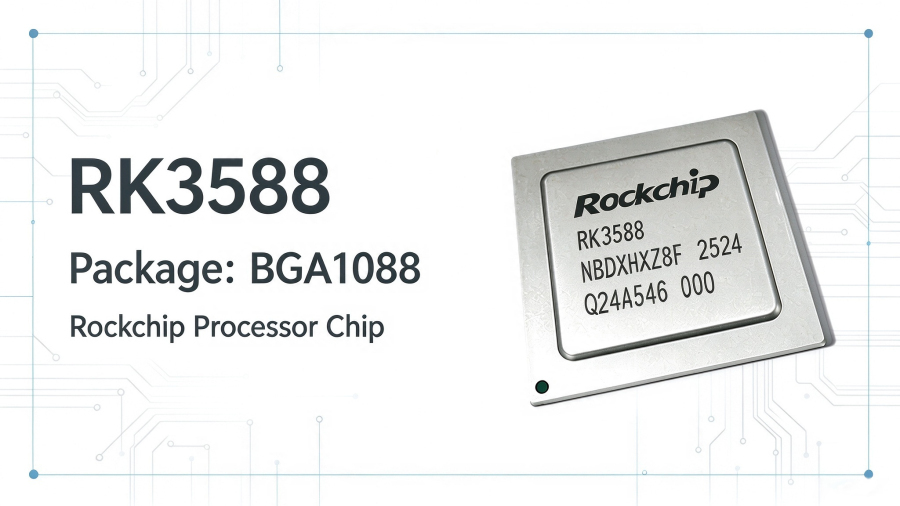
What Can Rockchip RK3588 Do?
RK3588 is one of the SoCs most frequently asked about in recent years: “What exactly can this chip do?” It is indeed heavily stacked: 8-core CPU, 6 TOPS NPU, 8K codec, multi-display independent output, PCIe 3.0—its spec sheet checks almost every box for the “high-end embedded” label. But between a beautiful spec sheet and “being able to get a product running,” there is an entire engineering validation chain. It breaks things down across four levels: where the compute is actually spent, which scenarios can really run, how to choose compared with Jetson, and which pitfalls to avoid before getting started.
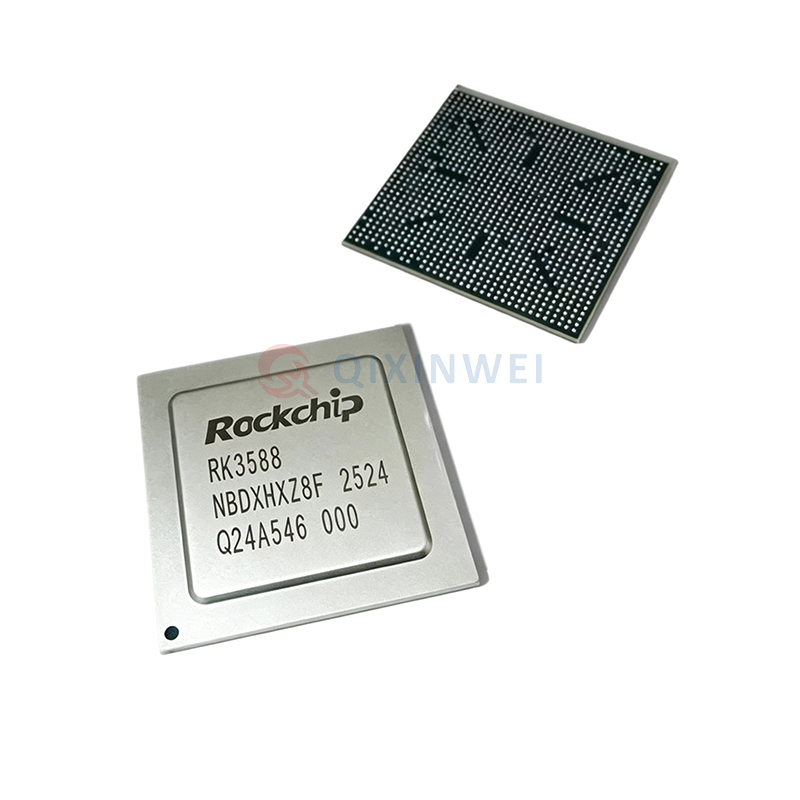
I. First, Understand RK3588’s Real Compute Distribution
RK3588’s compute comes from four mutually independent hardware units. Mixing them together when talking about “performance” is the starting point of selection misjudgment.
CPU: 4× A76 @2.4 GHz + 4× A55 @1.8 GHz. The A76 cores handle heavy-load threads, while the A55 cores cover background tasks and low-power scenarios. This eight-core configuration is in the first tier among ARM embedded SoCs; running a Linux desktop, ROS2, or multi-channel data distribution will not become a bottleneck. But note that the RK3588J industrial-grade version has its A76 downclocked to 1.6 GHz and A55 to 1.3 GHz, and does not support wide-voltage input. Sustained performance in high-temperature environments must be calculated based on the J version’s actual frequencies.
NPU: 6 TOPS (INT4), three-core architecture, supporting mixed INT4/INT8/INT16/FP16/BF16/TF32 operations. This is the part of RK3588 most discussed. 6 TOPS is the peak under INT4 precision; when running INT8 models, the effective compute will decrease. It supports deployment of TensorFlow/PyTorch/Caffe/ONNX models after conversion through the RKNN toolchain. Mixed precision means different layers in the same model can run at the most suitable precision.
VPU: 8K@60fps H.265/VP9 decoding, 8K@30fps H.264/H.265 encoding, 4K@60fps AV1 decoding. This is RK3588’s most easily underestimated hard capability. Many AI boxes claim “support for N-channel video analytics,” but the actual bottleneck is not the NPU; it is the VPU’s decoding throughput and multi-channel scheduling capability. RK3588’s 32-channel 1080p decoding + 24-channel AI analytics running at 8 W relies precisely on VPU hardware decoding to free the CPU from the video streams.
GPU: Mali-G610 MC4, supporting OpenCL 2.2 / Vulkan 1.2. It balances graphics rendering and general-purpose computing, but for the question “can it run large models,” the GPU is not the main force—the NPU is. The GPU’s value on RK3588 lies more in multi-display independent output, 3D interfaces, and lightweight parallel computing.
II. Breaking It Down by Scenario: What RK3588 Can Actually “Run”
Scenario 1: Multi-channel video analytics and intelligent security—RK3588’s home turf
This is the most mature and densely documented direction for RK3588 deployment. The core logic is: VPU hardware-decodes multiple video streams + NPU runs detection models in parallel + CPU handles business scheduling. Each performs its own role, and power consumption remains controllable.
Actual data: Rockchip’s official EVB achieves 32-channel 1080p decoding + 24-channel AI analytics (perimeter intrusion, etc.) at 8 W power consumption, and has been used in Hikvision intelligent NVR devices. The industrial-grade FCU3501 box is based on RK3588J, using its 6 TOPS NPU to simultaneously process 16 channels of 1080p, performing second-level lane control at smart traffic intersections, with an operating temperature range of -40 to +85°C and a fanless design.
Capability boundary: If the models are standard detection/classification tasks in the YOLO series and the channel count is within 16–32 channels of 1080p, RK3588 is one of the most cost-effective ARM solutions currently available. But if NMS-free architecture YOLOv10n is required, measured performance on the RK3588 NPU is poor because the toolchain’s adaptation for models without NMS post-processing is immature. Model-accelerator compatibility determines actual frame rate more than the TOPS number.
Scenario 2: On-device LLMs and multimodal inference—possible, but you must accept trade-offs in accuracy and speed
RK3588’s 6 TOPS NPU plus up to 16 GB LPDDR5 memory does make local execution of LLMs in the 2B–7B parameter class possible. Rockchip has completed low-level tuning for the Gemma and Qwen3.5 series, and measured first-token latency for Gemma4 can be as low as 169.93 ms. There are community cases of cooperatively running five types of models—such as Qwen3-VL, MoE, vector embeddings, and YOLO detection—on a 16 GB RK3588. On-device porting of DeepSeek-R1 also has implementation practice, and the toolchain path has been established.
But the gap between “can run” and “runs well” must be made clear. On the same NPU, measured performance on YOLOv8n is 34.6 FPS, indeed exceeding the same-model performance of Jetson Orin NX and Orin Nano Super; however, in end-to-end multi-stage pipelines (preprocessing + inference + post-processing + decoding), RK3588’s measured throughput may be significantly lower than Jetson’s, with some tests showing a gap of about 11×. The reason is that Jetson’s TensorRT performs deeper operator fusion and scheduling optimization across the entire pipeline, while RKNN acceleration is concentrated on the inference stage itself.
One-sentence boundary: For single-model, inference-intensive scenarios sensitive to first-token latency, RK3588 is sufficient and outstanding in cost-effectiveness; for multi-stage complex pipelines with hard end-to-end throughput targets, a complete real-chain measurement must be done first—do not infer system frame rate from NPU FPS.
Scenario 3: Robotics—a domestic foundation based on ROS2 + NPU is taking shape
RK3588’s positioning in robotics is becoming increasingly clear: act as the “brain,” not the “cerebellum.” The upper layer runs ROS2, SLAM, visual perception, and task decision-making; lower-layer motion control is handed to real-time MCUs such as STM32, with heterogeneous cooperation over CAN bus.
An open-source solution has validated this architecture: RK3588 (ROS2 + NPU) + STM32F407 (FreeRTOS) communicate over CAN at 500 kbps, running slam_toolbox laser SLAM and Navigation2 autonomous navigation. Rockchip’s official SDK is deeply customized based on Debian 11 + ROS2, covering the complete chain from visual perception to decision-making interaction, and has been used in humanoid robots, robot dogs, AGVs, industrial inspection, and other forms. Advantech’s rugged vision controller AFE-R761 is also based on RK3588 and targets AMR and in-vehicle auxiliary monitoring scenarios.
Capability boundary: Perception-layer tasks such as SLAM mapping, multi-sensor synchronization, and visual detection are handled comfortably by RK3588. But if the robot requires hard real-time control loops (microsecond-level jitter requirements), Linux on RK3588 cannot replace an MCU even with an RT patch; heterogeneous division of labor is mandatory, not optional.
Scenario 4: Smart cockpit and multi-display—hardware foundation is sufficient, but automotive-grade thresholds are a separate matter
RK3588 supports up to 7 independent displays (instrument cluster + center console + rear-seat entertainment), and Lianzhitongda’s R58C core board has been adapted for factory-installed programs at automakers such as BYD; the RK3588M automotive-grade version has passed AEC-Q100 certification, operates over a wide temperature range of -40°C to 85°C, and is used for autonomous-driving data fusion.
But there is a common misreading here: standard RK3588 and the RK3588M automotive-grade version are two product lines. Consumer/industrial RK3588 is fine for cockpit prototype validation, but mass-production factory-installed programs must switch to the automotive-grade model; the requirements for functional safety certification and supply chain traceability are not on the same level.
Scenario 5: Medical imaging and industrial vision—a combination of high resolution + local AI
RK3588’s 48 MP ISP and 8K DICOM data processing capability have clear deployment in medical imaging equipment: United Imaging Intelligence’s CT machine uses the RK3588 EVB to accelerate CT image reconstruction, with official comparisons claiming processing speed up to 2× that of GPU solutions; an endoscope solution uses the 6 TOPS NPU for polyp detection and bleeding point annotation, with accuracy exceeding 95%. On the industrial side, an RK3588 + FPGA solution achieves sub-millimeter positioning in AGV navigation, with SLAM latency <3 ms.
Capability boundary: The core of such scenarios is not “whether the NPU has enough compute,” but the ISP’s image quality and deterministic latency. The requirements of medical and industrial vision for image consistency, exposure control, and low latency often become bottlenecks before model accuracy does; during selection, the validation cost of the ISP chain and sensor adaptation must be included.
III. RK3588 vs Jetson Orin: Not “Who Is Stronger,” but “Whose Money Is Better Spent”
This is an unavoidable comparison during selection. Here is the conclusion directly:
In terms of cost-effectiveness, RK3588 has a clear advantage. A comparative study published in 2026 used the YOLO series as a benchmark to measure the inference performance and cost efficiency of four edge AI accelerators, concluding that the FPS per USD of RK3588 and Hailo-8 is 2.2–7.8× that of the Jetson platform; on YOLOv8n single-model inference, RK3588’s 34.6 FPS exceeds Orin NX and Orin Nano Super.
Jetson still leads in peak compute and toolchain maturity. The GPU compute of Jetson Orin NX is far higher than the NPU of RK3588, and TensorRT’s end-to-end optimization depth for complex pipelines is also greater. Measured tests show that in a complete pipeline including preprocessing and post-processing, Jetson’s throughput can reach about 11× that of RK3588. This means: if your workload is single-model detection, RK3588’s unit-cost advantage is huge; if your workload is multi-stage, heterogeneous in operators, and has hard end-to-end latency constraints, Jetson’s high premium buys toolchain maturity and determinism.
A middle option: If RK3588’s NPU happens to be right at the critical point for a certain model, consider the RK3588 + Hailo-8 M.2 combination. Hailo-8 achieves 101.2 FPS on YOLOv8s, about 4.6× that of the Jetson platform, and can serve as a compute supplement to RK3588’s built-in NPU.
IV. Toolchain and Pitfalls You Must Know Before Getting Started
The toolchain path is mature: on the PC side, RKNN-Toolkit2 is used for model conversion, quantization, and accuracy evaluation; on the board side, the RKNPU2 runtime executes inference. It supports direct conversion of PyTorch, TensorFlow, and ONNX; after INT8 quantization, the official claimed inference speed improvement is about 40%. LLMs use the RKLLM path; HuggingFace-format models can be converted to RKLLM and then hardware-accelerated on the NPU.
But the following pitfalls must be eliminated before the project starts:
Quantization accuracy loss is not something that can be “fixed with a quick tweak.” Accuracy drops after INT8 quantization, unsupported operators, and post-processing that must be split out of the model and run on the CPU—these are normal in RKNN deployment. First run a complete accuracy-speed evaluation of the target model on RKNN-Toolkit2, then decide the hardware budget; the order cannot be reversed.
The frequency and wide-voltage limitations of the industrial-grade J version must be confirmed in advance. RK3588J’s A76 runs at 1.6 GHz, and some fully domestic core boards do not support wide-voltage input. If the product specification writes thermal and performance budgets based on 2.4 GHz, they will directly fail to match after switching to the J version in mass production.
The bottleneck for multi-channel video is usually the VPU and memory bandwidth, not the NPU. When planning channel count, first calculate the VPU decoding load and DDR bandwidth usage based on target resolution and frame rate, then allocate the model inference budget to the NPU. Decoding 32 channels of 1080p alone already consumes a considerable portion of bandwidth; the NPU’s 6 TOPS is not the only constraint.
On-device LLM deployment must be evaluated separately by “first-token latency” and “sustained throughput.” The 169 ms first-token latency is an optimized ideal value; in actual products, prompt length, context window, and concurrent requests will significantly change the perceived experience. Use real business prompts for stress testing, not just short benchmark inputs.
FAQ
Q: What is the main difference between RK3588 and RK3588S?
A: The CPU, GPU, and NPU are identical. The RK3588 has more PCIe lanes (including PCIe 3.0), SATA interfaces, and a larger package for full industrial motherboards. The RK3588S is a cost-optimized, smaller package designed for single board computers (SBCs) with fewer high-speed I/O requirements.
Q: Can the RK3588 run large language models (LLMs) locally?
A: Yes, but with constraints. The 6 TOPS NPU can run small to medium quantized LLMs (e.g., 1B to 3B parameter models) at usable speeds. For larger models, the 32GB RAM configuration is essential. You must use Rockchip’s RKLLM or RKNN toolkit to quantize and deploy the model.
Q: How many cameras can the RK3588 process simultaneously?
A: The SoC supports multiple MIPI-CSI inputs. In practical deployments (like NVRs), it can decode and analyze 24 to 32 channels of 1080p video, depending on the complexity of the AI model and the NPU load. The bottleneck is usually memory bandwidth and thermal limits, not the raw interface count.
Q: What video codecs does the RK3588 support?
A: The VPU supports 8K@60fps H.265, VP9, AV1, and AVS2 decoding, as well as 8K@30fps H.264/H.265 encoding. It also supports multiple 4K streams simultaneously, making it ideal for multi-display commercial systems.
Q: What operating systems are supported?
A: The RK3588 has robust support for Linux (Debian, Ubuntu), Android, and various real-time operating systems (RTOS) via the co-processor cores. Mainline Linux kernel support is mature, which is critical for long-term product maintenance and security updates.
Summary
What RK3588 can do is get products running and into mass production at a unit cost far below Jetson in scenarios such as multi-channel video, edge vision, ROS2 robotics, low-to-medium-parameter on-device LLMs, and 8K multimedia. What it cannot do is replace Jetson for high-complexity end-to-end GPU pipelines, nor can it use a single SoC to simultaneously cover hard real-time control and the Linux application layer. Only by placing it in the position of “the brain for perception and decision-making,” rather than “an all-purpose chip that must do everything,” does this chip’s cost-effectiveness truly hold.
Shenzhen Qixinwei Technology Co., Ltd. focuses on electronic component supply, BOM kitting, part number matching, and supply chain solutions, and can assist in selecting corresponding products according to specific project requirements.
0users like this.