Electronic components
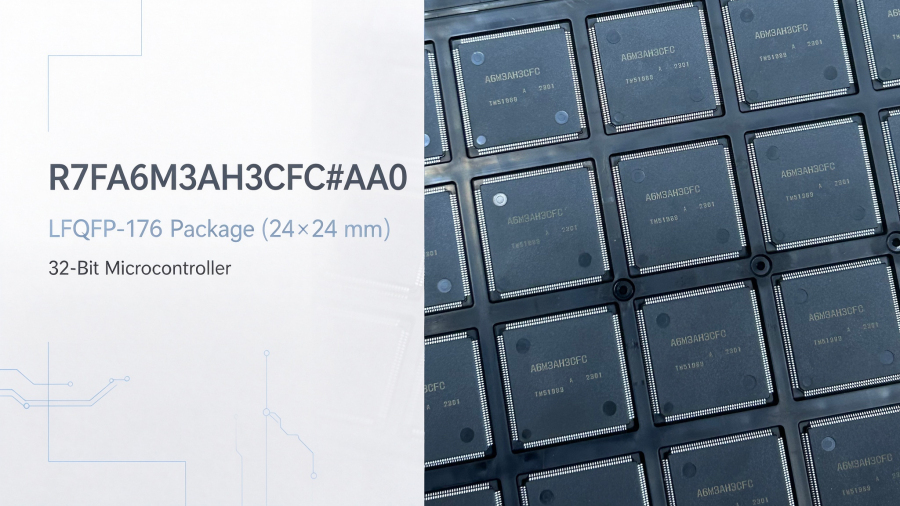
R7FA6M3AH3CFC#AA0 Renesas RA6M3 Series MCU Guide:120 MHz Cortex-M4 with TFT Controller, Ethernet MAC,176-LQFP
R7FA6M3AH3CFC#AA0 Overview
R7FA6M3AH3CFC#AA0 is a high-performance 32-bit microcontroller in Renesas Electronics' RA6M3 series. It is based on the Arm Cortex-M4F core, integrates a floating-point unit (FPU), and operates at up to 120 MHz. The chip includes 2 MB code flash, 640 KB SRAM, and 64 KB data flash, and integrates a TFT LCD controller, a 2D graphics accelerator, and a JPEG decoder. It is housed in a 176-pin LFQFP package (24 × 24 mm, 0.5 mm pitch) and operates over a temperature range of -40°C to +105°C.
The RA6M3 series uses a 40 nm low-power process and is positioned as a "high-performance graphics and connectivity MCU." Its core differentiation lies in the integrated TFT controller and 2D drawing engine, which can directly drive RGB-interface displays without an external display controller. It also features rich connectivity peripherals such as an Ethernet MAC (with DMA), USB 2.0 High-Speed (HS) interface, and SDHI, making it an ideal choice for IoT applications such as small- and medium-sized HMIs, industrial gateways, and smart home appliances.
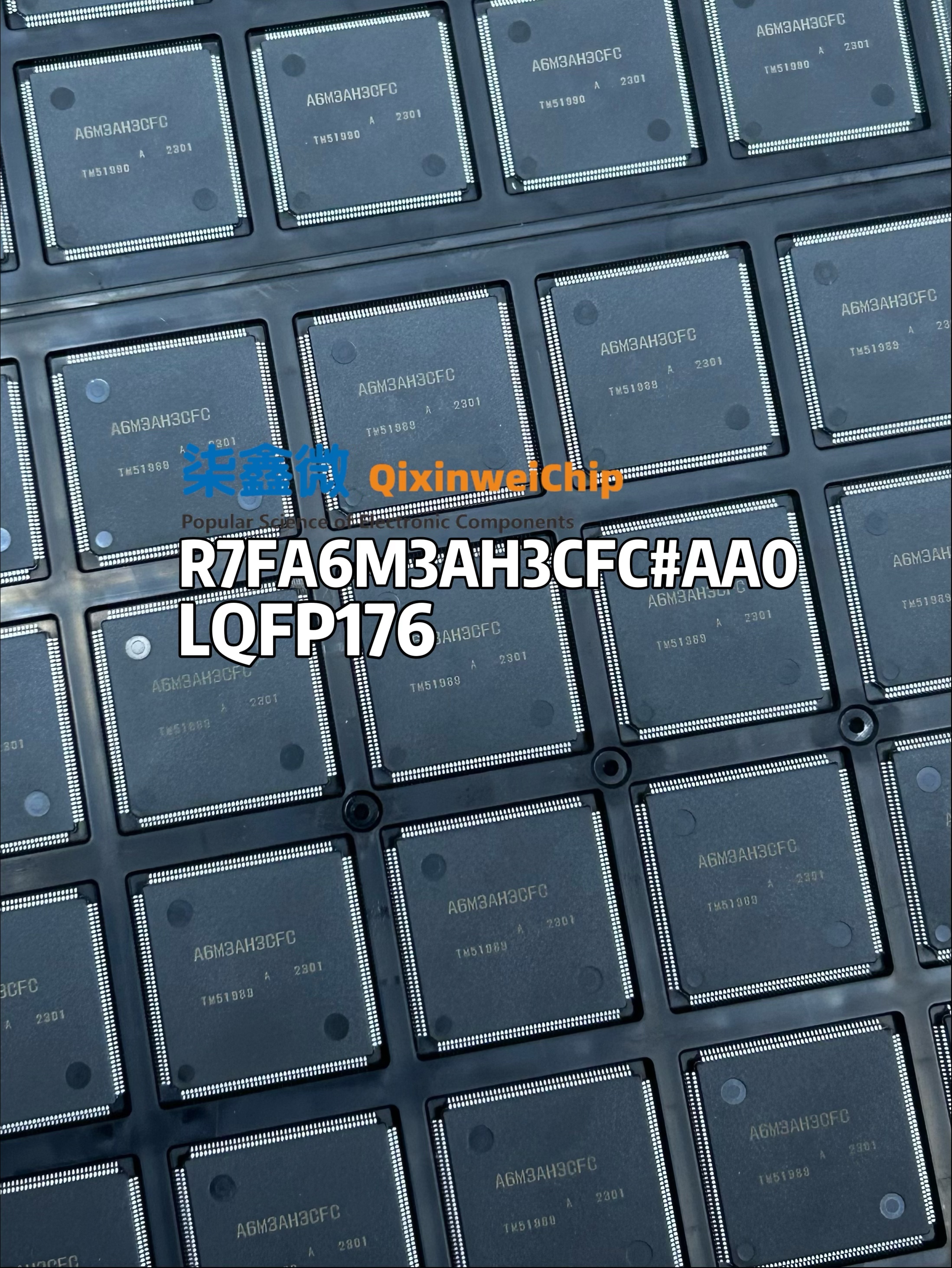
| Series | RA6M3 |
| Core | Arm Cortex-M4F (with FPU) |
| Maximum Clock Frequency | 120 MHz |
| Code Flash | 2 MB |
| SRAM | 640 KB |
| Data Flash | 64 KB (EEPROM function) |
| Package | LFQFP-176 (24 × 24 × 1.7 mm, 0.5 mm pitch) |
| I/O Ports | 124 |
| Operating Voltage | 2.7 V to 3.6 V |
| Operating Temperature | -40°C to +105°C |
| ADC | 24-channel 12-bit SAR |
| DAC | 2-channel 12-bit |
| Graphics Acceleration | TFT LCD controller + 2D drawing engine + JPEG decoder |
| Ethernet | 10/100M MAC (with dedicated DMA, IEEE 1588 PTP) |
| USB | USB 2.0 High-Speed (host/device) + USB 2.0 Full-Speed (host/device) |
| Communication Interfaces | CAN 2.0B (2 channels), SCI/UART (10 channels), SPI (2 channels), I2C (2/3 channels), SDHI (2 channels), Quad SPI |
| Security Features | Unique ID, TRNG, AES (128/192/256), ECC/RSA, SHA224/SHA256, GHASH |
Core Differentiating Advantage
The most prominent feature of the R7FA6M3AH3CFC#AA0 is its integrated graphics display subsystem. The TFT LCD controller can directly drive RGB-interface panels and supports parallel display output; the 2D drawing engine can hardware-accelerate graphics drawing operations (such as lines, rectangle fills, and bit block transfers); and the JPEG decoder can decode JPEG images at the hardware level, significantly reducing the CPU load for graphics processing. With Renesas' SEGGER emWin GUI library and AppWizard tool, developers can quickly build smooth graphical user interfaces. In actual cases, the RA6M3 has been used in a 480 × 272 resolution TFT screen solution for vertical water heater export products, driving animation and data display.
Connectivity and Peripheral Integration
The Ethernet MAC is equipped with an independent DMA channel and supports the IEEE 1588 PTP precision time protocol, making it suitable for industrial Ethernet and real-time communication scenarios. The USB 2.0 High-Speed (HS) interface provides transfer rates up to 480 Mbps, while retaining a USB Full-Speed (FS) channel for debugging or auxiliary communication. The SDHI interface supports SD card storage expansion, and Quad SPI can be used to connect external Flash or RAM. The chip also provides 2-channel CAN 2.0B, 10-channel SCI/UART, 2-channel SPI, and 2/3-channel I2C, meeting the diverse communication requirements of industrial control and IoT devices.
Features
The RA6M3 integrates a complete hardware security engine, including a true random number generator (TRNG), an AES encryption accelerator (supporting 128/192/256-bit keys), ECC/RSA public-key acceleration, SHA224/SHA256 hashing, and GHASH authenticated encryption. The chip provides a Unique ID for device identity recognition and has passed SESIP Level 1 security certification, verifying its ability to resist physical and logical attacks. For IoT devices requiring secure boot, secure firmware upgrade, or encrypted communication, these hardware security resources can significantly reduce the difficulty of security compliance.
Application Scenarios
Small- and medium-sized HMIs and display terminals. The chip's TFT controller and 2D accelerator make it very suitable for industrial HMIs, home appliance color screens, smart thermostats, and other devices requiring graphical display. The 120 MHz clock frequency and 640 KB SRAM provide ample computing and cache resources for GUI rendering.
Industrial control and robotics. The RA6M3's Ethernet MAC, CAN interface, and rich timer resources make it suitable for real-time control of industrial robots, gate controllers, sewing machines, vending machines, UPS systems, and other equipment.
Smart home and building automation. The chip is suitable for mid-range thermostats, smart panels, and security systems (fire detection, anti-theft alarms, panel control). The Ethernet and USB HS interfaces support high-speed data exchange with home gateways and cloud platforms.
Consumer electronics and home appliances. The RA6M3 has been used in home appliance color screen solutions and supports UL60730 certification requirements, making it suitable for white goods and consumer electronics requiring graphical interfaces and networking functions.
What the MCU actually has to survive
An MCU in a production HMI or gateway is not a dev board on a desk. It is the core of a system that has to render pixels, move packets, and respond to touch — all at the same time, for years. It has to hold up when the environment stops being friendly.
· Graphics throughput without an external controller. The TFT controller supports direct connection to RGB panels, and the 2D drawing engine (D/AVE 2D) accelerates line drawing, rectangle fills, and alpha blending. The JPEG decoder handles baseline and progressive JPEG images in hardware. Together, these blocks offload the CPU from pixel pushing, leaving the Cortex-M4 free for control logic and communication. Published HMI designs use the EK-RA6M3 with a 4.3-inch 480 x 272 pixel TFT display with capacitive touch overlay, driven directly from the MCU. The 640 KB of SRAM provides frame buffer headroom that most Cortex-M4 devices cannot match.
· Ethernet with hardware timestamping. The Ethernet MAC supports 10/100 Mbps operation with individual DMA channels and IEEE 1588 PTP hardware timestamping. This is not a software TCP/IP stack bolted onto a UART — it is a dedicated MAC with DMA that can sustain high data throughput without CPU intervention. For industrial gateways that need deterministic time synchronization, the PTP hardware support eliminates the jitter of software timestamping.
· USB High-Speed for data-intensive peripherals. The RA6M3 includes both USB 2.0 Full-Speed (host/device) and USB 2.0 High-Speed (host/device) interfaces. USB HS at 480 Mbps is unusual in Cortex-M4 class devices and is essential for applications that connect cameras, external storage, or high-bandwidth sensors. The USB HS interface shares the same DMA architecture as the Ethernet MAC, ensuring both can run simultaneously without starving the CPU.
· Touch sensing with hardware support. The capacitive touch sensing unit (CTSU) supports up to 18 channels and operates autonomously — it does not require CPU cycles to scan electrodes. In an HMI panel, this means the touch interface continues to respond even when the CPU is busy rendering graphics or processing network packets.
· Security and safety features. The RA6M3 includes the Secure Crypto Engine 7 (SCE7) with AES 128/192/256, ECC/RSA, SHA224/SHA256, GHASH, a true random number generator, and a unique ID. This provides the hardware foundation for secure boot, secure firmware update, and protection of cryptographic keys — without consuming CPU cycles for encryption
Where the R7FA6M3AH3CFC#AA0 fits — and where it doesn’t
The R7FA6M3AH3CFC#AA0 is the right choice when the product needs a graphical user interface with a TFT panel, Ethernet connectivity, USB High-Speed, and enough flash and RAM to run both the HMI and the application logic on a single chip. Industrial HMI panels, smart home control terminals, security panel controllers, vending machine interfaces, robotics teach pendants, and industrial gateways all fit.
It is the wrong choice when the design needs a Cortex-M7 or Cortex-A class processor for high-resolution graphics (1080p or above), multi-core processing, or an applications-class operating system. The RA6M3 is a high-performance MCU: it runs bare-metal or an RTOS, not Linux. Pick the RA6M3 when the display is mid-size (up to 480 x 272 or similar), the OS is FreeRTOS or bare-metal, and the value is integration — graphics, networking, and USB on one chip. Pick an MPU when the workload is a full graphical OS or 1080p video pipeline.
FAQs
Q1: When using SEGGER emWin, hardware acceleration cannot be enabled in color modes below 16 bits. How can this be solved?
This is a common problem in RA6M3 graphics development. Hardware acceleration is available only in 16-bit and higher color modes. When using 8-bit or lower color modes, emWin reports "Hardware acceleration is not supported in this color mode." Solution: Switch the display color mode to 16-bit (RGB565). If a Flash overflow error occurs after switching, it is usually because the total amount of application code and data exceeds the Flash capacity. Optimization directions: Enable optimization levels in the compiler options (such as -O2 or -Os); place the frame buffer and large graphics data in external SDRAM rather than on-chip Flash.
Q2: During screen switching, digital displays created with Mask become abnormal or disappear. How can this be troubleshooted?
Some developers have reported that graphical digits created with Mask in AppWizard randomly display incorrectly or disappear during screen switching. Troubleshooting directions: Confirm the version compatibility of FSP and AppWizard—it is recommended to use FSP 5.9 or later, which includes emWin 6.48 and may have fixed display-related issues in older versions. If the problem persists, try forcing a refresh of the entire display area during screen switching instead of updating only the changed area; or replace the Mask digits with ordinary text controls for comparative testing to determine whether the issue is with the Mask mechanism itself or with the graphics driver timing.
Q3: After setting pin P408, the MCUBoot startup process is blocked. How can this be solved?
In the FSP 5.6.0 environment, some developers have encountered program blocking after setting pin P408. Analysis: P408 may be occupied by MCUBoot or startup code, and configuring this pin in a bootloader project will conflict with the startup process. Solution: Remove the ioport stack from the bootloader project to reduce the bootloader image size and avoid pin configuration conflicts; or defer the use of P408 to the application stage rather than initializing it in the bootloader. If this pin must be used, try mapping it to another GPIO not occupied by startup code.
Q4: When Ethernet is not connected to a cable, the system becomes abnormal under Azure RTOS. How should this be handled?
When using Azure RTOS and FSP 3.5, if the Ethernet cable is intentionally unplugged, the system may enter an abnormal state due to link status detection logic. Solution: Add robust link status checks during Ethernet driver initialization—when a link down is detected, avoid executing operations that depend on the link being ready; enable link status callbacks at the TCP/IP stack layer and reinitialize the network interface after link recovery. If using the FSP Ethernet driver, check the link status handling configuration of the rm_ether module to ensure that a link down does not block the protocol stack.
Q5: What alternative models are available in the same series?
The RA6M3 series offers multiple package and flash capacity options. The R7FA6M3AH3CFB (LQFP-144) and R7FA6M3AH3CFP (LFQFP-100, 14 × 14 mm) are not fully pin-compatible with #AA0, but have the same core specifications and are suitable for scenarios with different PCB area requirements. The R7FA6M3AH2CBG (LFBGA-176) provides the same 176 pin count but a different package type. If TrustZone security features are required, the RA6M4 or RA6M5 series can be evaluated; if a TFT controller is not required, the RA6M2 series can provide a more economical cost option.
Conclusion
The R7FA6M3AH3CFC#AA0 is a highly integrated MCU in Renesas' RA6M3 series, aimed at graphics display and high-speed connectivity applications. The 120 MHz Cortex-M4F core, together with a 2 MB Flash + 640 KB SRAM memory configuration, provides ample computing resources for graphics rendering and real-time control; the integrated TFT controller, 2D drawing engine, and JPEG decoder allow it to drive small- and medium-sized RGB displays without an external display controller; and the combination of Ethernet MAC, USB 2.0 HS, and SDHI interfaces meets the wired connectivity and storage expansion requirements of industrial IoT devices. The hardware security engine (AES/ECC/RSA/TRNG) and SESIP Level 1 certification further enhance its suitability for security-sensitive applications. In actual development, developers should focus on the color mode requirements for graphics acceleration (must be ≥16-bit), optimization strategies for Flash overflow (enable compiler optimization or place data externally in SDRAM), compatibility between MCUBoot and pin configuration, and the choice of FSP version (it is recommended to use 5.9 or later to obtain the latest emWin support). With the EK-RA6M3 evaluation kit and FSP development environment, development from a graphical interface prototype to production firmware can be completed quickly.
Shenzhen Qixinwei Technology Co., Ltd. focuses on electronic component supply, BOM kitting, part number matching, and supply chain solutions, and can assist in selecting corresponding products according to specific project requirements.
0users like this.