Electronic components
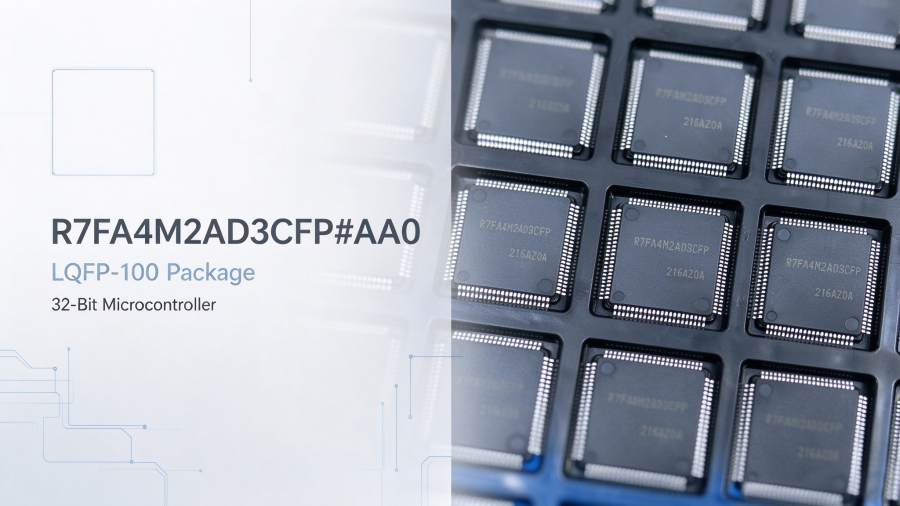
R7FA4M2AD3CFP#AA0 Renesas RA4M2 Series MCU Guide
If you are picking an MCU for a new secure industrial or IoT design, the first question is not “which core runs fastest” — it is “what does this chip actually have to protect.” A smart meter and a factory PLC look nearly identical on a datasheet and behave nothing alike once a hostile network is involved. Get that distinction right and the rest of the selection is mostly arithmetic.
1.What the R7FA4M2AD3CFP#AA0 is
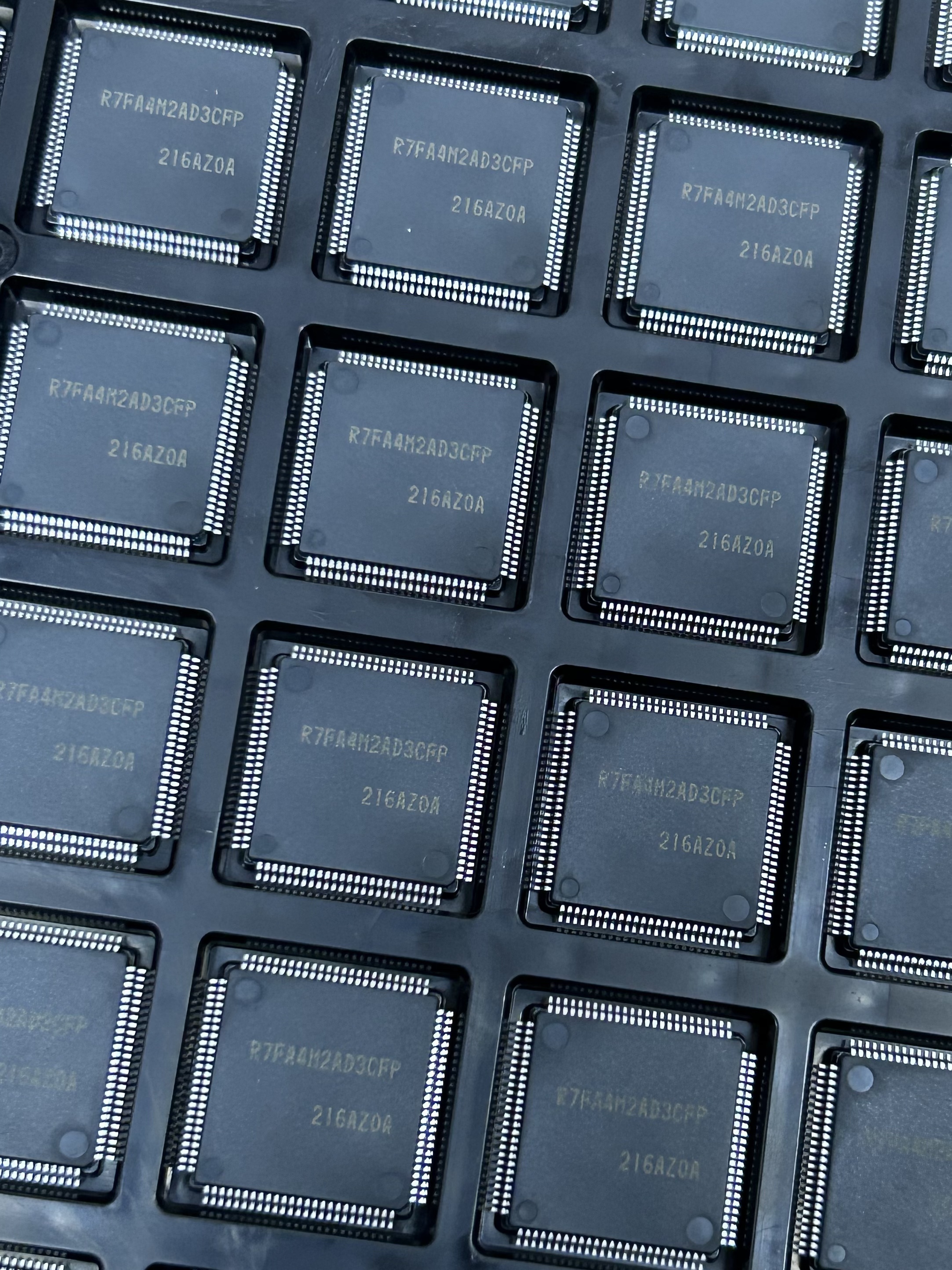
R7FA4M2AD3CFP#AA0 is a high-performance 32-bit microcontroller in Renesas Electronics' RA4M2 series. It is based on the Arm Cortex-M33 core, integrates TrustZone security extensions and a Secure Crypto Engine (SCE), and operates at up to 100 MHz. The chip is manufactured using a 40 nm low-power process, with operating power consumption of only 80 µA/MHz (CoreMark algorithm), standby current as low as 0.7 mA, and wake-up time of only 30 µs, achieving an excellent balance between performance and power consumption. The chip includes 512 KB code flash, 8 KB data flash, and 128 KB SRAM (with ECC), is housed in a 100-pin LQFP package (14 × 14 mm), provides 78 I/O ports, and operates over a temperature range of -40°C to +105°C, making it suitable for industrial-grade and consumer-grade embedded applications.
The RA4M2 series is positioned as a "high-performance, high-security, low-power" general-purpose MCU. Its TrustZone security architecture, combined with the SCE crypto engine, enables hardware-level security isolation and cryptographic operations, meeting the stringent requirements of IoT devices for data security and privacy protection. The chip has obtained PSA Certified Level 2 and SESIP Level 1 security certifications, providing strong assurance for product security compliance.
2. Chip Specifications, Features, and Application Scenarios
2.1 Core Specifications
| Manufacturer | Renesas Electronics |
| Series | RA4M2 |
| Core | Arm Cortex-M33 (with TrustZone, FPU) |
| Maximum Clock Frequency | 100 MHz |
| Code Flash | 512 KB |
| Data Flash | 8 KB (can emulate EEPROM) |
| SRAM | 128 KB (with ECC) |
| I/O Ports | 78 |
| Package | LQFP-100 (14 × 14 × 1.7 mm, 0.5 mm pitch) |
| Operating Voltage | 2.7 V to 3.6 V |
| Operating Temperature | -40°C to +105°C |
| ADC | 13-channel 12-bit SAR ADC |
| DAC | 2-channel 12-bit |
| Timers | 4 × 32-bit GPT + 4 × 16-bit GPT + 6 × AGT |
| Communication Interfaces | USB FS (host/device), CAN, SCI/UART (6 channels), SPI, QSPI, I2C, SDHI |
| Security Features | TrustZone, SCE (AES/RSA/SHA/TRNG), secure boot |
| Package Dimensions | 14 mm × 14 mm × 1.7 mm |
| Moisture Sensitivity Level | MSL 3 (168 hours) |
2.2 Security Features (Core Differentiating Advantages)
The security capability of the RA4M2 series is its core competitiveness that distinguishes it from ordinary general-purpose MCUs. The chip integrates Arm TrustZone security extensions, enabling hardware isolation between the secure and non-secure domains. Combined with Renesas' in-house Secure Crypto Engine (SCE), it supports cryptographic algorithms such as AES-128/256, RSA-2048, and SHA-256, and provides key management, secure boot, and side-channel attack resistance. The SCE has also obtained NIST CAVP certification, and the correctness of its cryptographic algorithm implementation has been authoritatively verified. In addition, the RA4M2 supports Secure Firmware Installation (SFI) and secure debug authentication. Developers can use the TF-M (Trusted Firmware-M) component in FSP to quickly build secure applications based on the PSA Certified Crypto API.
2.3 Low-Power Design
The RA4M2 uses a 40 nm process and performs excellently in power control. In operating mode, the operating current is only 80 µA/MHz (CoreMark algorithm), standby current is as low as 0.7 mA, and wake-up from standby mode takes only 30 µs. The chip supports multiple low-power modes, including Sleep, Snooze, Software Standby, and Deep Software Standby, allowing developers to flexibly choose according to the application scenario to optimize power consumption. Dynamic voltage and frequency scaling (DVFS) technology further improves energy efficiency, giving the chip significant advantages in battery-powered portable devices and long-running industrial monitoring equipment.
2.4 Key Features
Rich peripheral integration. The chip integrates a 13-channel 12-bit ADC, 2-channel 12-bit DAC, 8 GPT timers (4 × 32-bit + 4 × 16-bit), 6 AGT timers, and a 12-channel capacitive touch sensing unit, meeting various application requirements such as sensor data acquisition, motor control, and touch interaction.
Comprehensive communication interfaces. It integrates a USB full-speed controller (host/device mode), CAN bus, 6-channel SCI (configurable as UART/I2C/SPI), QSPI, SDHI (SD card interface), etc., supporting high-speed data exchange with a variety of external devices.
Mature development ecosystem. Renesas provides the Flexible Software Package (FSP) and e2 studio IDE, built on FreeRTOS and supporting RTOS and middleware extensions. It is compatible with Keil MDK and IAR EWARM toolchains, significantly accelerating development cycles.
2.5 Typical Application Scenarios
Industrial automation and motor control. The RA4M2's 8 GPT timers (including 4 32-bit high-precision timers) can output multiple PWM waveforms and are widely used in motor control, LED dimming, and servo drive applications. The CAN interface and wide operating temperature range (-40°C to +105°C) make it suitable for industrial field equipment.
Smart wearables and smartwatch displays. In smartwatch display solutions, the RA4M2 serves as the core processor, responsible for sensor data fusion, algorithm processing, display driving, and wireless communication control. Its 100 MHz clock frequency, combined with low-power characteristics, can extend battery life while ensuring system performance.
IoT security terminals. The combination of TrustZone and SCE makes the RA4M2 very suitable for IoT terminal devices requiring secure boot, secure communication, and data encryption, such as smart locks, secure sensor nodes, and industrial gateways.
Smart home and building automation. The 12-channel capacitive touch sensing unit can be used for touch panels and button control, and the rich communication interfaces support interconnection with WiFi/BLE modules and sensor nodes.
Portable medical devices. Low-power operation and fast wake-up characteristics make it suitable for portable health monitoring devices requiring long battery life.
3.Where the R7FA4M2AD3CFP#AA0 fits — and where it doesn’t
The R7FA4M2AD3CFP#AA0 is the right choice when the product needs a secure, power-efficient MCU with hardware root of trust, advanced PWM for motor control, and industrial communication interfaces. Servo motor control for robot limbs, industrial PLC, elevator control systems, infusion pumps, IO-Link sensors, smart meters, and fire/security detection panels all fit.
It is the wrong choice when the design needs an applications processor — Linux, multi-camera input, or NPU-class inference. That is SBC territory. The RA4M2 is an MCU: it runs bare-metal or an RTOS, not a full OS. Pick the RA4M2 when the workload is deterministic control and security; pick an MPU when the workload is a graphical interface or a full network stack.
At QIXINWEI (Shenzhen Qixinwei Technology Co., Ltd.), we have spent 13 years supplying Renesas RA family microcontrollers, Arm Cortex-M33 devices, and the broader embedded ecosystem alongside full PCBA assembly. If you are mid-selection and want a second pair of eyes on the MCU, the security configuration, or the supporting components, send the spec or the BOM and we will flag the risks before you commit.
FAQ
Q: What is the difference between the RA4M2 and RA4M1?
A: Both use the Arm Cortex-M33 core, but the RA4M2 runs at 100 MHz with 512 KB flash and 128 KB SRAM, while the RA4M1 runs at 48 MHz with lower memory density. The RA4M2 also includes CAN bus, USB, and a wider peripheral set. The RA4M1 is the lower-cost, lower-power option for simpler control applications.
Q: Does the RA4M2 support TrustZone?
A: Yes. The RA4M2 includes Arm TrustZone for hardware-enforced isolation of secure and non-secure code and data. Combined with the Secure Crypto Engine 9 (SCE9), it provides the hardware foundation for secure boot, secure firmware update, and protection of cryptographic keys.
Q: What is the Secure Crypto Engine 9 (SCE9)?
A: The SCE9 is a hardware security module integrated into the RA4M2. It supports AES 128/256-bit encryption, SHA-256 hashing, HMAC-SHA256, RSA, and a true random number generator. Key information is stored only inside the SCE9, and all external access can be blocked — the module shuts down if accessed without the correct protocol.
Q: How many PWM channels does the RA4M2 have for motor control?
A: The RA4M2 includes general PWM timer (GPT) modules that generate high-precision PWM signals. Published motor control projects use the GPT7 timer at 120 MHz clock to produce PWM from 1600 Hz to 19200 Hz. The GPT can also trigger the ADC for synchronized current sampling.
Q: What is the difference between the EK-RA4M2 evaluation board and the Clicker 4 development board? How should I choose?
The EK-RA4M2 is Renesas' official full-featured evaluation kit, with an onboard SEGGER J-Link debugger, 32 MB external Quad-SPI flash, USB full-speed host/device interface, and five ecosystem expansion interfaces such as mikroBUS, Qwiic, and Grove. It is suitable for in-depth performance evaluation and complete application development. Clicker 4 for R7FA4M2AD3CFP is a compact development board from MIKROE, equipped with four mikroBUS sockets and an onboard CODEGRIP programmer/debugger, supporting USB-C programming and debugging, and is more suitable for rapid prototype verification and concept testing. If comprehensive peripheral verification and power measurement are required, the EK-RA4M2 is recommended; if the goal is to quickly build a functional prototype, Clicker 4 is more convenient.
Conclusion
R7FA4M2AD3CFP#AA0 is a general-purpose MCU in Renesas' RA4M2 series that combines high performance, high security, and low power consumption. The 100 MHz Cortex-M33 core, together with TrustZone and the SCE security engine, gives it significant differentiated advantages in the industrial IoT and intelligent terminal fields; the 80 µA/MHz operating power consumption and 0.7 mA standby current also make it perform well in battery-powered and long-running scenarios. Rich peripheral resources—including a 13-channel ADC, 8 GPT timers, and communication interfaces such as CAN/USB/SDHI—provide ample hardware support for applications such as motor control, sensor fusion, and display driving. In actual development, developers should focus on the reasonable configuration of the Flash protection mechanism, safe operation of registers for pins that are not brought out, and version compatibility of the FSP toolchain. With the EK-RA4M2 evaluation kit or Clicker 4 development board, together with FSP and e2 studio, development from prototype verification to production firmware can be completed quickly.
0users like this.