Electronic components
AVR Supply Disruptions and MCU Sourcing Risk: A Practical Guide to MCU Selection and Replacement
Introduction
The supply disruptions and price increases seen across some AVR microcontroller models have left hardware teams with an important lesson: an MCU should not be treated as just another line item in the BOM.
For products with a long production cycle, replacing an MCU can involve much more than changing the part number. Hardware designers may need to modify the PCB, while firmware engineers may need to port drivers, clocks, peripherals, boot code, and communication interfaces. Additional EMC, ESD, temperature, reliability, and system-level testing may also be required.
This is why MCU selection needs to consider both technical performance and supply-chain continuity.
AVR remains an important legacy MCU family, particularly in existing products and embedded designs. At the same time, STM32, NXP, Microchip, Infineon, GD32, AT32, STC, Espressif, and other MCU platforms provide different options for new designs.
For a new project, the question is not simply whether an imported MCU or a domestic MCU is better. The more practical question is whether the selected MCU can meet the application's performance requirements, remain available throughout the product lifecycle, and have a realistic replacement option if supply conditions change.
1. What Happened to AVR MCU Supply?
AVR is an 8-bit RISC microcontroller architecture originally developed by Atmel. The family eventually expanded into several well-known product lines, including ATtiny, ATmega, and ATxmega.
Because AVR devices are relatively easy to develop with and have a long-established software ecosystem, they have been widely used in industrial controllers, instruments, consumer electronics, development boards, and embedded control systems. ATmega328P is particularly well known because of its use in the Arduino ecosystem.
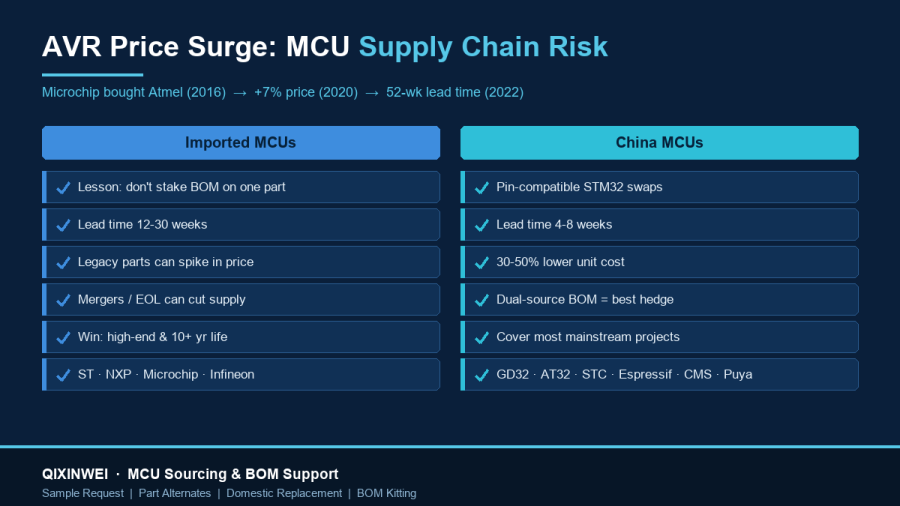
In 2016, Microchip completed its acquisition of Atmel, bringing AVR into the Microchip product portfolio. An acquisition does not automatically mean that an established product family will disappear, but semiconductor companies continuously adjust product portfolios, manufacturing capacity, and production priorities according to market demand and business strategy.
The situation became more difficult during the global semiconductor shortage that began around 2020. MCU manufacturers across the industry experienced extended lead times, allocation, inventory shortages, and price volatility. AVR was not the only MCU family affected.
Some AVR models experienced significant availability and price fluctuations during this period, while widely used devices such as ATmega328P also experienced extended lead times in certain markets.
The more important lesson is therefore not that one particular MCU brand is unreliable. The broader lesson is that a single-source MCU can become a significant supply-chain risk when the device is difficult to replace.
2. Why MCU Supply Risk Is Different from Ordinary Component Shortages
Replacing a resistor or capacitor is usually straightforward because engineers can often find multiple devices with similar electrical characteristics and standardized footprints.
MCUs are different.
An MCU is closely connected to the PCB design, firmware architecture, development environment, production test system, and sometimes regulatory certification.
Consider a controller based on a specific MCU. If the original device suddenly becomes unavailable, the engineering team may need to verify GPIO assignments, clock configuration, ADC performance, PWM timing, interrupt behavior, Flash and RAM requirements, communication interfaces, startup code, and bootloader compatibility.
If the product uses CAN, USB, Ethernet, motor-control PWM, high-speed ADC, DMA, or complex communication protocols, the replacement process can become even more complicated.
This is why waiting until a shortage occurs before looking for an alternative MCU is usually inefficient.
A better approach is to consider supply continuity during the initial component-selection stage.
3. Imported MCU Brands and Their Typical Applications
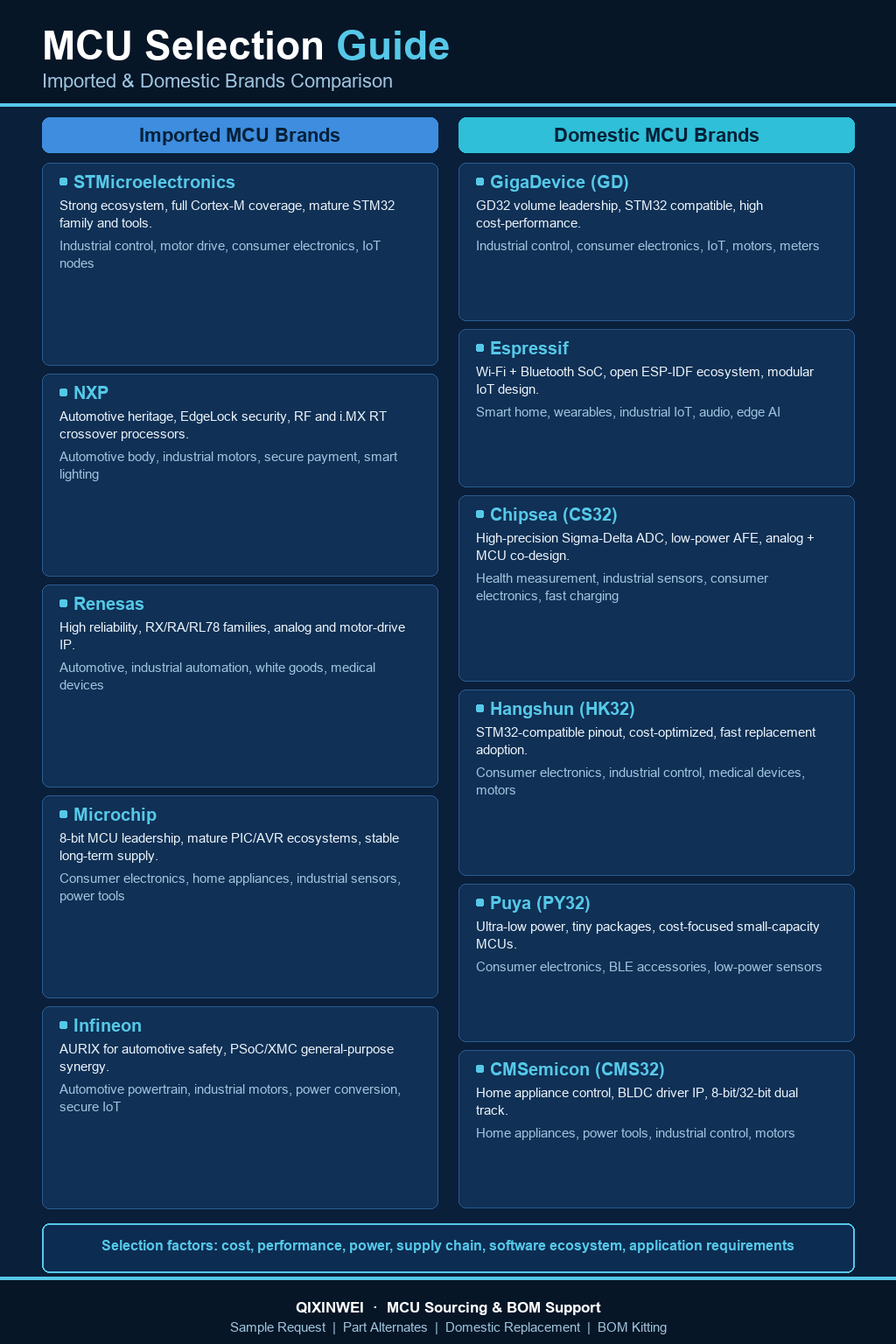
STMicroelectronics: STM32
STMicroelectronics' STM32 family is one of the most widely used 32-bit MCU platforms in embedded system development.
The STM32 portfolio covers different Cortex-M architectures and performance levels, ranging from entry-level controllers to high-performance devices. Common families include STM32F0, STM32F1, STM32F4, STM32G0, STM32G4, STM32L4, STM32H7, and STM32WB.
One of STM32's major advantages is its development ecosystem. STM32CubeMX, STM32CubeIDE, HAL libraries, reference designs, development boards, and a large engineering community can significantly reduce development time.
Typical applications include industrial automation, motor control, power control, instrumentation, HMI systems, IoT devices, medical equipment, and embedded control systems.
Commonly encountered parts include STM32F103C8T6, STM32F103RCT6, STM32F405RGT6, STM32F407, STM32F429, STM32L431, STM32G030, STM32H743, and STM32WB55.
However, the availability of a specific STM32 part should always be evaluated at the individual part-number level. A mature product family does not eliminate the need for supply-chain planning.
NXP: LPC, Kinetis, and i.MX RT
NXP offers MCU and crossover-MCU solutions covering industrial, automotive, networking, and embedded applications.
The LPC family is widely used for general embedded control, while Kinetis and i.MX RT products target higher-performance applications.
NXP's long experience in automotive and industrial electronics makes its products relevant for applications where reliability, communication interfaces, performance, and product lifecycle are important considerations.
Typical applications include industrial controllers, gateways, motor-control systems, energy equipment, networking products, and automotive electronics.
Microchip: AVR, PIC, and SAM
Microchip has a broad MCU portfolio that includes AVR, PIC, and SAM families.
AVR remains important for legacy designs and applications that already have mature AVR firmware. PIC is widely used in 8-bit and 16-bit embedded control applications, while SAM devices provide Arm Cortex-M based solutions for more advanced designs.
For an existing AVR product, moving to another Microchip MCU can sometimes simplify the supply-chain discussion because the company already provides multiple MCU families. However, switching from AVR to PIC or SAM is still a real hardware and firmware migration project rather than a direct replacement.
For a long-running product, engineers should first evaluate the actual lifecycle and supply status of the existing AVR part before deciding whether to continue production or begin a replacement program.
Infineon: XMC and AURIX
Infineon's MCU portfolio is particularly relevant to motor control, power electronics, industrial automation, and automotive applications.
XMC devices target industrial control and power-related applications, while AURIX is positioned toward higher-performance automotive and industrial control systems.
For motor drives, inverters, energy conversion equipment, and other systems requiring real-time control, Infineon MCUs can be considered alongside other high-performance MCU platforms.
The important point is to select the MCU according to the control requirements rather than choosing a high-end device simply because it offers more processing power.
4. Domestic MCU Options for New Designs
GigaDevice GD32
GigaDevice's GD32 family has become a widely considered domestic alternative in the Arm Cortex-M MCU market.
GD32 products cover performance MCUs, low-power MCUs, value-oriented devices, and RISC-V based products.
Examples include GD32F103, GD32F303, GD32F407, GD32E230, GD32L233, and other product families.
Some GD32 devices have package and pin configurations that are highly compatible with specific STM32 devices. This makes them useful candidates when engineers evaluate STM32 replacement options.
However, pin compatibility does not mean complete firmware compatibility. Clock configuration, registers, ADC behavior, timers, startup code, and peripheral libraries must still be verified.
Artery AT32
Artery Technology's AT32 series is another domestic Arm MCU platform frequently considered for STM32 replacement projects.
Products such as AT32F403A, AT32F407, AT32F421, and AT32F435 target industrial control, motor control, instrumentation, power electronics, and other embedded applications.
Some AT32 devices were designed with compatibility with established STM32 applications in mind, which can help reduce hardware and firmware migration effort in certain projects.
Nevertheless, engineers should evaluate compatibility at the specific device level rather than assuming that all products within a family are interchangeable.
STC
STC has a long history in the Chinese 8-bit MCU market and remains relevant for relatively simple control applications.
STC89C52, STC12C5A60S2, STC8A8K64S4A12, and STC32G12K128 are examples of devices used in different embedded-control applications.
STC can be suitable for temperature controllers, relay boards, simple instrumentation, sensor interfaces, keypads, and other systems where processing requirements are moderate.
For high-speed multi-axis motion control, complex communication, or computationally intensive applications, however, engineers should compare CPU performance and peripheral resources carefully before selecting an 8-bit platform.
Espressif
Espressif takes a somewhat different position from traditional MCU vendors because wireless connectivity is one of its major strengths.
ESP32, ESP32-C3, ESP32-S3, ESP32-C6, and related devices integrate wireless capabilities with processing resources, making them attractive for IoT terminals, wireless sensors, gateways, smart devices, and remote monitoring equipment.
When Wi-Fi or Bluetooth is already required by the system, an integrated wireless MCU can reduce the number of external components and simplify the overall hardware architecture.
Puya PY32
Puya's PY32 family focuses on low-power and cost-sensitive MCU applications.
Devices such as PY32L020, PY32F071, and PY32F040 can be considered for sensors, battery-powered equipment, meters, portable instruments, and other compact embedded systems.
For projects originally based on low-end 8-bit MCUs, a low-cost Cortex-M device may also provide additional Flash, RAM, and peripheral resources without requiring a high-end MCU.
5. Imported MCU vs. Domestic MCU: How Should Engineers Decide?
There is no universal answer to whether an imported MCU or a domestic MCU should be selected.
For automotive electronics, safety-related equipment, high-reliability industrial systems, and products with demanding certification or long-term maintenance requirements, engineers may place greater emphasis on the manufacturer's qualification system, functional-safety documentation, reliability data, lifecycle information, and technical support.
For general industrial control, instrumentation, IoT devices, consumer electronics, and cost-sensitive products, domestic MCU platforms now provide a much broader range of options.
The practical selection process should therefore start with the application rather than the country of origin.
The engineering team should first define the required CPU performance, Flash, RAM, ADC, PWM, communication interfaces, operating temperature, package, power consumption, software environment, certification requirements, and expected product lifetime.
Supply availability and replacement difficulty should then be evaluated alongside those technical requirements.
6. Building a Dual-Source MCU BOM
A dual-source MCU strategy does not necessarily mean manufacturing the same product with two different MCUs at the same time.
The main purpose is to establish a verified fallback option before a supply problem occurs.
The first stage is component selection. The primary MCU is selected according to the project requirements, while one or more potential alternatives are identified.
The second stage is engineering validation. The alternative MCU should be checked for package compatibility, pin mapping, memory resources, peripheral functions, clock configuration, electrical characteristics, and software support.
The third stage is firmware validation. The most important drivers should be ported and tested before mass production. UART, SPI, I²C, ADC, PWM, CAN, USB, timers, DMA, interrupts, and boot functions should be verified according to the actual product design.
The final stage is production planning. Procurement and engineering teams should continuously monitor lead times, lifecycle information, PCNs, EOL notices, inventory conditions, and market pricing.
With this approach, an alternative MCU becomes a real engineering option instead of simply being a part number written on a purchasing list.
7. Eight Parameters to Check During MCU Selection
Operating Temperature
The MCU's temperature rating should match the actual operating environment. Indoor equipment and outdoor industrial systems may require very different temperature specifications.
Flash and RAM
Memory should be selected based on actual firmware requirements with sufficient headroom for future features, communication protocols, logging, bootloaders, and firmware updates.
Peripheral Resources
ADC, PWM, UART, SPI, I²C, CAN, USB, timers, DMA, and other peripherals should be checked against the actual circuit design.
EMC and ESD Requirements
Industrial equipment operating in electrically noisy environments may require careful evaluation of MCU electrical characteristics as well as complete system-level EMC and ESD testing.
Package Availability
A technically suitable MCU is not necessarily a practical choice if its package is difficult to source or difficult to manufacture consistently.
Lead Time
Lead time can vary significantly between manufacturers, families, and individual part numbers. Current supply conditions should be verified before committing to a production schedule.
Lifecycle Status
For a product expected to remain in production for many years, engineers should check lifecycle information and avoid selecting a legacy device without understanding its current production status.
Development Ecosystem
Documentation, SDKs, development tools, reference designs, example code, community resources, and technical support can have a direct impact on development and maintenance costs.
8. Why Pin-to-Pin Compatibility Is Not Enough
One of the most common misunderstandings in MCU replacement projects is treating pin compatibility as complete compatibility.
A replacement MCU may have the same package and similar GPIO mapping but still behave differently at the firmware level.
Clock trees, ADC characteristics, timer behavior, DMA implementation, interrupt handling, boot configuration, peripheral registers, and library APIs can all differ.
For a simple controller, these differences may be manageable. For motor control, high-speed ADC acquisition, USB, CAN, low-power operation, or real-time control, the migration effort can be much larger.
A reliable MCU replacement should therefore be evaluated as a complete engineering project covering hardware, firmware, testing, and production validation.
9. How Can Hardware Teams Reduce MCU Supply Risk?
The most effective supply-chain strategy is to address the risk before the shortage happens.
For new designs, engineering and procurement teams should work together during the MCU selection stage. Engineering can evaluate performance and software requirements, while procurement can assess availability, lead time, lifecycle information, sourcing channels, and cost trends.
For existing products, the MCU should be reviewed periodically, particularly when the product is expected to remain in production for many years.
If a product depends on an older MCU that has been on the market for a long time, it may be worth evaluating a replacement before the original device becomes difficult to source.
For cost-sensitive projects, teams can also evaluate imported and domestic MCUs in parallel. For example, an STM32-based design may evaluate GD32 or AT32 as potential alternatives, while an 8-bit AVR design may evaluate STC or another suitable MCU depending on the application's requirements.
The goal is not to replace every imported MCU with a domestic device. The goal is to ensure that the project has a realistic and technically validated path forward if the primary MCU becomes difficult to source.
10. MCU Selection FAQ
Q1: Can AVR still be used in a new project?
Yes. AVR can still be technically suitable for some new projects, especially when the software ecosystem, development resources, and supply situation meet the project's requirements.
For long-lifecycle products, however, engineers should verify the current lifecycle and supply status of the specific AVR part number and consider a backup option during the design stage.
Q2: Can a domestic MCU directly replace an STM32?
Some domestic MCUs offer high levels of package and pin compatibility with specific STM32 devices, but direct replacement should not be assumed. Hardware, peripheral behavior, registers, clock configuration, and firmware usually require verification.
Q3: Are GD32 and STM32 the same?
No. GD32 and STM32 are products from different manufacturers. Both use Arm Cortex-M architectures across many product families, and some GD32 devices provide compatibility with specific STM32 applications. However, the two platforms should still be treated as separate MCU families during engineering validation.
Q4: Can AT32 replace STM32?
Certain AT32 devices can be evaluated as STM32 replacement candidates. The feasibility depends on the exact MCU, package, peripheral requirements, firmware architecture, and system-level validation requirements.
Q5: Does every industrial product require a -40°C to 85°C MCU?
No. The required temperature grade depends on the actual operating environment. Indoor equipment operating under controlled temperatures may not require industrial wide-temperature specifications, while outdoor or harsh industrial equipment may require them.
Q6: Why shouldn't MCU selection focus only on CPU frequency?
CPU frequency is only one part of MCU performance. Flash, RAM, ADC, PWM, timers, DMA, communication interfaces, power consumption, interrupt performance, and software ecosystem can be equally important.
Q7: When should an engineer choose an 8-bit MCU instead of a 32-bit MCU?
8-bit MCUs can still be practical for simple control logic, relay control, temperature monitoring, key scanning, and basic data acquisition.
A 32-bit MCU is generally more suitable when the application requires more memory, complex algorithms, high-speed communication, advanced motor control, graphics, or multiple sophisticated peripherals.
Q8: Is it safe to buy MCU stock from the secondary market during a shortage?
Secondary-market inventory can sometimes help with urgent production requirements, but traceability, authenticity, date codes, packaging, storage conditions, and testing should be carefully evaluated.
For long-term production, relying entirely on high-priced spot inventory is usually not a sustainable supply strategy.
Q9: What is the most difficult part of MCU replacement?
Firmware migration is often one of the most important challenges. Even when the replacement MCU has compatible pins, low-level drivers, registers, clocks, ADCs, timers, interrupts, and communication peripherals may require modification.
Q10: How can a company reduce MCU price and shortage risks?
A practical approach is to establish a primary MCU and a validated alternative during the design stage. Lifecycle monitoring, supplier diversification, safety stock planning, and periodic replacement evaluation can further reduce supply-chain exposure.
Q11: Should an existing AVR product immediately switch to a domestic MCU?
Not necessarily. An existing production design should first be evaluated based on its remaining lifecycle, current supply situation, replacement cost, certification requirements, and production volume.
If the existing AVR supply remains stable, continuing production may be reasonable. If the product has many years of production ahead, developing a validated alternative can reduce future risk.
Q12: Where are domestic MCUs commonly used?
Domestic MCUs are used across industrial control, instrumentation, IoT devices, motor control, power management, consumer electronics, smart devices, sensors, and other embedded applications.
The appropriate device depends on the specific requirements for processing performance, peripherals, power consumption, reliability, software ecosystem, and certification.
Conclusion
The supply fluctuations experienced by AVR and other MCU families during periods of semiconductor shortages demonstrate why MCU selection should be treated as both an engineering decision and a supply-chain decision.
An MCU is deeply connected to the hardware design and firmware architecture. When a core MCU becomes unavailable, the impact can extend far beyond purchasing costs and may affect PCB design, firmware development, testing, certification, and production schedules.
Imported MCU manufacturers such as STMicroelectronics, NXP, Microchip, and Infineon continue to provide mature solutions for industrial, automotive, high-performance, and long-lifecycle applications. Domestic platforms such as GD32, AT32, STC, Espressif, and PY32 have also expanded their coverage across general industrial control, IoT, instrumentation, consumer electronics, and cost-sensitive embedded applications.
The key is not to choose an MCU based solely on whether it is imported or domestic. Engineers should evaluate performance, peripherals, development ecosystem, lifecycle, sourcing channels, replacement difficulty, and total project risk together.
For long-term products, one of the most practical approaches is to establish a primary and backup MCU during the design stage, complete the necessary hardware and firmware validation in advance, and continue monitoring the supply status throughout the product lifecycle.
QIXINWEI provides electronic component sourcing and supply-chain support for both imported and domestic MCU products, including ST, NXP, Microchip, Infineon, GD32, AT32, STC, Espressif, and other MCU brands. Services can include sample sourcing, part-number comparison, MCU replacement evaluation, domestic substitution assessment, and BOM kitting for production projects.
For engineering teams planning a new MCU design, dealing with an existing part shortage, or evaluating a second-source MCU, early technical and supply-chain assessment can help reduce the risk of unexpected shortages, price volatility, and costly last-minute redesigns.
0users like this.