Power Supply
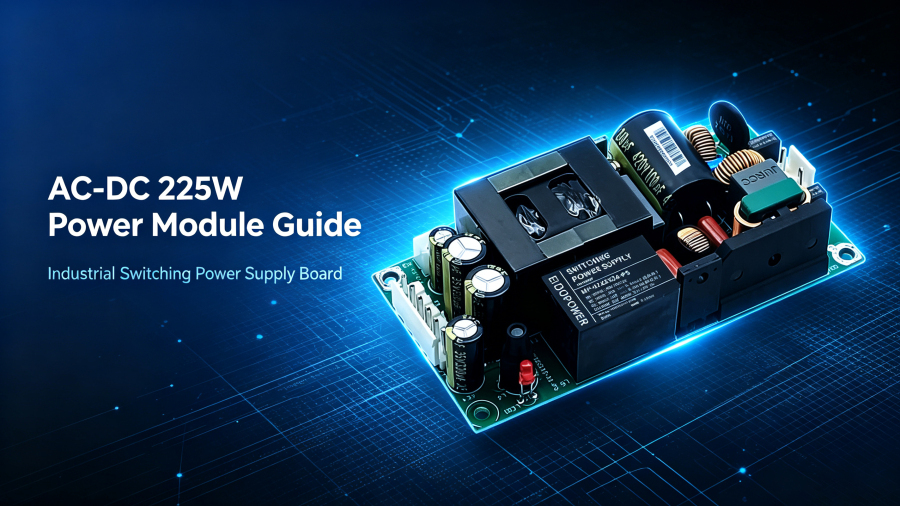
AC-DC 225W Power Module Guide
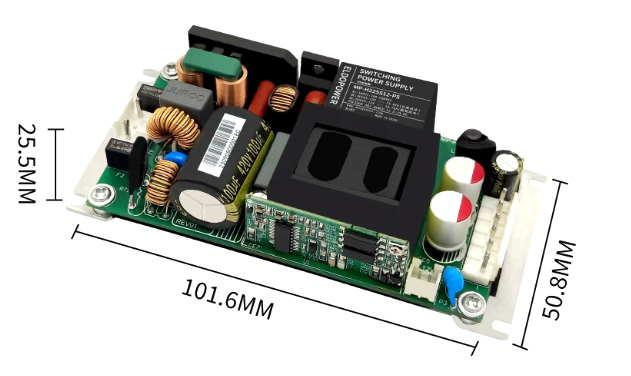
The MP-H225SXX-PS series is a 225W AC/DC open-frame switching power supply designed for medical and industrial applications. It complies with EN60601-1 medical safety standards and offers 3000VAC input-to-output isolation. The input voltage range is 176-264VAC, and the series is available in six output voltages — 12V, 19V, 24V, 36V, 48V, and 54V — each with a defined adjustment range (e.g., 11.3-13.6V for the 12V model, 21.6-27.5V for the 24V model). It delivers 140W with natural convection cooling and 225W with 13CFM forced air cooling, reaching up to 93% efficiency in a compact 101.6 x 50.8 x 25.5 mm footprint.
225W AC-DC Power Module Selection Guide
| Model | Input Voltage | Cooling Method | Max Output Power | Output Voltage & Current | Voltage Adjust Range | Efficiency |
|---|---|---|---|---|---|---|
| MP-H225S12-PS | 176-264VAC | Natural Convection | 140W | 12V / 11.67A | 11.3-13.6V | 92% |
| 13CFM Forced Air | 225W | 12V / 18.75A | ||||
| MP-H225S19-PS | 176-264VAC | Natural Convection | 140W | 19V / 7.36A | 17.9-21.2V | 93% |
| 13CFM Forced Air | 225W | 19V / 11.85A | ||||
| MP-H225S24-PS | 176-264VAC | Natural Convection | 140W | 24V / 5.84A | 21.6-27.5V | 93% |
| 13CFM Forced Air | 225W | 24V / 9.38A | ||||
| MP-H225S36-PS | 176-264VAC | Natural Convection | 140W | 36V / 3.89A | 34.3-38.3V | 93% |
| 13CFM Forced Air | 225W | 36V / 6.25A | ||||
| MP-H225S48-PS | 176-264VAC | Natural Convection | 140W | 48V / 2.92A | 46.7-51.5V | 93% |
| 13CFM Forced Air | 225W | 48V / 4.69A | ||||
| MP-H225S54-PS | 176-264VAC | Natural Convection | 140W | 54V / 2.59A | 51.3-56.8V | 93% |
| 13CFM Forced Air | 225W | 54V / 4.16A |
Note: Data measured at 25°C ambient temperature and 230VAC input.
What the power supply actually has to survive
A power module in a medical or industrial product is not a dev kit on a desk. It is a safety-critical component that has to hold up when the environment stops being friendly.
· Medical-grade isolation. The 3000VAC input-to-output isolation and compliance with EN60601-1 (IEC62368-1 for industrial) mean this module can be used in equipment that comes into physical contact with patients. The 0.25mA max leakage current at 240VAC is a critical spec for patient-connected devices — do not substitute a standard industrial supply and assume it will pass.
· Thermal derating is the real spec. The series delivers 140W with natural convection cooling, and 225W with 13CFM forced air cooling. The 85W gap is not a marketing number — it is the difference between a unit that runs at 70°C ambient and one that shuts down. If your enclosure has no fan, plan for 140W and design the aluminum plate mounting accordingly.
· Narrow input, real-world implications. The 176-264VAC input range is narrower than wide-input industrial supplies. It is designed for stable mains environments (Europe, North America, and most of Asia). If the product ships to regions with severe grid instability, verify the input range meets the local standard before design-in.
· Protection that actually recovers. Output overcurrent (110-150% hiccup mode), output overvoltage (110-130% hiccup mode), short circuit (hiccup mode with auto-recovery), and over-temperature (shutdown with restart) — the module protects itself and the downstream electronics without requiring a service call. Input undervoltage protection triggers at 75-80VAC, preventing startup under brownout conditions.
· Connections that match production tooling. The CH3.96-3P (AC input) and CH3.96-6P (DC output) terminals, plus the XH-2A fan connector, are standard interfaces. The 12V/0.5A fan auxiliary supply means you can power a cooling fan directly from the module, simplifying the thermal design.
Where the MP-H225SXX-PS fits — and where it doesn’t
The MP-H225SXX-PS is the right choice when the product needs a regulated, high-efficiency DC rail from an AC mains input, in a compact open-frame format, with medical-grade isolation. Medical diagnostic equipment, patient monitors, dental chairs, industrial control panels, communication base stations, and test instruments all fit.
It is the wrong choice when the product needs a fully enclosed IP-rated supply, or when the load profile requires more than 140W without forced air. For those cases, select a higher-power enclosed unit or design active cooling into the enclosure from the start. It is also the wrong choice for 85-264VAC wide-input requirements — the 176-264VAC range is deliberately narrower.
The selection checklist we actually use
· Output voltage and current. Match the nominal voltage to your load, then check the adjustment range. A 24V rail that can be trimmed to 27.5V gives headroom for long cable runs and voltage drop.
· Cooling method. Natural convection (140W) or forced air (225W)? This determines the enclosure design and the mounting plate requirement. The datasheet specifies an aluminum plate for full derating — do not skip it.
· Efficiency at your load point. The 92-93% typical efficiency is measured at full load. If your product idles at 20% load, confirm the light-load efficiency meets your standby power budget. The standby power is ≤0.5W.
At QIXINWEI (Shenzhen Qixinwei Technology Co., Ltd.), we have spent 13 years supplying AC-DC power modules, medical-grade power supplies, and the broader electronic component ecosystem alongside full PCBA assembly.If you are mid-selection and want a second pair of eyes on the power supply, thermal design, or supporting components, send the spec or the BOM and we will flag the risks before you commit.
FAQ
Q: What is the difference between the 140W and 225W ratings?
A: The 140W rating applies to natural convection cooling. The 225W rating requires 13CFM forced air cooling. The electrical design is the same; the difference is thermal management. If your enclosure has no fan, use the 140W figure for derating calculations.
Q: Can I use the MP-H225SXX-PS for AC and DC input?
A: The input voltage range is 176-264VAC. It does not support wide-range DC input in the same way as the 350W series. If your application requires DC input, confirm the DC voltage range with the factory before design-in.
Q: How do I adjust the output voltage?
A: The module includes an ADJ pin (output voltage adjustment). The adjustment range varies by model — for example, the 24V model adjusts from 21.6V to 27.5V. Use a precision potentiometer or a fixed resistor divider to set the exact voltage.
0users like this.