Electronic components
ATmega Microcontrollers: The Go-To 8-Bit MCU for Hobbyists & Industrial Embedded Projects
What Is an ATmega Microcontroller?
If you have ever used an Arduino Uno, built a DIY robot, or taken an electronics course, you have almost certainly encountered an ATmega microcontroller. So, what exactly is an ATmega microcontroller?
In simple terms, an ATmega microcontroller is a single-chip computer designed to control electronic devices. It integrates a processor, memory, and input/output peripherals all on one piece of silicon — essentially a complete computer system small enough to fit on your fingertip.
ATmega is a family of 8-bit microcontrollers based on the AVR RISC (Reduced Instruction Set Computing) architecture,
What makes ATmega microcontrollers special? Three things stand out:
First, they use a Harvard architecture with separate memory buses for program and data, allowing simultaneous access to both. Second, they employ advanced RISC technology that executes most instructions in a single clock cycle — a significant advantage over older architectures like the 8051, which require at least 12 clock cycles per instruction. Third, they were among the first microcontroller families to use on-chip Flash memory for program storage, making them erasable and reprogrammable.
This is why you can find ATmega microcontrollers everywhere: from the ATmega328P powering millions of Arduino boards, to the ATmega2560 controlling 3D printers, to ATmega chips embedded in industrial equipment, consumer electronics, automotive systems, and medical devices.
However, there is an important detail that is often overlooked: the ATmega family is not a single product but a broad family with dozens of variants. Choosing the wrong one for your application can lead to insufficient I/O pins, inadequate memory, or unnecessary cost.
Core Advantages That Make ATmega MCUs Timeless
1. Unmatched Ecosystem Compatibility
2. Low Power & High Stability
3. Rich Peripherals & Flexible Models
4. Cost-Effective & Easy Mass Production
ATmega Architecture: The “8-Bit Workhorse” Design
To truly understand what makes ATmega microcontrollers so capable, we need to look under the hood.
The Core: AVR RISC Architecture
At the heart of every ATmega is the AVR RISC core. Unlike complex instruction set (CISC) architectures that have many complicated instructions, RISC keeps things simple and fast. The AVR core has 32 general-purpose registers directly connected to the Arithmetic Logic Unit (ALU), allowing operations to be performed in a single clock cycle.
Performance is measured in MIPS (Millions of Instructions Per Second) . Most ATmega microcontrollers can achieve up to 20 MIPS at 20MHz — impressive for an 8-bit chip.
Memory Organization
ATmega microcontrollers use a modified Harvard architecture with three types of memory:
| Memory Type | Function | Typical Size Range |
|---|---|---|
| Flash | Program storage (non-volatile) | 32KB – 256KB |
| SRAM | Runtime data storage (volatile) | 1KB – 8KB |
| EEPROM | Long-term data storage (non-volatile) | 1KB – 4KB |
In-System Programming (ISP)
One of the most important features of ATmega microcontrollers is In-System Programmability — the Flash memory can be programmed while the chip is already soldered onto a PCB. This makes prototyping and firmware updates incredibly convenient.
Peripherals and I/O
ATmega chips integrate a rich set of peripherals:
Digital I/O pins — from 32 to 100 pins depending on the package
Analog-to-Digital Converters (ADC) — typically 6–16 channels of 10-bit resolution
Serial communication — USART, SPI, I²C interfaces
Timers/Counters — for PWM generation, frequency measurement, and timekeeping
Watchdog Timer (WDT) — for system reset on hang
Analog Comparator — for comparing two analog voltages
Power-on Reset (POR) — ensures reliable startup
Voltage and Power
ATmega microcontrollers operate over a wide voltage range: 1.8V to 5.5V. At 1.8V and 1MHz, power consumption drops to just 0.2mA in active mode, and as low as 0.1µA in power-down mode — making them excellent for battery-powered applications.
Popular ATmega Models: A Family Overview
The ATmega family spans a wide range of capabilities. Here are the most important models:
ATmega328P — The Maker’s Favorite
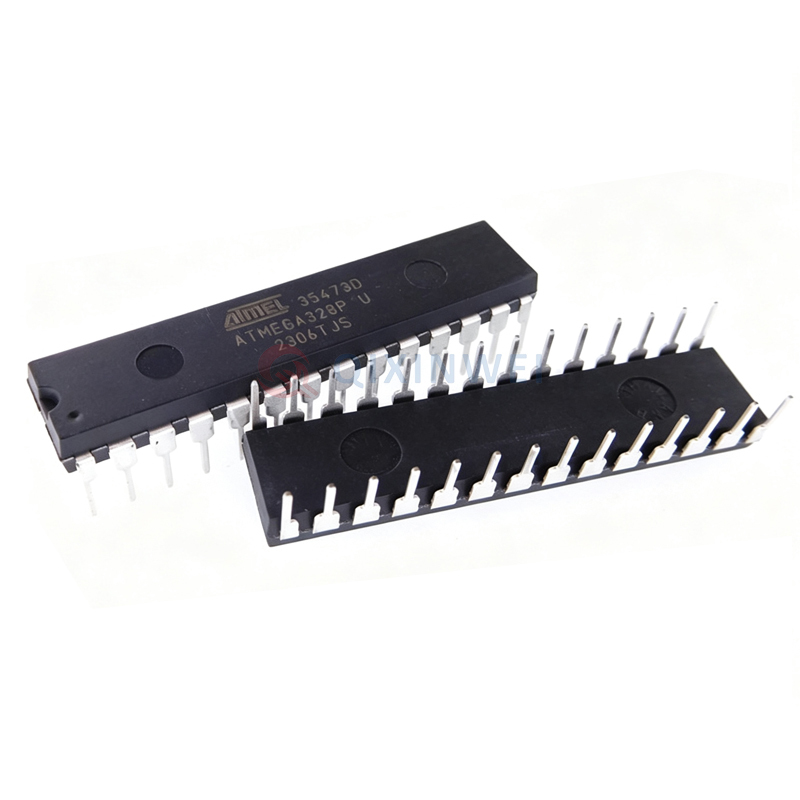
The ATmega328P is arguably the most famous microcontroller in the world. It powers the Arduino Uno, the most popular development board ever created.
| Feature | Specification |
|---|---|
| Flash | 32KB |
| SRAM | 2KB |
| EEPROM | 1KB |
| Speed | 16 MIPS at 16MHz |
| I/O Pins | 23 (DIP-28 package) |
| Voltage | 1.8V – 5.5V |
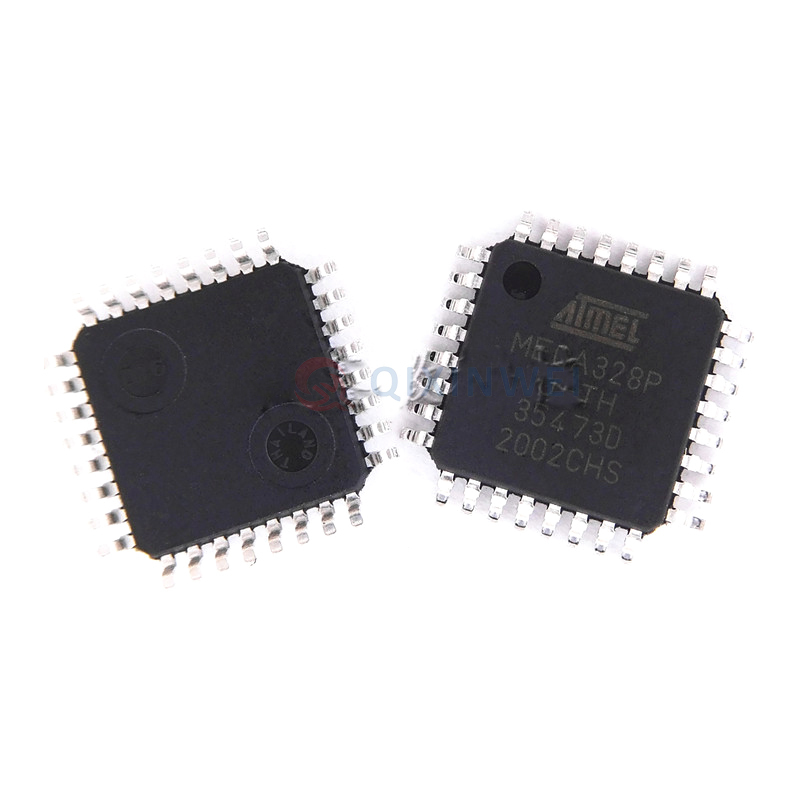
| Packages | DIP-28 (PDIP), TQFP-32, QFN-28 |
The ATmega328P comes in multiple package variants:
ATmega328P-PU — DIP-28 package, ideal for breadboard prototyping
ATmega328P-AU — TQFP-32 surface-mount for compact designs
ATmega328P-MU — QFN-28 for the smallest footprint
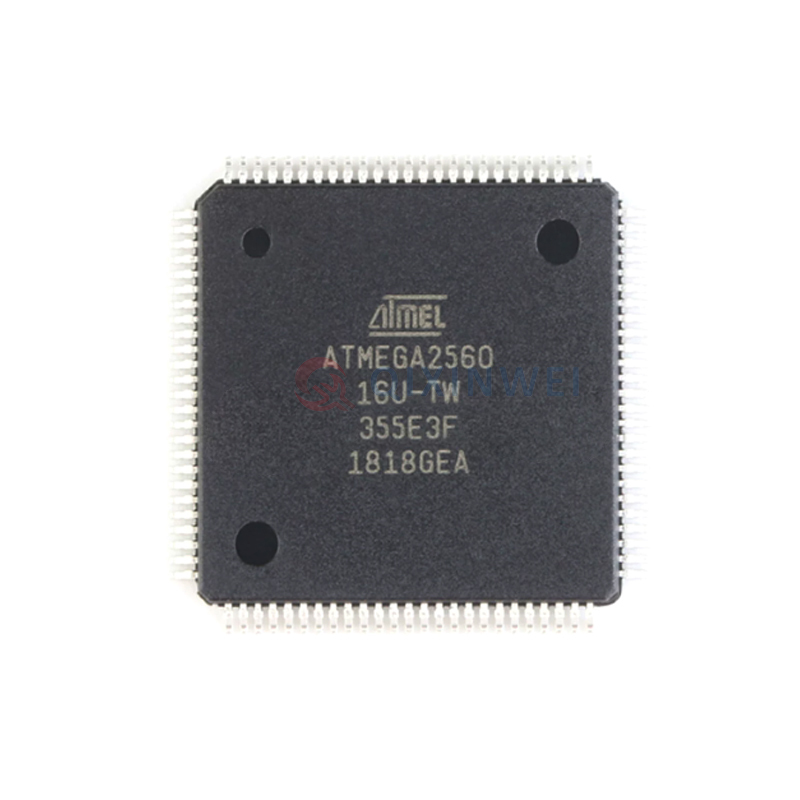
ATmega2560 — The Heavy Lifter
The ATmega2560 is the high-end member of the family, powering the Arduino Mega 2560.
| Feature | Specification |
|---|---|
| Flash | 256KB |
| SRAM | 8KB |
| EEPROM | 4KB |
| Speed | 16 MIPS at 16MHz |
| I/O Pins | Up to 86 |
| Voltage | 2.7V – 5.5V |
| Analog Inputs | 16 |
With 256KB of Flash and 86 I/O lines, the ATmega2560 is designed for complex applications that demand maximum memory and connectivity.
Other Notable Models
ATmega328 — similar to 328P but without the “P” (picoPower) enhancements
ATmega128 — 128KB Flash, widely used in industrial applications
ATmega16 — 16KB Flash, popular in education
ATmega4809 — a newer model with 48KB Flash, 6KB RAM, featured in Arduino Uno WiFi Rev 2
ATmega324PB — part of Microchip’s Functional Safety (FuSa) series
- ATmega1609 — 16KB Flash, 2KB RAM
What Is an ATmega Microcontroller Used For?
ATmega microcontrollers are used wherever reliable, low-cost, low-power control is needed. Here are the most common applications:
1. Maker and Educational Projects
This is where ATmega shines brightest. From the Arduino Uno to countless clones and shields, ATmega microcontrollers are the foundation of the maker movement. They appear in:
DIY electronics kits
University lab courses
STEAM education
Rapid prototyping
2. Robotics
ATmega microcontrollers are the brains of countless robots:
Line-following and obstacle-avoidance robots
Combat robotics (150g class)
Robot arms and manipulators
Autonomous vehicles
3. IoT and Smart Home
While newer chips like ESP32 offer built-in WiFi, ATmega microcontrollers still play a crucial role:
Sensor nodes and data loggers
Smart home controllers
Environmental monitoring
Agricultural sensors
4. Industrial Control
ATmega’s industrial-grade reliability makes it suitable for factory automation:
Process control systems
Equipment monitoring
Human-machine interfaces
5. Consumer Electronics
Remote controls
Small appliances
Toy electronics
Audio devices
6. Medical Devices
The ATmega328P has been used in projects ranging from blood glucose monitors to portable diagnostic equipment.
7. Automotive
ATmega microcontrollers are found in various automotive subsystems.
ATmega 2026: New Developments and the Future of 8-bit
You might wonder: in an era of 32-bit microcontrollers and AI chips, are 8-bit ATmega microcontrollers still relevant?
The answer is a resounding yes.
In 2026, ATmega microcontrollers are not just surviving — they are evolving. Microchip continues to invest in the AVR platform with new product lines:
megaAVR 0-Series
This is the next generation of ATmega microcontrollers. The ATmega4808 and ATmega4809 offer up to 48KB of Flash with improved low-power characteristics. The ATmega4809 is already featured in the Arduino Uno WiFi Rev 2.
ATmega328PB-AU
Described as a “versatile all-rounder” for IoT and industrial control, this is an upgraded version of the classic ATmega328P with richer peripherals and industrial-grade stability.
AVR DD, DB, and EA Families
These newer AVR families integrate advanced features like:
Multi-Voltage I/O (MVIO) — supports different voltage levels on different pins
12-bit high-speed analog — for more precise measurements
Capacitive touch — for modern user interfaces
Why 8-bit Still Matters
The enduring appeal of 8-bit microcontrollers like ATmega comes down to a few key factors:
Simplicity — easier to learn and debug
Cost — significantly cheaper than 32-bit alternatives
Power efficiency — excellent for battery-powered devices
Maturity — decades of proven reliability
Ecosystem — vast community, tools, and libraries
As one industry observer noted, ATmega families continue to be favored for their affordability and simplicity.
FAQs:
Q1: What are ATmega microcontrollers used for?
Q2: Is ATmega the same as Arduino?
Q3: What is the most popular ATmega microcontroller model?
Q4: Are ATmega microcontrollers hard to program?
Q5: Are ATmega MCUs suitable for industrial projects?
Q6: What’s the difference between ATmega and 32-bit MCUs?
Q7: Do ATmega microcontrollers support low-power battery operation?
Q8: Can ATmega chips support IoT and wireless projects?
Q9: What are the limitations of ATmega microcontrollers?
Q10: Is ATmega still worth using in 2026?
Is ATmega a Good Choice?
The ATmega microcontroller family remains one of the most important and enduring platforms in embedded systems because it solves a fundamental problem extremely well: providing reliable, low-cost, easy-to-use control for a vast range of applications.
For engineers, makers, educators, and buyers, the real selection criteria should be processing requirements, memory needs, I/O count, power budget, cost, and ecosystem support rather than simply searching for an “ATmega microcontroller.”
If you are developing a new electronic product, looking for ATmega microcontrollers, development boards, or other electronic components, or facing component shortages and need alternative parts, QIXINWEI can support component sourcing, BOM matching, model comparison, and supply-chain solutions. For engineering projects that require stable supply rather than simply the lowest unit price, selecting the right component configuration at the beginning can save much more time during testing and mass production.
0users like this.