Electronic components
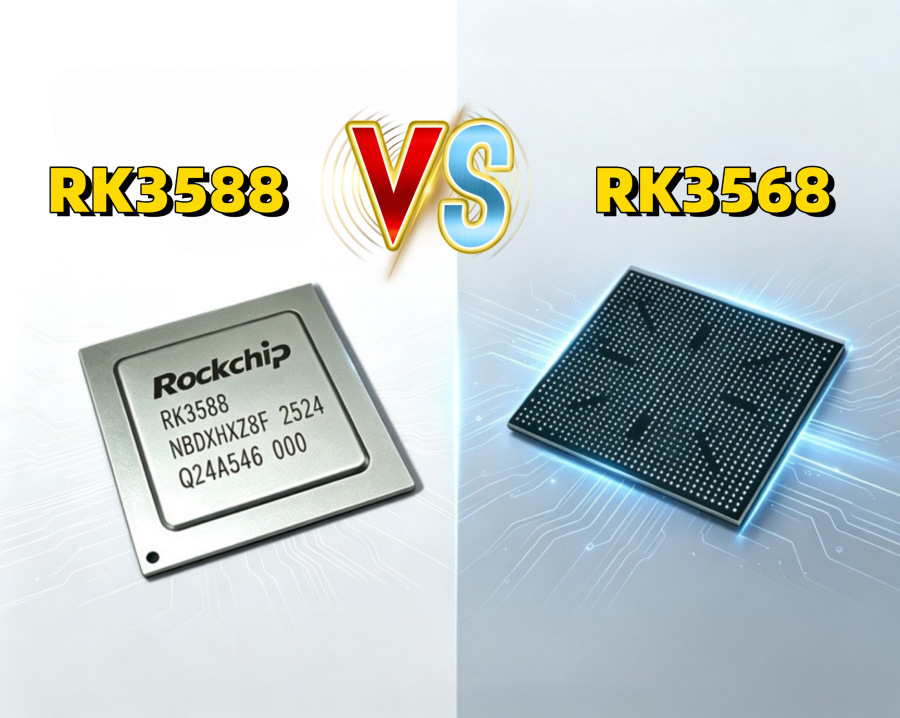
RK3588 vs RK3568: Full Specification & Application Selection Guide
Introduction
Rockchip RK3588 and RK3568 are two mainstream embedded SoCs widely adopted in industrial control, edge AI computing, smart display, and IoT terminal projects. Although both chips belong to Rockchip’s high-performance IoT processor lineup, they feature completely different market positioning, hardware architecture, computing power, video processing capabilities, and industrial adaptability.
TheRK3568 is a cost-effective mid-range quad-core processor designed for stable operation, low power consumption, and mass production. It supports industrial-grade wide-temperature versions (RK3568J) and has been massively deployed in industrial gateways, HMI human-machine terminals, 4K commercial displays, and general IoT devices. With mature software ecology, sufficient market stock, and low BOM cost, it remains the preferred solution for cost-sensitive embedded projects.
In contrast, the RK3588 is Rockchip’s flagship 8nm octa-core high-end SoC. Equipped with a big.LITTLE architecture (4×Cortex-A76 + 4×Cortex-A55), upgraded Mali-G610 GPU, 6TOPS high-power NPU, 8K ultra-high-definition video decoding and encoding, and high-speed industrial interfaces such as PCIe 3.0 and 10G Ethernet expansion, it is specially built for high-load edge AI reasoning, multi-channel video analysis, 8K ultra-HD display, and high-performance industrial computing scenarios.
It is worth emphasizing that RK3588 and RK3568 are not pin-to-pin compatible. Direct chip replacement is not feasible. Engineers must comprehensively evaluate CPU performance, AI computing power, video resolution requirements, interface expansion, power consumption heat dissipation, and project budget during hardware selection to avoid subsequent performance bottlenecks and secondary hardware modifications.
Core Technical Differences Between RK3588 and RK3568
1. CPU & GPU Architecture and Overall Performance
Rockchip RK3568 adopts a pure quad-core Cortex-A55 architecture with a main frequency of up to 2.0GHz. Equipped with Mali-G52-2EE GPU, it delivers stable and power-efficient computing capability. This configuration fully meets lightweight system operation, simple UI rendering, conventional industrial data collection, and routine logic processing. Its power consumption and performance balance are very suitable for long-term standby and 7×24-hour stable operation of general industrial equipment.
Rockchip RK3588 uses a heterogeneous octa-core big.LITTLE design: 4 high-performance Cortex-A76 cores (up to 2.4GHz) + 4 energy-efficient Cortex-A55 cores (up to 1.8GHz). Paired with Mali-G610 MP4 high-end GPU, its comprehensive CPU performance is approximately three times that of the RK3568. The stronger graphics rendering capability supports complex 3D UI interfaces, multi-task concurrent processing, and high-load system operation, perfectly matching high-end industrial hosts and intelligent visual devices with high-performance requirements.
2. NPU Edge AI Computing Power
RK3568 NPU: 1TOPS INT8
The built-in NPU of RK3568 only supports lightweight artificial intelligence inference. It can handle basic algorithm tasks such as static face recognition, simple target detection, and human body induction. However, due to limited computing power, it cannot support multi-channel camera parallel analysis, complex image segmentation algorithms, or local deployment of small and medium-sized AI models. It is only suitable for low-level AI auxiliary scenarios.
RK3588 NPU: 6TOPS INT8
RK3588’s 6TOPS high-power NPU supports INT4/INT8/FP16 multi-precision operation. It stably runs multi-target detection, defect segmentation, posture analysis, and other complex visual algorithms. It supports simultaneous reasoning of multiple AI models and multi-channel video stream analysis, becoming the mainstream cost-effective solution for industrial machine vision and local edge large model deployment.
3. Video Decoding & Encoding Capability
RK3568 Video Specification
Max decoding resolution: 4K@60fps (H.264/H.265) Max encoding resolution: 1080P@60fps Applicable scenarios: conventional 4K commercial advertising screens, ordinary video playback terminals, and low-resolution video recording devices. It does not support 8K ultra-high-definition signal processing and AV1 format decoding.
RK3588 Video Specification
Max decoding resolution: 8K@60fps Max encoding resolution: 8K@30fps Supports AV1 ultra-high compression format decoding, multi-channel 4K video simultaneous processing. It is widely used in 8K ultra-HD digital signage, high-end video conference equipment, multi-channel NVR video analysis hosts, and professional multimedia terminal devices.
4. Multi-Screen Display Output Ability
RK3568 supports dual-screen synchronous and asynchronous display, with a maximum output resolution of 4K. It is suitable for dual-screen industrial HMI, dual-area advertising machines, and dual-display IoT terminals, meeting most conventional split-screen display needs.
RK3588 supports up to four-screen independent display, equipped with native HDMI2.1 and DP1.4 high-definition interfaces, realizing 8K ultra-high-definition output. It is the preferred chip for multi-screen splicing systems, ultra-high-definition exhibition display equipment, and multi-group asynchronous display industrial terminals.
5. High-Speed Peripheral Interface Expansion
RK3568 Interface Configuration: Dual Gigabit Ethernet, SATA3.0, PCIe 2.1, USB3.0. The interface resources are sufficient for most industrial IoT devices, supporting ordinary network transmission, mechanical hard disk storage, and general peripheral expansion.
RK3588 Interface Configuration: Quad Gigabit Ethernet, PCIe 3.0 high-speed channel, multi-channel SATA3.0, USB3.1, DP display interface. It supports maximum 32GB large-capacity memory expansion, suitable for high-speed SSD storage, multi-network port data gateways, and high-performance edge computing boxes requiring large bandwidth transmission.
6. Power Consumption, Heat Dissipation and Project Cost
RK3568 features ultra-low power consumption design, with full-load power consumption controlled at 3–5W. Most application scenarios can adopt fanless passive heat dissipation, no complex heat dissipation structure is required. The overall BOM cost is low, which is very friendly for mass production. The industrial version RK3568J supports -40℃~+85℃ wide-temperature operation, adapting to harsh industrial workshop environments.
RK3588 has stronger overall performance but higher power consumption, with full-load power consumption ranging from 5–10W. When NPU computing and multi-channel video decoding are running at full load, heat generation increases significantly. It is recommended to configure heat sinks or active heat dissipation structures. The chip unit price and overall project cost are higher, suitable for mid-to-high-end equipment with mandatory performance indicators.
Applicable Scenario Selection Comparison
Choose RK3568 / RK3568J for these projects:
- Industrial HMI human-machine interface terminals
- Industrial data acquisition gateways and IoT control terminals
- Ordinary 4K commercial advertising machines and digital displays
- Lightweight face recognition access control and simple AI sensing equipment
- NAS network storage and low-power embedded devices
- Cost-sensitive mass production projects pursuing stability and maturity
Choose RK3588 for these projects:
- Multi-channel machine vision defect detection and industrial AI inspection equipment
- High-performance edge AI computing boxes and local large model reasoning terminals
- 8K ultra-high-definition digital signage and high-end multimedia display equipment
- Multi-screen splicing and multi-group asynchronous display systems
- Multi-channel video analysis NVR hosts and intelligent monitoring terminals
- High-end industrial control computers and high-load embedded intelligent devices
Practical Industry Application Cases
Case 1: Wide-Temperature Industrial HMI Terminal (RK3568J)
An industrial control manufacturer launched a 10-inch industrial touch display terminal, adopting the industrial-grade RK3568J solution. Equipped with dual Gigabit Ethernet and SATA3.0 storage interface, the device runs stably on Android system, realizing industrial parameter configuration, equipment status monitoring, and data uploading. With fanless passive heat dissipation design, it adapts to -20℃~70℃ workshop environment, supports 7×24-hour uninterrupted operation, and achieves large-scale batch delivery with controllable cost.Case 2: Multi-Channel AI Visual Inspection Box (RK3588)
A factory automation equipment developer built an on-site AI visual inspection system based on RK3588. The device accesses multiple industrial cameras simultaneously, uses the 6TOPS NPU for real-time defect detection, shape classification, and flaw analysis. The four Gigabit Ethernet ports stably transmit multi-channel video data, realizing fully automatic production line inspection, effectively improving production efficiency and reducing manual detection errors.Case 3: Commercial Display Equipment Selection Case
For ordinary shopping mall and elevator 4K single-screen advertising machines, RK3568 can fully meet daily loop playback and basic display functions with lower cost and more stable supply. For high-end shopping malls, exhibition halls, and science and technology museums that require 8K ultra-high-definition playback, multi-screen splicing, and multi-channel video stream processing, RK3588 is the only reliable solution to ensure ultra-clear picture output and smooth system operation for a long time.
Frequently Asked Questions
Q1: Can RK3588 and RK3568 be directly pin-to-pin replaced?
A1: No direct replacement is supported. The two chips have different packaging specifications, pin definitions, power supply timing, and hardware circuit requirements. Even if partial software functions are transplantable, PCB redesign, power circuit adjustment, and BSP driver adaptation are mandatory, and they cannot be interchanged in physical hardware.
A1: No direct replacement is supported. The two chips have different packaging specifications, pin definitions, power supply timing, and hardware circuit requirements. Even if partial software functions are transplantable, PCB redesign, power circuit adjustment, and BSP driver adaptation are mandatory, and they cannot be interchanged in physical hardware.
Q2: Can RK3568 run local large AI models?
A2: RK3568 only has 1TOPS NPU computing power, which can only support extremely lightweight single AI algorithms. It cannot carry medium and large parameter models or multi-channel concurrent reasoning tasks. For local edge large model deployment and complex visual algorithm projects, RK3588 is the standard choice.
A2: RK3568 only has 1TOPS NPU computing power, which can only support extremely lightweight single AI algorithms. It cannot carry medium and large parameter models or multi-channel concurrent reasoning tasks. For local edge large model deployment and complex visual algorithm projects, RK3588 is the standard choice.
Q3: Does RK3588 must use a fan for heat dissipation?
A3: Under daily low-load operation, passive heat dissipation with heat sinks is sufficient. However, when running full-load NPU reasoning and multi-channel 8K video decoding simultaneously, the power consumption and heat generation will increase sharply. For long-term high-load industrial scenarios, active heat dissipation is recommended to ensure stable operation.
A3: Under daily low-load operation, passive heat dissipation with heat sinks is sufficient. However, when running full-load NPU reasoning and multi-channel 8K video decoding simultaneously, the power consumption and heat generation will increase sharply. For long-term high-load industrial scenarios, active heat dissipation is recommended to ensure stable operation.
Q4: How to choose between industrial-grade RK3568J and RK3588?
A4: If your project focuses on wide-temperature industrial stability, basic control, and conventional 4K display, choose RK3568J for higher cost performance and more mature industrial stability. If your industrial equipment needs 8K ultra-high-definition display, multi-screen splicing, and complex AI computing functions, select industrial-grade RK3588 solution.
A4: If your project focuses on wide-temperature industrial stability, basic control, and conventional 4K display, choose RK3568J for higher cost performance and more mature industrial stability. If your industrial equipment needs 8K ultra-high-definition display, multi-screen splicing, and complex AI computing functions, select industrial-grade RK3588 solution.
Q5: Are RK3588 and RK3568 software SDK universal?
A5: They share the same Rockchip kernel framework, but differ in NPU toolchains, video decoding drivers, device tree configuration, and high-speed interface drivers. Upper-layer application software can be ported appropriately, but it cannot be directly compiled and used, requiring targeted secondary development and debugging.
A5: They share the same Rockchip kernel framework, but differ in NPU toolchains, video decoding drivers, device tree configuration, and high-speed interface drivers. Upper-layer application software can be ported appropriately, but it cannot be directly compiled and used, requiring targeted secondary development and debugging.
Q6: How to balance budget and AI performance when selecting chips?
A6: For simple single-channel face recognition and lightweight detection scenarios, RK3568 can completely meet the demand and control costs effectively. For projects involving multi-camera parallel analysis, complex defect algorithms, and local large model reasoning, RK3588 must be selected to avoid performance bottlenecks and project rework caused by insufficient computing power in the later stage.
A6: For simple single-channel face recognition and lightweight detection scenarios, RK3568 can completely meet the demand and control costs effectively. For projects involving multi-camera parallel analysis, complex defect algorithms, and local large model reasoning, RK3588 must be selected to avoid performance bottlenecks and project rework caused by insufficient computing power in the later stage.
If you are engaged in R&D model selection, facing chip shortage, EOL risks, or looking for a stable long-term supplier, QIXINWEI supplies the full range of Rockchip chips. You can contact us to get samples, detailed parameter comparison documents, and professional BOM kitting services.
0users like this.